
1 - Before England
The Dark Ages

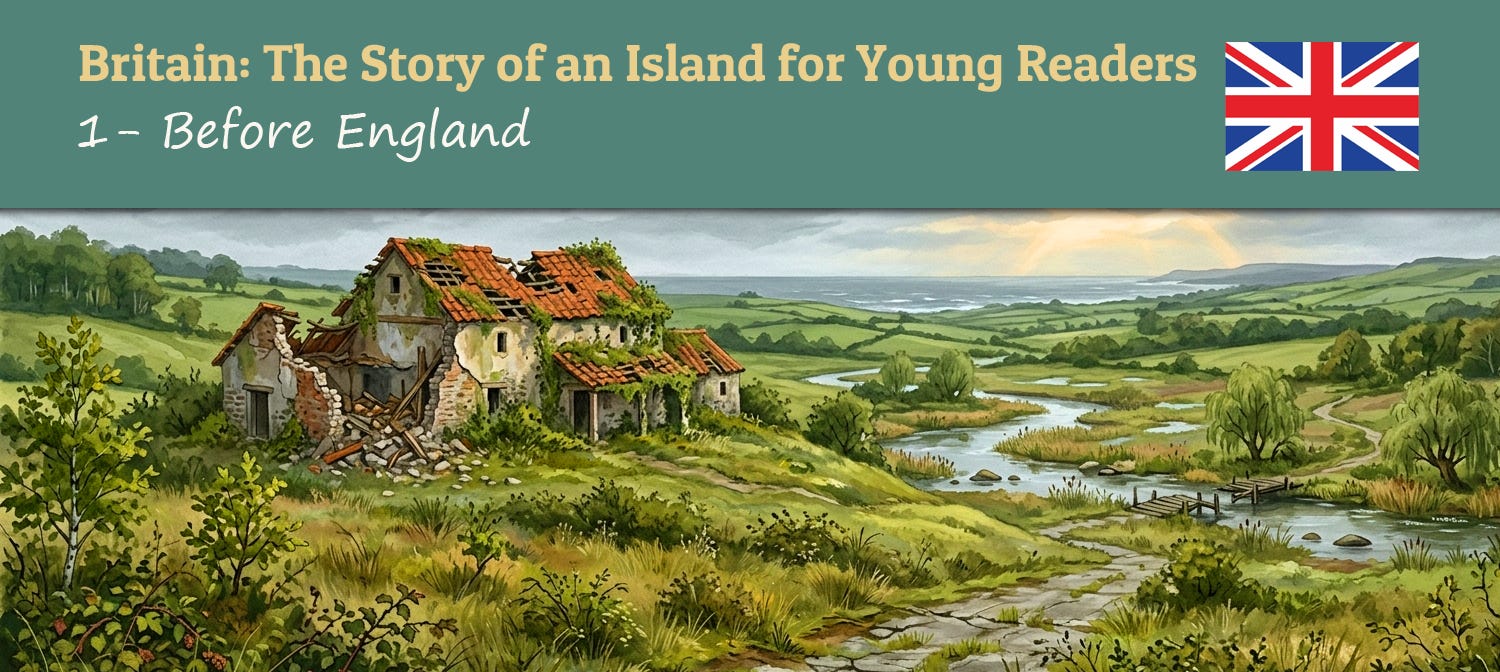
The villa stood on a hillside above a shallow river in the south of Britain, and for as long as anyone could remember it had been a good place to live.
There were stone floors with patterns set into them – red and white and blue tiles arranged into pictures of dolphins and birds and twisting vines. There was a kitchen garden where herbs grew in neat rows. There was a bathhouse with heated floors – warm air from a furnace flowed through hollow spaces beneath the stone, held up on rows of small pillars, so that the floor itself became hot to the touch. This system is called a hypocaust. On cold winter mornings the household sit in the warm steam of the bathhouse and listen to the cold rain outside.
The family who lived there were not Roman. They were British – people whose ancestors had lived on this island long before the legions came. But they spoke Latin as well as their own tongue. They wore Roman clothes, they drank wine from pottery made in Gaul, and their children were taught to read and write. They paid their taxes, obeyed the Roman laws, and in return the Empire kept them safe.
For nearly four hundred years, this is how life had been. Roads ran straight across the countryside, connecting towns with stone walls and market squares and temples. Roman soldiers stood guard on the great northern wall that the Emperor Hadrian had built from coast to coast to keep out the Pictish tribes of the north. Along the eastern and southern shores, a chain of massive forts watched the grey sea for raiders. In the earlier centuries of Roman rule, a fleet of warships had patrolled the Channel and the North Sea, keeping the shipping lanes open and the pirates at bay.
Britain was not the centre of the Roman world. It was a province on the edge of it, a green and rainy island at the end of the known earth. But it was peaceful, and it was prosperous, and the people who lived in its villas and towns had every reason to believe that life would go on like this for ever.
It didn’t.
By the early part of the fourth century AD – the three-hundreds – things had begun to change. The Roman Empire was enormous, stretching from Britain in the west to the deserts of Syria in the east, and it was starting to crack. There were too many frontiers to defend, too many enemies pressing in from every direction, and not enough soldiers to hold them all back.
In Britain, the trouble came from three sides at once. From the north, the Picts poured over Hadrian’s Wall. From the west, across the Irish Sea, came raiders the Romans called the Scots – though in those days the Scots were Irish, which is confusing but true. And from the east, rowing long wooden boats across the cold waters of the North Sea, came the most feared raiders of all.
The Saxons.
Their very name was said to come from the seax – a short, single-edged sword, the kind of weapon made for close, ugly, brutal fighting. They came from the flat, marshy coastlands of what we now call northern Germany and Denmark, and they came in growing numbers. At first it was raiding parties – a few boats at a time, striking the coast, burning and looting, then rowing home with whatever they could carry. But year by year the raids grew bolder and more frequent, until the people of eastern Britain lived under the same dread of attack from the sea that a later age would know from the air.
The Romans did what they could. They built new coastal fortresses – great thick-walled strongholds at places like Richborough in Kent and Portchester near Portsmouth. They appointed a commander called the Count of the Saxon Shore to defend the eastern coast, just as the Duke of the Northern Marches defended Hadrian’s Wall. In earlier times, the Romans had used specially camouflaged galleys – painted sea-green from hull to sail, the crews’ faces daubed the same colour so that they were nearly invisible on the water. The writer Vegetius tells us they were called the Painted Ones.
But it was not enough. The Empire was pulling its soldiers away to fight more urgent battles elsewhere. In the year 367, the worst happened. The Picts, the Scots, and the Saxons all attacked at the same time, as though they had agreed amongst themselves to strike together. The Duke of the Northern Marches and the Count of the Saxon Shore were both killed. The defences broke open, and the raiders poured through.
They came upon a world of country houses and farms and quiet lanes, and they destroyed it. Homes were burned. Families fled. Somewhere in Suffolk, a wealthy household buried their finest silver – plates, bowls, spoons, a magnificent set of tableware – in the ground, hoping to come back for it when the danger passed. They never did. That silver may have been buried around this time, or perhaps earlier, during some other moment of crisis – no one knows for certain. What we do know is that it lay hidden for well over a thousand years before it was dug up in 1942. You can see it today in the British Museum in London. It is called the Mildenhall Treasure, and it is still very beautiful.
Rome sent help. A general called Theodosius arrived with fresh troops, drove back the raiders, and repaired the defences. But it was like mending a crumbling wall with patches. The patches held for a while, and then the wall crumbled somewhere else.
Again and again, ambitious men in Britain stripped the island of its soldiers and marched them off to the continent to fight for the Imperial throne. A Roman Emperor called Magnus Maximus did it in 383, taking the garrison with him to Gaul. He won his war, ruled for five years, and then lost everything. None of his troops came back. Then another commander did the same thing, and another, each one draining away the defenders who were needed at home.
By the year 410, every last Roman soldier had gone – sent away to fight in wars that had nothing to do with Britain. The Emperor Honorius, besieged in Italy, received one final desperate letter begging for help. His reply was short and bleak. The people of Britain, he said, must look to their own defences.
They were on their own.
What happened next is one of the darkest and most mysterious passages in all of British history, which is why it is know as the Dark Ages. For nearly two hundred years, very little was written down, and what we do know comes from only a handful of sources – a British monk called Gildas, writing around the year 545, the Venerable Bede writing two centuries after that, and a collection of old records that were gathered together in the ninth century and are known as the Anglo-Saxon Chronicle. Between them, they give us a picture, though it is like looking through a window of very old and uneven glass. The shapes are there, but nothing is quite clear.
What we can see is this. Britain did not fall apart overnight. For a generation or more after the Romans left, life carried on. Towns still functioned. The Christian churches were still open. The fields were still farmed. A visiting bishop from Gaul named Germanus came to Britain around the year 429 and found a country that was still wealthy, still organised, still recognisably the same place the Romans had known – but frightened, and at war.
The real catastrophe came around the year 450, when a British chief named Vortigern made a decision that would haunt these islands for ever. Facing attacks he could not repel on his own, he invited a band of Saxon warriors across the sea to fight for him as mercenaries. Their leader was a man called Hengist.
It was a trap – though not at first. Hengist and his warriors came, and they fought, and they were given land in Kent as payment. But the door was now open. More Saxons came, and then more, and then the Angles and the Jutes from further north. What had begun as a hired war-band became a flood of settlers. They came up the rivers and along the coasts, and they did not go home.
The Britons fought back. They fought with desperate courage, and in places they held their ground. The old Roman towns with their stone walls became refuges. In the mountains of the west – Wales, Cornwall, the Lake District – the British held out for generations, pushed back but never conquered.
And somewhere in this long and terrible struggle, there rose a leader whose name has never been forgotten.
Arthur.
No one knows exactly when he lived, or where he fought, or even whether Arthur was his real name. The earliest records call him Dux Bellorum – the war leader – and nothing more. He was not a king in the way we think of kings, with a crown and a throne and a castle. He was a commander, a war captain, a man who gathered the scattered British forces together and led them against the invaders.
What we do know is that somewhere around the year 500, a great battle was fought at a place called Mount Badon. Nobody can say for certain where Mount Badon was – people have argued about it for centuries – but the result is beyond doubt. The Saxons were defeated, so completely and so crushingly that their advance was halted for nearly fifty years. A whole generation grew up in something like peace.
And the name attached to that victory, passed down through the centuries, was Arthur.
That is the seed from which the legend of King Arthur grew. Centuries later, the storytellers took that seed and let it flower into something extraordinary – the Round Table, the sword in the stone, Lancelot and Guinevere, Merlin, the quest for the Holy Grail. Geoffrey of Monmouth wrote it down in the twelfth century. Thomas Malory retold it in the fifteenth. Tennyson gave it new life in the nineteenth. Each generation added its own beauty to the story, until the real Arthur – the war-worn cavalry commander on a muddy British hillside – was wrapped in so many layers of legend that he almost disappeared.
But he was there. Historians have argued about it endlessly, and some have tried to dismiss him altogether, but the latest and best-informed scholars agree that behind the legend there was a real man. A British warrior who gathered horsemen around him – men in armour, perhaps the last to wear Roman-style armour – and rode from one threatened district to another, rallying the local fighters, leading the charge. The Saxons fought on foot with swords and spears and almost no armour. Against mounted, armoured cavalry, they could be beaten.
Arthur held the line. And when he was gone – however he died, wherever he fell – the memory of him became the most powerful story in British history. The hope that he would one day return, the Once and Future King, burned on through the darkest centuries. From Cornwall to Cumberland, every Celtic tribe in Britain claimed him as their own.
But the victory at Mount Badon could not last for ever. The Saxons kept coming. Wave after wave of settlers crossed the North Sea, not just to raid now but to stay. They cleared the forests and drained the valleys. They built farms and villages. They brought their families, their language, and their gods – Thor and Woden, whose names we still carry in Thursday and Wednesday.
The British language faded. Latin vanished. In the places the Saxons settled most thickly, the old British names for things survived only in the names of hills and rivers and streams – ancient Celtic words still hiding inside the English landscape like fossils in rock.
What grew in the place of Roman Britain was something entirely new. Not one kingdom but many – a patchwork of small, fierce, quarrelling Saxon territories that later historians would call the Heptarchy, the seven kingdoms. Northumbria in the north. Mercia in the midlands. East Anglia in the east. Essex, Sussex, Wessex, and Kent in the south. There was no single English king, no unity, no common purpose. Their boundaries shifted constantly as one ruler rose and another fell. They fought each other as readily as they had fought the British, and for a long time there was no order and no peace.
Then Christianity returned.
It came from two directions at once, like two streams flowing towards the same valley.
The first stream came from Ireland. A young Romano-British man named Patrick had been captured by Irish raiders as a boy and carried across the sea into slavery. For six years he tended pigs in the Irish hills before he escaped and eventually found his way home. But something had changed in him during those years of captivity, and he went back to Ireland as a missionary, carrying the Christian faith to the people who had enslaved him. Patrick’s church took root and flourished, and from Ireland the Gospel spread northward. A monk named Columba, born half a century after Patrick’s death but burning with the same fire, sailed to the tiny windswept island of Iona off the west coast of Scotland and founded a monastery there. From Iona, his followers carried Christianity into the north of Britain. One of them, a gentle and tireless monk named Aidan, crossed to the Northumbrian coast and founded a new monastery on the island of Lindisfarne.
The second stream came from Rome. Pope Gregory chose a monk named Augustine and sent him across the sea to bring Christianity to the English. Augustine landed in Kent in 596, because Kent was the kingdom closest to the continent, and its king, Ethelbert, had already married a Christian princess from the Frankish court. Augustine converted Ethelbert and established his church at Canterbury, which has remained the centre of English Christianity ever since.
But the two streams of the faith were different in character. The Roman monks reported to the Pope in Rome and followed the customs of the wider European Church. The Celtic monks of Ireland and Iona lived in small, scattered communities and answered to their abbots. They even disagreed about when to celebrate Easter, and about how to cut a monk’s hair – which may seem trivial now but mattered enormously then, because it touched on the question of who had the right to say how Christians should live.
The argument was settled at a gathering in a Northumbrian monastery in the year 664 – the Synod of Whitby. The king himself sat and listened while monks from both traditions argued their case, and in the end he decided in favour of Rome. From that moment, England was part of the wider Christian world, connected to the same Church that stretched across the whole of Europe.
Monasteries were built, and in them monks began to write – to copy out the scriptures, to record the history of their own times, to create works of astonishing beauty. On the island of Lindisfarne, a monk painted a copy of the four Gospels by hand, every letter shaped with care, every page alive with colour and pattern. The Lindisfarne Gospels are among the most beautiful books ever made, and they survive to this day.
In a monastery at Jarrow, in the far north of England, another monk named Bede spent almost his entire life reading, writing, and thinking. He barely travelled beyond the walls of his monastery, yet he became the most learned man in Europe and became known as the Vernerabel Bede. His great work, a history of the English Church, is one of the earliest and most important books of English history, and we still read it today. It is Bede we have to thank for the practice of numbering our years from the birth of Christ – a system the whole world now uses.
Two great kings eventually rose above the chaos of the Heptarchy to claim something close to rule over all the English south of the River Humber. Ethelbald of Mercia reigned for forty years, and his successor Offa for another forty. Offa was the more remarkable of the two. He corresponded as an equal with Charlemagne, the King of the Franks, who ruled most of western Europe from his court in what is now France and Germany. Charlemagne was the most powerful ruler in the western world, and to be treated as his equal was no small thing. When the great king proposed a marriage between their children, Offa calmly insisted that the arrangement must go both ways – his son must marry a Frankish princess in return. Charlemagne was furious at first, but he came round. You do not argue long with a man whose trade you need.
Offa built a great dyke – a massive earthwork running from the mouth of the River Severn to the neighbourhood of the Mersey – to mark the boundary between Saxon England and the unconquered British lands to the west. Offa’s Dyke still runs across the hills and valleys of the borderlands today. To build it required enormous labour and iron authority. It tells you everything about the kind of kingdom Offa commanded.
One of his coins tells a different story, and a rather funny one. It is a gold coin, carefully copied from an Arabic original, and stamped with the words Offa Rex. The die-cutter who made it had copied the Arabic inscription as well, treating it as decoration – he clearly had no idea what the flowing script meant. Nobody noticed that it declared there was no God but Allah. The coin was found in Rome centuries later. How it got there, nobody knows for certain, though some have guessed it was sent as a gift to the Pope. One trusts that nobody in Rome could read Arabic either.
By the late eighth century, England was Christian, increasingly literate, and beginning to produce scholars and artists whose work was admired across Europe. There was, at last, the faint outline of a nation. Not yet united, not yet at peace, but alive, and recognisably English. The old Roman world was gone. The British had been driven to the mountains and the western coasts. The darkness of the invasion years had lifted, and in its place stood something new – rough, quarrelsome, often brutal, but full of energy and a stubborn will to build.
And then, on a June day in 793, raiders from across the North Sea fell upon the monastery at Lindisfarne and tore it apart.
But that is the next story.
My first article on my new publication Flint & Fable. The story of Britain as a weekly story series for children, and very much inspried by Charlotte Mason.