

In the early autumn of 1087, in a priory on the edge of the French city of Rouen, the most powerful man in the western world lay dying, and he could not decide what to do with all that he had won.
He was William the Conqueror, King of England, the man who twenty-one years before had crossed the sea and taken a whole kingdom at the point of a sword. King William had held it in an iron grip ever since, but even an iron grip cannot last forever. That summer, riding through the burning town of Mantes in a quarrel with the King of France, King William’s horse had stumbled, and the heavy old king had been thrown hard against the front of his saddle. He was badly hurt, and for six weeks he lay in pain, growing weaker, while the question that troubled him more than the pain, went round and around in his mind. He had two great possessions: England and Normandy. He had three living sons. And he did not love all three of them equally.
His eldest son was Robert. Men called him Curthose, which meant something like ‘short boots’, a teasing name for his short legs, and it was the kind of name you give to someone you are fond of but do not quite take seriously. Robert was brave, generous, and good company. He was also lazy, easily led, and hopeless at saying no. He and his father had quarrelled bitterly for years, and more than once they had faced each other on opposite sides of a battlefield. Even now, with his father dying, Robert was far away and sulking, in the court of the King of France.
There had been a fourth son too, Richard, but he had died years before in a hunting accident, in the great forest his father had made in the south of England, known today as the New Forest.
So the king’s favourite, and the one he chose to inherit the English crown, was his third son, another William. Because of his red face, which grew even redder when he was angry, everyone called him William Rufus, which simply meant William the Red.
And the youngest? His name was Henry. To Henry, the dying king left no land at all. He left him five thousand pounds of silver and the cold comfort that one day, perhaps, he might come into greatness of his own. Henry was the cleverest of the three brothers and the most patient, and patience, as it turned out, was the most dangerous weapon in the whole family. He took the silver and waited.
William died on the morning of the ninth of September, 1087. And the moment he died, something unusual happened. The great men who had stood around his bed did not weep, or pray, or keep watch over their dead king. They ran. Each of them bolted for his horse and rode for home as fast as he could, desperate to guard his own lands and castles now that the hand which had controlled everything lay still. The servants left behind stripped the room. They took the hangings, the silver, and the clothes of the dead king, and left the body of William, the Conqueror of England, lying on the floor.
In the end a humble knight, out of plain decency, paid to have the King’s body taken down the river to the city of Caen, and the great abbey church the king himself had built. Even the funeral went wrong. As the bishops were speaking, a man pushed forward out of the crowd and shouted that the church stood on land that had been stolen from his father, and the whole service had to stop while the matter was looked into. He was right, as it happened, and had to be paid. Then came the worst of it. The stone coffin had been made too short. The body, swollen and rotten after weeks of summer heat, would not fit, and when the monks pressed it down to force it in, they released a smell so foul that the mourners fled into the open air.
It was not a dignified end for the mightiest man of his age. All his life King William had held his kingdom together by the sheer force of will, and the moment that will was gone, everything started to unravel. The looting, the bolting nobles, the squabble over the church for his funeral, were small signs of a far bigger problem. His sons would fight over what King William had left behind.
So the inheritance was split. Robert, the eldest, was given Normandy, the French dukedom, and William Rufus was given England and its crown. And almost at once the trouble began, because there were already powerful barons in place who held land on both sides of the Channel, and they did not at all like serving two masters. Better, they thought, to have one. The very next year a group of them rose in revolt, led by the dead king’s own half-brother, a fighting bishop named Odo, with a plan to push King Rufus off the throne and hand the whole inheritance, England and Normandy together, to easy-going Robert.
It might have worked. But it depended on Robert, and Robert, true to form, never came. He stayed in Normandy, the ships never sailed, and the rebellion crumbled without him. King Rufus kept his crown.
Rufus was not a king easy to love, and the men who later wrote the history of his reign were monks, who loved him least of all. King Rufus was greedy. He taxed hard, seized land where he could, and quarrelled furiously with the Church, leaving bishoprics, ( areas of land and the revenue it generated) empty so that he might pocket the bishop’s wealth. He had no patience for holy men or their warnings, and when monks came to tell him of dreams that foretold his death, he laughed in their faces. Yet King Rufus was no coward, and he thought big. In London he raised a hall so vast that men came to simply stare at it. You can stand in it yourself today, for it became the heart of the Houses of Parliament, and is called Westminster Hall. When someone told Rufus the hall was too large, he answered that it was not half large enough, and was a mere bedchamber compared to what he meant to build one day.
For years the two brothers, Robert and King Rufus, circled each other, one moment fighting, the next patching up an uneasy peace. Then, in 1096, the whole of Christendom caught fire with the call to go on a Crusade, and to march east and take the holy city of Jerusalem from those who held it. Robert, who could never resist an adventure, was desperate to go. But Crusades cost money, and money was the one thing Robert never had. So he did something that tells you everything about him. He pawned his dukedom. He handed Normandy over to his brother Rufus to look after, in return for ten thousand marks of silver to pay for the journey, and rode off to the wars in the East. For the moment, King Rufus held both England and Normandy – almost the whole of his father’s inheritance, while the rightful duke of Normandy was a thousand miles away.
Now for the New Forest.
When King William the Conqueror had wanted somewhere to hunt, he created a place. In the south of England he threw whole villages off their land, pulled down houses and even churches, and let the woods and heath grow back over the ploughed fields, so that he and his sons could ride after deer in peace. The people who had been driven from their homes called it the New Forest, and they hated it, and the cruel laws that guarded the king’s deer more fiercely than they guarded ordinary men. It was a beautiful place built on other people’s grief. And it was already known to be unlucky for the Conqueror’s family, for it was here that King William’s son Richard had met his death.
On the morning of the second of August, 1100, King Rufus rode out into the New Forest to hunt. With him went a small party of nobles, and among them his youngest brother, Henry. As the long summer evening drew on, the hunters spread out through the trees. Rufus and a French lord named Walter Tirel, who had a name as a deadly shot, found themselves alone in a clearing as the light began to fail. A stag broke from cover. The king loosed an arrow and missed. And then a second arrow flew, and it struck the king full in the chest. No one knew where the arrow had come from.
Rufus fell without a word, and within moments he was dead.
What happened next, happened fast. Walter Tirel did not stop to help, or to explain. He leapt on his horse, galloped for the coast, took ship to France, and never came back to England. The other nobles scattered to look to their own affairs, exactly as the men around the Conqueror’s deathbed had done thirteen years before. The dead King Rufus was left lying on the forest floor until a local charcoal-burner named Purkis loaded the body onto his cart and trundled it all the way to Winchester.
Was it an accident? A stray arrow at dusk, a piece of terrible bad luck? Or was it murder? People asked the question at the time, and they have never stopped asking it, because no one, even today, can prove the answer either way. But there is one fact that has always made people suspicious. Of all the men in that forest, one knew exactly what to do, and did it without a moment’s hesitation. Henry, the patient youngest brother, did not ride to his brother’s body, or see to his funeral, or grieve. He spurred his horse straight for Winchester, where the royal treasure was kept, and seized it. From there he rode hard for London, and within three days, before his brother Robert could so much as hear that the throne stood empty, Henry had himself crowned King of England.
Whether he had planned the whole thing, or simply snatched a chance that fell into his lap, no one can say. What is certain is that the cleverest of the Conqueror’s sons was now the king.
And here is the strange thing about King Henry. The same coldness that makes him a prime suspect in the death of his brother Rufus, made him a very good king for England. After years of King Rufus, the country was weary of greed and lawlessness, and King Henry gave it order. He was clever and well educated, so much so that men nicknamed him Beauclerc, meaning ‘the fine scholar’. He wrote things down. He sent his judges out across the land to settle quarrels and punish wrongdoers, so that an ordinary man might hope for fair dealing and not merely rely on the will of the strongest baron nearby. King Henry built up a careful system for gathering the king’s money and keeping account of every penny of it, the beginnings of real, organised government. He could be hard, even brutal, but he kept the peace, and a hard king who keeps the peace is worth a great deal to people who have to plough fields and raise children, neither of which they can do in the middle of a war. Later ages would call him the Lion of Justice.
He did one more thing that mattered more than he perhaps knew. He married a princess of the old English royal house, a descendant of the line of King Alfred the Great, the very line the Normans had swept aside at Hastings. Their children would carry in their blood both the Norman conquerors and the old kings of England, the winners and the beaten joined at last in a single family. After more than thirty years in which the English had been treated as a defeated people in their own country, it was a small, quiet sign that the two peoples might one day simply become one.
There was still the matter of his brother. Robert came home from the Crusade at last, a hero of the fighting in the East, expecting to take up again his Normandy dukedom . Instead he found his clever little brother on the throne of England and in no mood at all to share. For a few years the two of them manoeuvred and bargained. Then King Henry crossed the sea with an army, and on the twenty-eighth of September, 1106, the brothers met in battle at a place in Normandy called Tinchebrai.
It did not last long, perhaps an hour. King Henry won. And when it was over, he had his own brother in chains. Robert Curthose, eldest son of the Conqueror, the brave, foolish, open-handed man who had pawned a dukedom to ride to the wars, spent the rest of his life as his brother’s prisoner. He was shut away in Cardiff Castle, and there he stayed for twenty-eight years, until he died an old, old man who had outlived almost everyone he had ever known.
So it was done. King Henry now held everything, both England and Normandy, the great inheritance gathered up again under one of the Conqueror’s sons. The turmoil of the brothers was over. After all the fighting, the family had come through to firm ground. Henry had a strong kingdom, a wise and careful government, and, best of all, a son to leave it to, a boy named William, like his grandfather, growing up to be the next king. Everything the old Conqueror had fretted over on his deathbed had, in the end, come right.
And then, on a cold November night, the sea took it all away.
In the autumn of 1120, King Henry and his court were at the port of Barfleur, on the coast of Normandy, waiting to sail home to England. The king’s son William was seventeen now, almost grown, the bright centre of everything that was still to come. As Henry’s own ship was making ready, a sea-captain came to him with an offer. His name was Thomas, and his father, he said proudly, had captained the very ship that carried William the Conqueror across the Channel in the great year of 1066. Now Thomas had a fine new vessel of his own, the fastest afloat, and she was called the White Ship. Would the king do him the honour of sailing in her?
The king had already arranged his own passage. But he let his son go aboard the White Ship instead, along with a great crowd of the young lords and ladies of the court. It must have seemed a fine idea, all the young people together in the newest, swiftest ship in the fleet, free of their parents for one night.
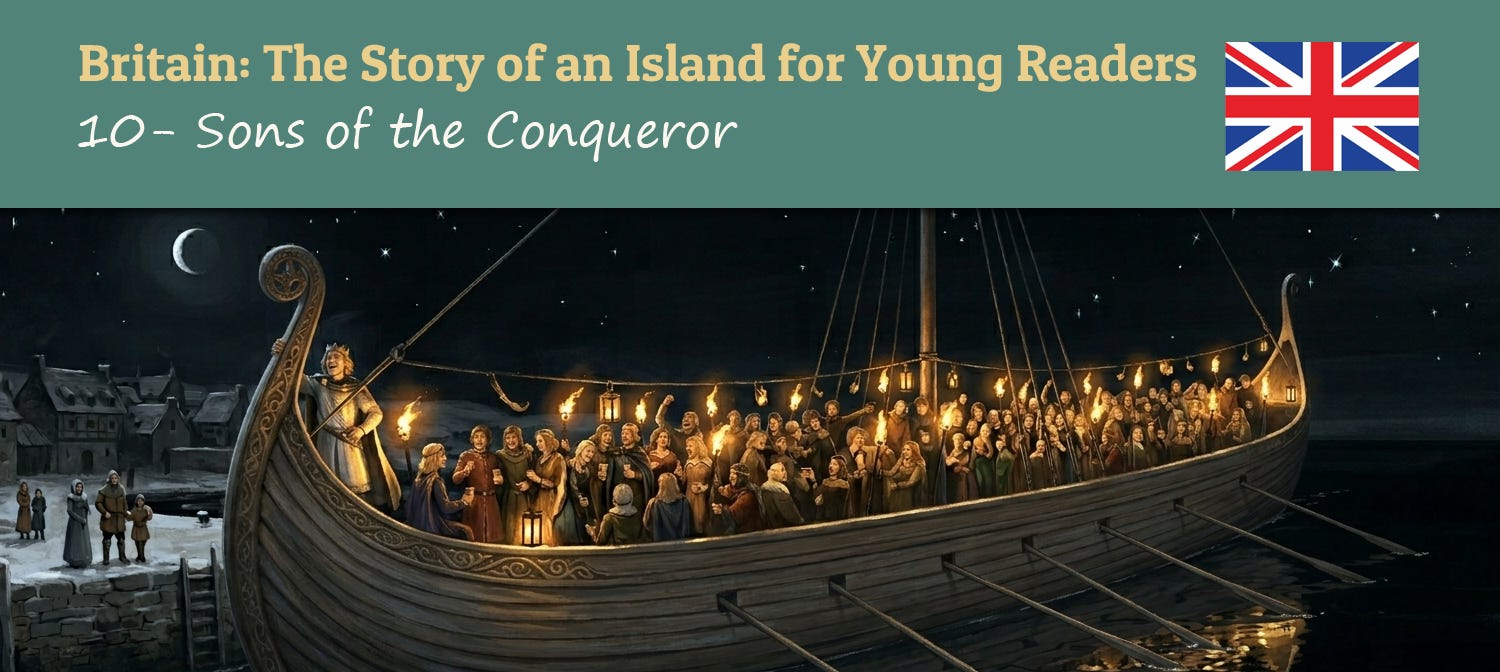
It was a disaster from the very start. Wine was carried aboard, and the young nobles and the crew drank wine right into the night. When priests came down to the harbour to bless the ship before it sailed, as was the custom, the laughing, drunken company waved them away. It was nearly midnight of a bitterly cold night by the time the White Ship sailed. The passengers, full of wine and high spirits, called out to the oarsmen to row hard and overtake the king’s ship, which had sailed hours before. The crew, just as drunk, bent to the oars and drove her forward into the dark at full speed.
A mile out of the harbour, going fast, the White Ship struck a rock.
The hull tore open. The sea poured in. In the panic and the dark and the freezing water, almost everyone aboard was lost within minutes. The crew did manage to get young William, the king’s son, the heir to England and Normandy, down into a small boat, and pushed it clear of the wreck, saving his life.
And then, across the black sea, he heard a voice. It was his half-sister, still clinging to the sinking ship, crying out to him not to leave her. William ordered the little boat round and rowed back for her. But as it drew close to the wreck, the people still struggling in the water flung themselves onto it, and the small boat, swamped under the weight of too many people – sank. William drowned, and his sister with him, and very nearly every soul who had stepped aboard the White Ship.
When the sun came up, the fishermen of Barfleur found a single living man. He was a butcher from the city of Rouen named Berold, who had come aboard only to chase up some money he was owed. He had clung all night to a piece of the broken mast in the icy water, while one by one the others who clung beside him lost their strength and slipped away into the sea. He was the only one to survive out of around three hundred people.
No one dared tell King Henry. For a whole day the court at Barfleur knew, and could not bring themselves to tell the king. In the end it was a small, trembling boy, who told King Henry that his son was dead. They say the king fell to the floor as though he had been struck down, and for the rest of his life, he never smiled again. A monk writing soon afterwards put it more plainly than anyone has managed since. No ship, he wrote, had ever brought England so much sorrow.
Think for a moment of all that was lost on that rock in the dark. Not only a boy of seventeen and his sister, although that was grief enough for any father. The whole careful work of King Henry’s life went down with them. He had schemed and fought and imprisoned his own brother to gather the great inheritance into one safe pair of hands, and now there was no one to pass it on to. King Henry was an old man now, and his wife had died some years earlier. So in hope Henry married again, but no more children came.
In the end he did the only thing left to him. He had one other true-born child, a daughter named Matilda, a proud and able woman who had been married to the Emperor in Germany and was now a widow. Henry named her his heir, and made all the great lords of England swear a solemn oath to accept her as their queen when he was gone. They swore, and Henry must have hoped that an oath would be enough.
It was not. When King Henry died in the winter of 1135, after, the story goes, greedily eating a dish of lampreys (a fish), the lords who had sworn their oath to Matilda, broke their word. King Henry’s nephew Stephen moved fast, exactly as Henry himself had once moved faster than his brother Robert, and snatched the crown before Matilda could reach it. At that moment, England fell into nearly twenty years of the cruellest civil war it had ever known, a time so dark that people said openly that Christ and his saints slept. But that is a story for another day.
King William the Conqueror had taken England, he once boasted, with both his hands. He had held it, and Normandy too, in a grip that nothing could loosen while he lived. But no man’s hands can grip for ever. Within the lifetime of those who had known him, two of his sons and his best-loved grandson had come to grief by an arrow in his New Forest and a rock in his sea, and the great inheritance he had fought so hard and so cruelly to win had slipped, in the end, clean through his children’s fingers.
The New Forest is still there. You can walk in it today, out on the heath and under the old oaks, in the forest William the Conqueror created. Somewhere among the trees a stone still marks the place where, they say, a king fell with an arrow in his chest on a summer evening more than nine hundred years ago – The Rufus Stone. The forest keeps its secret, and it will not say whether what happened there was an accident, or something darker, or simply the price that is always paid, in the end, for a crown.