

They were the strangest pair in Christendom.
King Henry, with his rough hands and cracked voice and plain clothes, riding hard through the rain from one end of England to the other. And beside him, as often as not, his Chancellor, Thomas Becket, dressed in silk and fur, laughing easily, keeping up with the king on horseback as though he had been born to it.
They hunted together, they ate together, they argued about law and money and bishops, and then went hawking together as though none of it mattered. The king’s own son, the young prince Henry, lived in Becket’s household, and it was Becket who oversaw his education. People at court said the two men were closer than brothers.
It was a friendship that would end in blood on the stone floor of a cathedral. But in the early years of King Henry’s reign, nobody could have seen it coming.
Thomas Becket was not born to greatness. His father, Gilbert, was a merchant in London, a Norman who had settled in Cheapside, and done well enough for himself without ever becoming truly rich. Thomas grew up sharp, charming, and ambitious. He had a gift for making people like him and a talent for getting things done. As a young man he entered the household of Theobald, the Archbishop of Canterbury, where he quickly made himself so useful that the old archbishop began sending him on important missions, including trips to Rome. When King Henry needed a Chancellor in 1155, Theobald recommended Becket. It was the best advice the archbishop ever gave, and the worst.
Becket took to the Chancellor’s office like a man who had been waiting for it all his life. He ran the royal household, managed the king’s money, oversaw the courts, led embassies abroad, and even commanded troops in battle. He was brilliant at it. He was also, without apology, spectacularly extravagant. His household was one of the largest in the kingdom. He threw lavish dinners, wore magnificent clothes, and travelled with a train of servants and horses that made foreign courts stare. When he went as ambassador to Paris, he took twenty-four changes of clothing with him. He was, in every way that mattered, the king’s right hand. He enforced the king’s will, collected the king’s money, and backed the king’s authority over the Church without a second thought.
King Henry loved him for it.
And then Theobald died.
The Archbishop of Canterbury was the most powerful churchman in England. He crowned kings. He answered to the Pope. He controlled a vast web of Church courts, Church lands, and Church wealth. And when Theobald died in 1161, King Henry saw an opportunity that seemed almost too good to be true.
He would make Thomas Becket the new Archbishop.
Think about what Henry was trying to do. He was building a system of law that would cover the whole kingdom, from the Common Law and the travelling judges we heard about in the last chapter to the Exchequer that counted every penny. But there was one great flaw in that system. The Church ran its own courts under its own rules, and those courts answered not to the king but to the Pope in Rome. If a priest committed a crime, even a serious one, he could not be tried in the king’s court. He was sent to a Church court, where the punishments were far lighter. A man who would have been hanged or mutilated under the king’s justice might face nothing worse than a penance or the loss of his position.
King Henry thought this was outrageous. Stories circulated of more than a hundred cases of murder by members of the clergy that had gone effectively unpunished. The king wanted the Church to hand over these criminal clerics to his courts for proper punishment. The Church refused. Its courts were sacred, its clergy answerable only to God and the Pope. No king, however powerful, could change that.
Unless, of course, the Archbishop of Canterbury was your closest friend.
That was the plan. With Becket in Canterbury, Henry would have an ally at the very heart of the Church. Together they would bring the Church courts under the king’s law and close the gap in the system. It was clever. It was bold. And it was a catastrophic misjudgement of the man Henry thought he knew.
Becket did not want the job. He is said to have warned the king, looking down at his own fine clothes, that Henry would soon come to hate him as much as he loved him now. Whether he truly said this, or whether the story was exaggerated after everything that followed, nobody can be sure. But in June of 1162, Thomas Becket was ordained a priest one day and consecrated Archbishop of Canterbury the next. He was, overnight, the highest churchman in England.
And overnight, he became a different man.
The silk and fur vanished. The lavish dinners stopped. The magnificent household was stripped bare. Becket put on the plain black robes of a monk. Beneath them, against his skin, he wore a hair shirt, a coarse, scratchy garment deliberately uncomfortable, crawling with lice, worn as a private act of penance. Nobody saw it while he lived. He rose before dawn to pray. He washed the feet of the poor. He ate simply, drank little, and threw himself into the duties of his office with the same fierce energy he had once given to the king’s business.
He resigned as Chancellor.
The transformation stunned everyone, the king most of all. Whether Becket’s change of heart was a genuine spiritual awakening, or whether he simply threw himself into his new role as completely as he had thrown himself into his old one, is a question that people have argued about ever since. What mattered was the result. The man King Henry had appointed to be his obedient servant in Canterbury had become the most determined defender of the Church’s independence in all of Europe.
The quarrel between King Henry and Becket started with small things. Becket reclaimed lands and rights he said had been taken from Canterbury. He clashed with the king’s officials. He opposed Henry publicly at a council at Woodstock, embarrassing the king in front of his own court. And then the great issue, the one that had been simmering from the beginning, came to a head over the criminal clerics.
In January 1164, at a royal hunting lodge called Clarendon Palace, near Salisbury, King Henry summoned his bishops and presented them with a set of sixteen rules that he called the Constitutions of Clarendon. These were meant to spell out, clearly and in writing, the old customs that governed the relationship between the crown and the Church. The most controversial rule was the one about clerics who committed serious crimes. They would be tried first in a Church court, but if found guilty, they would be handed over to the king’s court for punishment. No more hiding behind a bishop’s robes after committing murder.
Some of the bishops were willing to agree. Becket, at first, reluctantly accepted the Constitutions. But then, almost immediately, he changed his mind. Pope Alexander III condemned them. Becket, bound by his loyalty to Rome, refused to sign. He said the Constitutions violated the ancient freedoms of the Church. He would not put his seal to them, no matter what the king demanded.
King Henry was furious. He had expected obedience from his old friend, and what he got was open defiance. In October 1164, he summoned Becket to Northampton Castle and put him on trial, not for the Church dispute itself, but for financial irregularities during his time as Chancellor, charges that many people believed were invented simply to bring Becket down.
The trial was a humiliation. Becket was found guilty. His property was forfeit. The king demanded his submission.
Becket refused. Instead, in the middle of the night, he fled. He crossed the Channel in secret, slipped into France, and threw himself on the protection of King Henry’s great rival, King Louis VII. For six years, the Archbishop of Canterbury lived in exile, moving between French monasteries, kept alive by the grudging support of Louis and the distant, cautious sympathy of the Pope, who needed King Henry’s support too much to risk taking Becket’s side openly.
For six years, the quarrel festered.
It was a strange kind of war. No armies marched. No battles were fought. But across the Channel, letters flew back and forth, bitter and accusing. Becket threatened to excommunicate the king. Henry threatened to seize all of Canterbury’s property. Papal legates travelled between the two men, trying to broker a peace that neither truly wanted. The Pope urged compromise. Becket refused to bend. Henry refused to give way. Year after year, the impasse dragged on.
Then, in the summer of 1170, King Henry did something that broke the deadlock, though not in the way he intended.
He had his eldest son, Henry the Young King, crowned as joint ruler of England. It was the Archbishop of Canterbury’s ancient right to crown English kings, and everyone knew it. But Becket was in exile, so Henry had the Archbishop of York perform the ceremony instead.
It was a calculated insult, and it worked. Becket was enraged. The Pope, too, was furious at the violation of Canterbury’s privileges, and threatened to place all of England under an interdict, a punishment that would close every church in the kingdom. Under this pressure, King Henry was forced to negotiate.
In July 1170, King Henry and Becket met in France and spoke privately for the first time in six years, and they agreed to a peace – of sorts. Becket would return to England, and his rights as Archbishop would be restored. Whatever passed between them, it was enough for Becket to believe it was safe to go home.
He crossed the Channel in early December 1170. Crowds lined the roads to welcome him back. Monks wept with joy. The people of Kent came out in their hundreds to see the Archbishop restored to Canterbury at last.
But before he left France, Becket had done something that would cost him his life.
He had excommunicated three of the most powerful churchmen in England, the Archbishop of York and the Bishops of London and Salisbury, for their part in the unauthorised coronation of the young king. It was within his rights as Archbishop. It was also, given the fragile state of the peace, spectacularly provocative.
The three excommunicated churchmen crossed immediately to Normandy and reported what Becket had done to King Henry, who was spending Christmas at his court near Bayeux. Henry, who had thought the quarrel was finally over, exploded.
What he said next has been repeated for more than eight hundred years. No one knows his exact words. The version most people remember is ‘Will no one rid me of this turbulent priest?’ But the earliest account, written by a man who was there, gives something rather different. Henry raged at his household, calling them miserable cowards and traitors who stood by while a low-born cleric treated their king with contempt.
Whatever the words, four knights heard them.
Their names were Reginald Fitzurse, Hugh de Morville, William de Tracy, and Richard le Breton. They were men of Henry’s own household, eager to prove their loyalty. Without telling the king what they intended, they slipped away from the court, rode for the coast, and crossed the Channel to England.
On the twenty-ninth of December, 1170, the four knights arrived at Canterbury.
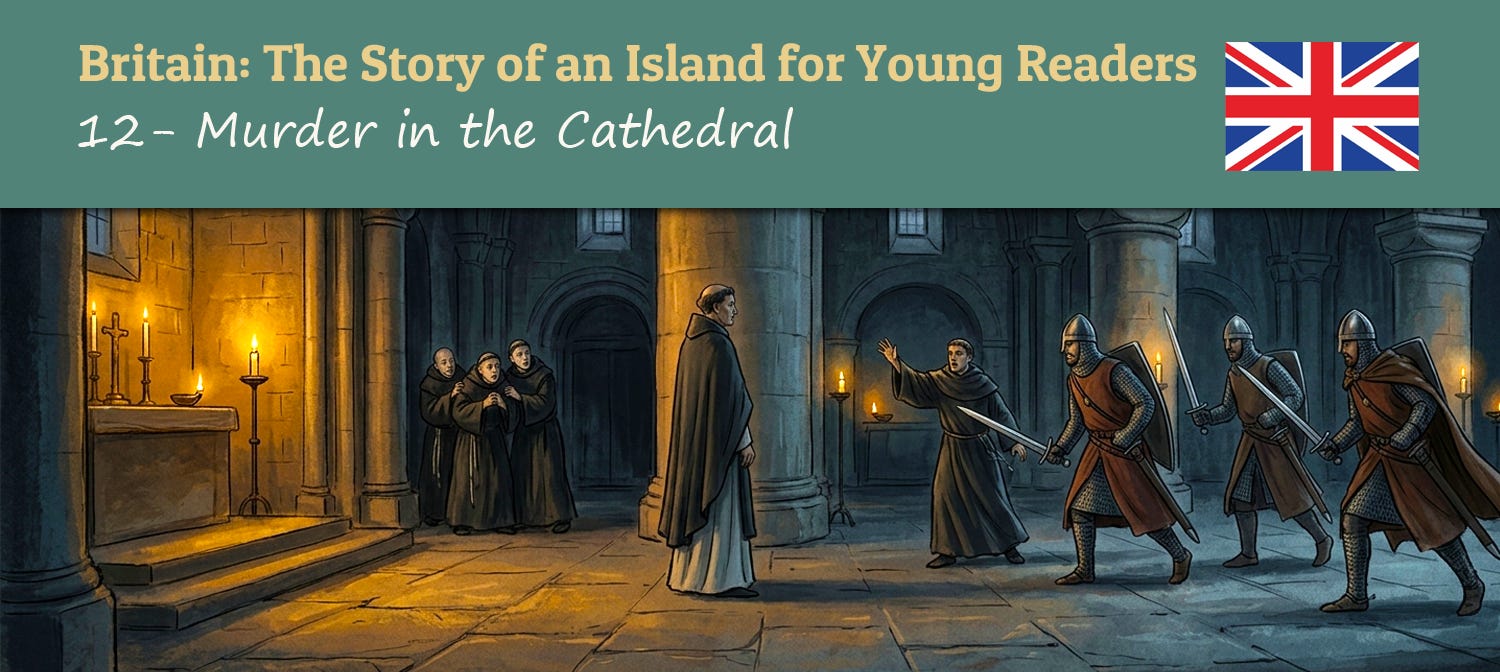
They found Becket in his palace, beside the cathedral. They told him he must come with them to the king and answer for his actions. Becket refused. The argument grew heated. The knights left, and Becket’s monks, terrified, urged him to take shelter inside the cathedral, where Vespers, the evening prayers, were already being sung.
Becket walked through the cloister and into the great dark church. The monks tried to bar the doors behind him, but Becket stopped them. ‘It is not right,’ he said, ‘to make a fortress out of the house of prayer.’ He ordered the doors left open.
The four knights came back. They had put on their armour and drawn their swords. The cathedral was dim, lit by candles, full of shadows and the sound of chanting. The knights pushed through the darkness, shouting for the traitor.
‘Where is Thomas Becket, traitor to the king and country?’
No answer came. They shouted again.
‘Where is the Archbishop?’
Becket stepped forward out of the knot of monks who had gathered around him.
‘Here I am,’ he said quietly. ‘Not a traitor to the king, but a priest.’
What happened next was swift and savage. The knights seized him, tried to drag him outside. Becket clung to a pillar. A sword came down. Edward Grim, a visiting cleric who was standing beside the Archbishop and who later wrote down what he saw, tried to shield Becket with his arm and was badly wounded. Another blow struck the Archbishop’s head. A third sent him to the ground. A fourth sliced away the crown of his skull. His blood and brains spilled across the cold stone floor.
A fifth man, not a knight but a clerk who had followed them in, stepped forward and set his foot on the dead Archbishop’s neck. ‘He will not get up again,’ he said.
It was dark by then. The twenty-ninth of December, four days after Christmas.
The news spread across Europe like fire.
King Henry, when he heard what his knights had done, is said to have been overwhelmed with horror and grief. Whether he had truly meant for Becket to be killed, or whether his angry outburst had been taken further than he ever intended, no one has ever been able to say for certain. But it did not matter. His words had set the four knights in motion, and now the most famous churchman in England lay murdered on the floor of his own cathedral, and the blood was on the king’s hands.
The monks of Canterbury prepared Becket’s body for burial. When they stripped away his robes, they found the hair shirt beneath them, crawling with lice, and they understood what kind of man he had been in secret. The story of the hair shirt spread quickly, and it sealed his reputation. Within days, people were coming to touch the place where he had fallen. They reported miracles. The sick were healed. The blind could see.
On the twenty-first of February, 1173, barely two years after his death, Pope Alexander III declared Thomas Becket a saint. It was one of the fastest canonisations in the history of the Church.
King Henry moved quickly to limit the damaging fallout from the murder. He negotiated with the Pope. He agreed to a formal settlement at Avranches in Normandy, where he swore that he had not ordered the murder, though he admitted that his angry words had caused it. He made concessions and was absolved.
But he did not go to Canterbury. He did not kneel at the tomb of the man who had once been his closest friend. That, he could not bring himself to do, but this was not enough, so his own family then tore his world apart.
In 1173, Henry’s wife Eleanor, proud and bitter after years of being pushed aside, encouraged their elder sons to rise against him. The Young King Henry, who had been crowned but given no real power, and his brother Richard both demanded a share of the kingdom their father refused to let go. They found allies everywhere. Louis VII of France, who had waited a generation for this moment, joined them eagerly. William the Lion, King of Scotland, invaded from the north. Rebels rose across England and Normandy. The empire Henry had held together by sheer force of will was coming apart, and his own sons were pulling it to pieces.
People whispered that they knew the reason. God was punishing the king. The man who had caused the death of a saint was being destroyed through his own blood, and no settlement with the Pope, no formal absolution, could save him. Only one thing could. He had to go to Canterbury, to the tomb itself, and beg forgiveness from the friend he had betrayed.
So in the summer of 1174, and with enemies pressing in from all sides, King Henry went to Canterbury. He walked barefoot through the streets of the city, wearing sackcloth instead of his royal robes. At the cathedral he knelt before the tomb of the man who had once been his closest friend, and submitted to a scourging, which meant that every monk in the priory could and did strike the king with a rod. He spent the night in prayer and fasting on the cold stone floor beside the grave of Thomas Becket.
The very next day, by an extraordinary coincidence that people at the time took as a sign from God, news arrived that the King of Scotland, who had invaded the north, had been captured. Immediately, King Henry’s fortunes turned.
Meanwhile, Becket’s tomb became the most famous pilgrimage site in England. For three and a half centuries, people came from all over Europe to pray at the shrine of Saint Thomas. The cathedral grew rich on the offerings of the faithful. Two hundred years after the murder, a poet named Geoffrey Chaucer imagined a group of pilgrims riding from London to Canterbury to visit the saint’s tomb, and the stories they told each other along the way became one of the greatest books in the English language, The Canterbury Tales.
Then, in 1538, another King Henry – the eighth, who had his own quarrel with the Church and his own reasons for despising a churchman – sent his men to Canterbury. They destroyed the shrine, scattered the bones, and seized the treasure. The pilgrims stopped coming. The candles went out.
But the cathedral still stands.
You can walk into it today, through the same door the monks tried to bar on that December evening more than eight hundred and fifty years ago. You can stand in the place where Becket fell, where a single candle burns in the north-west transept and the stone floor is worn smooth by the feet of all the people who have come, over all the centuries, to remember what happened there. The knights are gone. The king is gone. The silk and the hair shirt and the argument about who should judge a priest who committed murder, all of it is gone.
What remains is the story. A friendship that turned to hatred. A stubborn king and a stubborn priest, each of them certain he was right. And a question that still has no easy answer, even now: when a king and a church disagree, who has the final word?