

In the summer of 1189, Richard, the eldest surviving son of King Henry II, went to war against his own father.
He was not the first of King Henry’s sons to rebel. His brothers had done it before him, encouraged by the King of France, who understood that the easiest way to destroy the great Angevin empire was to set its heirs against each other. But Richard’s rebellion was the last, and the worst. Allied with King Philip of France, he attacked King Henry’s lands in the Loire, and at Le Mans he routed the old king’s army and sent it fleeing.
King Henry ran. Behind him, covering the retreat, rode one of his most loyal knights, a man named William Marshal. And it was Marshal, stationed in the rearguard with the dust of the fleeing army still hanging in the air, who looked up and saw Prince Richard thundering toward him at the head of the pursuing cavalry.
Richard was not even wearing his mail. He was reckless, furious, and utterly exposed. Marshal, mounted and armed, could have killed him in a heartbeat. But killing a prince who was almost certainly about to become king was not the same as killing an enemy. It was a decision that would follow a man for the rest of his life, one way or the other.
Richard saw the lance. ‘Spare me,’ he cried out.
Marshal turned his lance and drove it into the prince’s horse instead. The animal went down. Richard crashed to the ground in a tangle of dust and reins while Marshal looked down at him.
‘I will not slay you,’ Marshal said. ‘The Devil may slay you.’
Then he rode away.
The insult was worse than death. To be unhorsed and spared, publicly, by a man who could have ended you, was a humiliation that most princes would have remembered with a burning desire for revenge. However, when King Henry died a few weeks later and Richard became king, Marshal and his friends waited with real anxiety to discover what the new ruler would do to them.
What the new King Richard did surprised everyone. He summoned Marshal, spoke calmly and even with admiration about the incident at Le Mans, confirmed him in every office and honour, and sent him to England as his representative. Then he gave Marshal a rich heiress in marriage, making him one of the most powerful barons in the country.
It was quietly noticed, that the new king’s favour fell most warmly upon those who had stood loyally by his father against him, even at the expense of those who had been Richard’s own allies in the rebellion.
This was the kind of man King Richard was. Grand. Generous. Surprising. And almost entirely uninterested in the kingdom he had just inherited.
King Henry II, the restless, brilliant, rough-handed king who had rebuilt English law and quarrelled with Thomas Becket, died at Chinon in Anjou on the sixth of July 1189. He was fifty-six years old, exhausted, and broken. His sons had rebelled against him, one after another, encouraged by the King of France. His wife Eleanor had supported her sons and spent sixteen years in captivity for it. The great Angevin empire King Henry II had spent his life holding together was cracking under the pressure of its own contradictions, exactly as the patient French king had always hoped it would.
At the end, so the story goes, King Henry turned his face to the wall and said, ‘Shame, shame on a vanquished king.’
Richard knelt beside his father’s body no longer than it would have taken to recite the Lord’s Prayer. Then he stood up and turned to the business of being king.
He was crowned at Westminster Abbey on the third of September 1189. He was thirty-one years old, and he would reign for ten years. In that time he would become the most famous warrior in Christendom, fight a crusade that would echo through the centuries, spend a fortune that would bleed England dry, and set foot in his own kingdom only twice, for a few months each time.
Yet somehow, against all reason, the English never stopped loving him.
What did this new king look like?
He was tall and well-proportioned, long-limbed and strong, with reddish-gold hair and a bearing that made people look twice. He was a superb horseman, a devastating fighter in single combat, and he moved with the easy confidence of a man who had never doubted, for one moment of his life, that he was born to lead armies. He loved war the way some men love music, not just the strategy and the grand sweep of it, but the physical business of fighting, the weight of a sword, the shock of impact, the roar and chaos of a cavalry charge. He wrote poetry and sang well. He spoke French and the language of southern France, and Latin too, and he had a sharp, restless intelligence that could turn cruel when he was bored or crossed.
He was, in short, everything a medieval king was supposed to be. His contemporaries called him Cœur de Lion, the Lionheart, and they meant it as the highest compliment they knew. In those days the lion was the most admired creature in heraldry, and more than one king tried to claim a connection with it. When they gave the name to Richard, it stuck, because everyone who saw him in battle knew it was true.
But the people of England barely knew him. He had grown up in France, in his mother Eleanor’s warm, cultured duchy of Aquitaine, surrounded by troubadours (travelling poet musicians), southern sunshine and the soft vowels of the langue d’oc. England was cold, wet, and far away. He had no attachment to it. He did not speak English. What England had, and what King Richard wanted, was money because he was going on a crusade.
Three years before Richard became king, something had happened in the east that sent a shudder through every Christian country in Europe – Jerusalem had fallen.
The Christian kingdom that the First Crusade had established nearly a century earlier had always been fragile, a narrow strip of coastline held together by fortified castles, military orders, and the disunity of the surrounding Muslim powers. That disunity ended when a Kurdish-born general named Saladin rose to become Sultan of Egypt and then took Damascus and Aleppo, encircling the Christian territories from every side.
In 1187, Saladin proclaimed a jihad, a holy war. At the Battle of Hattin – a rocky hilltop in the waterless hills above the Sea of Galilee – his forces destroyed the Christian army. The Crusader knights, weighed down by armour in the terrible heat, gasping for water that did not exist, were surrounded and cut to pieces. The King of Jerusalem was captured, and the Grand Master of the Templars was taken. In October of that year, Saladin entered Jerusalem.
The shock was enormous, and the Pope’s legates raced across Europe demanding that Christian princes stop fighting each other and fight the infidel instead. Pictures were shown of the Holy Sepulchre defiled by the horses of Saracen cavalry. A special tax, the Saladin Tithe, was levied on everyone who did not take the Cross. The three greatest kings of the West, the rulers of England, France, and Germany, pledged themselves to the rescue.
King Richard, newly crowned, threw himself into the crusade with a single-mindedness that was breathtaking. He sold everything he could lay his hands on. Offices, castles, lordships, entire towns, all went to the highest bidder. He sold the right to govern whole counties. He released the King of Scotland from his oath of allegiance in exchange for ten thousand marks. He is supposed to have said, ‘I would sell London itself if I could find a buyer.’
England, which had only just recovered from the long bleeding of King Henry II’s reign, was bled again. The shires that had been patiently rebuilt, the courts that had been carefully restored, the treasury that had been slowly refilled, all of it was raided to pay for a war in a country most English people could not have found on a map, had maps existed for them to look at.
But Richard did not care about any of that. He had a war to fight, and it was the only thing that mattered to him.
King Richard the Lionheart left England in December 1189 and would not return for more than four years.
The Third Crusade was the greatest military expedition of the Middle Ages. King Richard sailed with a fleet of over a hundred ships, carrying a vast force of knights, men-at-arms, and siege engineers. He stopped in Sicily, where he quarrelled spectacularly with the local king and took the city of Messina almost as an afterthought. He conquered Cyprus on his way past, deposing its ruler in a matter of weeks, and arrived at the siege of Acre in June 1191. The war that had been dragging on for two years suddenly caught fire.
Acre was a walled port city on the coast of what is now Israel, and the Christian forces had been besieging it without success since 1189. King Richard’s arrival changed everything. He brought men, money, siege engines, and above all he brought himself, a commander of ferocious energy who drove his troops forward by sheer force of will. Even when he fell ill with a fever so bad that his hair and nails began to fall out, he had himself carried to the front on a litter and went on directing the siege from his stretcher, choosing positions for his crossbowmen and watching the bombardment through the tent flaps.
Acre fell in July 1191. It was the first great Christian victory in the Holy Land for a generation.
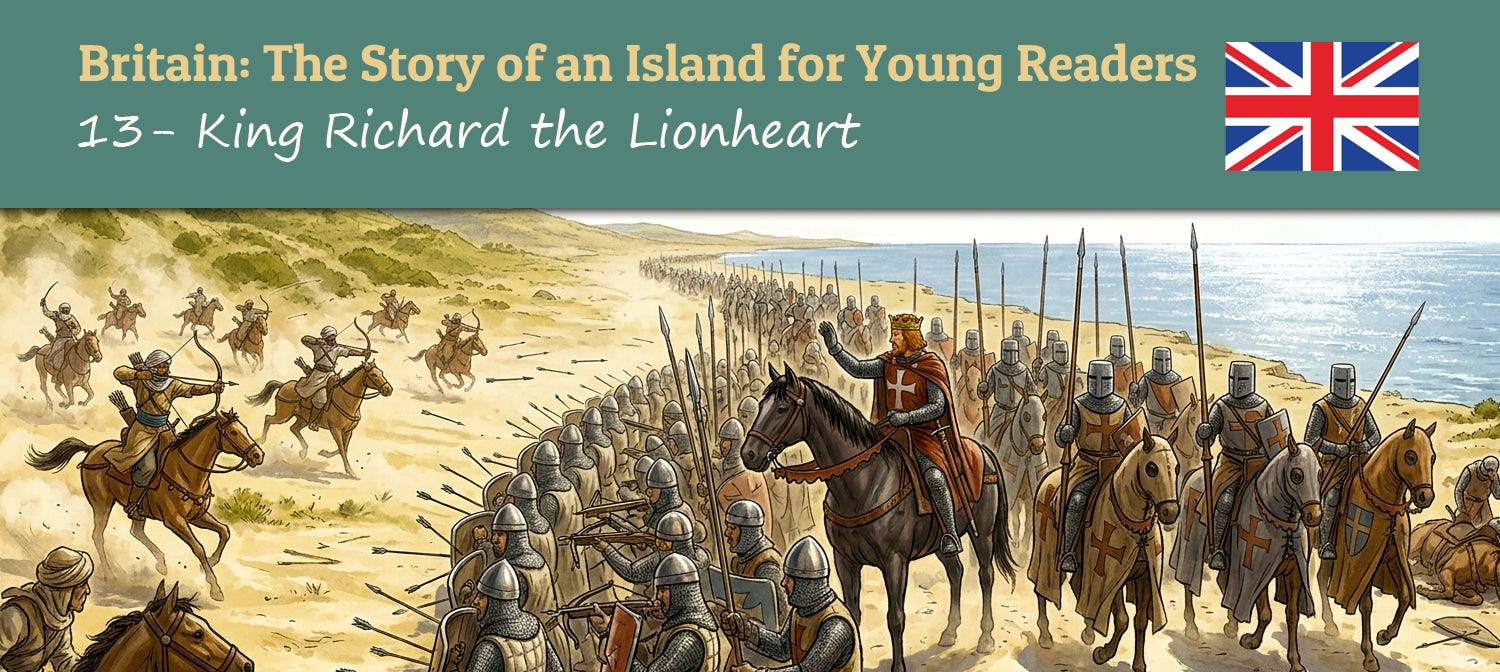
What followed was one of the most famous military marches in history. Richard led his army south along the coast toward the port of Jaffa, the gateway to Jerusalem. The column moved slowly through the scorching heat of a Palestinian summer, the men drenched in sweat inside their armour, flies blackening every wound. Saladin shadowed them the entire way, sending his cavalry in wave after wave against the Christian flank, probing for a gap, trying to break the formation apart.
But King Richard’s discipline held. He kept his army in tight formation, the infantry on the landward side absorbing the Saracen arrows and charges, the knights in reserve, forbidden to break ranks until the moment was right. Men fell and the column kept moving. Horses screamed and the column kept moving. The Saracen arrows came so thick at times that the infantrymen looked, according to one chronicler, like porcupines bristling with shafts, and still the column kept moving.
At the Battle of Arsuf, when Saladin committed his full force, King Richard launched his cavalry in a devastating counter-charge that broke the Muslim line and sent them streaming from the field. It was a textbook victory, perfectly timed, and it confirmed what every soldier in the Holy Land already knew. In battle, King Richard was extraordinary.
But battles are not the same as wars.
King Richard advanced to within a day’s march of Jerusalem. Twice he brought his army close enough that the soldiers could feel the prize within reach. But he knew, with the hard clarity of a professional soldier, that he could not take the city and hold it. His army was too small, the supply lines too long, the desert too unforgiving. If he stormed the walls and won, Saladin’s vastly larger forces would simply encircle him and starve him out. The Christian army at Hattin had been destroyed because it was surrounded and cut off from water in open country. Richard could see that the same thing would happen to him inside Jerusalem, only worse, because walls that keep an enemy out also keep an army in.
He turned back. It was the right decision, militarily. It may have been the hardest decision of his life. The whole purpose of the crusade, the thing he had sold half his kingdom to achieve, stood shimmering on the horizon, and he rode away from it.
In September 1192, Richard and Saladin agreed a truce. Christian pilgrims would be allowed to visit the holy places in Jerusalem. The coastal cities would remain in Christian hands. It was something, but it was not what the crusade had set out to achieve. Jerusalem remained under Muslim rule. It would not return to Christian hands in Richard’s lifetime, or in any lifetime after.
There is a tradition that Saladin sent Richard a gift of fruit and snow to cool his fever during the campaign, and that the two men, who never met face to face, developed a grudging mutual respect. Whether or not every detail is true, it captures something real about both of them. Saladin was a man of genuine honour and considerable magnanimity, and Richard, for all his violence, recognised quality when he saw it.
King Richard the Lionheart left the Holy Land in October 1192. He would never return, but his journey home became a disaster.
Richard’s ship was driven ashore in the Adriatic, and he was forced to travel overland through territories ruled by men he had offended during the crusade. He tried to pass through Austria in disguise, but the disguise was poor and the grudge was deep. Duke Leopold of Austria, whom Richard had publicly humiliated at the siege of Acre by tearing down his banner from the walls, had him seized near Vienna just before Christmas 1192.
Leopold handed his prisoner over to the Holy Roman Emperor, Henry VI, who locked King Richard away in a castle and demanded a ransom so enormous that it beggared belief. One hundred and fifty thousand marks of silver, roughly two to three times the entire annual revenue of the English crown, and England was stripped bare to pay it.
A special tax was levied on every free man in the country. The churches gave up their plate. The Cistercian monks, who owned no gold or silver because their rule forbade it, handed over their wool clip, the only wealth they possessed. Farmers and merchants who had never left their own county, who had never seen the king and never would, reached into whatever they had and gave, because the alternative was a kingdom with no ruler and the chaos that would follow. Richard’s mother Eleanor, now seventy years old and released from her own long captivity, drove the collection with fierce determination.
It took more than a year to raise the money. In February 1194, after fifteen months in prison, King Richard was released. He returned briefly to England, showed himself to his subjects, raised yet more money, and left again within weeks.
He had unfinished business in France. While King Richard had been rotting in a German cell, King Philip of France had been busily seizing his territories, and King Richard’s own brother John had been scheming to take the English throne. King Richard dealt with John contemptuously, calling him a child who had been led astray by bad advisers, and turned his full attention to Philip.
The last five years of his life were spent in a grinding war across Normandy and the Loire valley. King Richard fought Philip with the same energy and tactical brilliance he had shown against Saladin, and he was winning. He built a great fortress on the Seine, Château Gaillard, the most advanced castle in Europe, and boasted that he could hold it even if its walls were made of butter. It was a masterpiece of military engineering, and it was also a statement. King Richard was not going to lose France.
Then, in the spring of 1199, he besieged a small, insignificant castle called Châlus-Chabrol in the Limousin. The garrison was tiny. The castle was nothing. There was a rumour, probably false, that a peasant had found a hoard of Roman gold and the local lord had refused to hand it over. It was the kind of petty quarrel King Richard would normally have settled in an afternoon.
On the evening of the twenty-fifth of March, King Richard was riding around the castle walls inspecting the siege works. He was carrying a shield but wearing no armour. A crossbowman on the battlements, a man some sources call Pierre Basile, took aim and shot him in the left shoulder, near the neck.
Unfortunately, after the bolt was removed, the wound turned gangrenous. Quite soon, King Richard knew he was dying. He sent for the crossbowman and, according to the chroniclers, forgave him. ‘Live on,’ he is supposed to have said, ‘and by my bounty behold the light of day.’
Whether the crossbowman actually survived King Richard’s mercy is another question. Some accounts say that after the king died, his mercenary captain, Mercadier, had the man flayed alive. The age of chivalry had its limits.
Richard I, King Richard the Lionheart of England, Duke of Normandy, Duke of Aquitaine, Count of Anjou, Cœur de Lion, died on the sixth of April 1199. He was forty-one years old. His mother Eleanor was at his bedside.
He had been King of England for ten years and had spent barely six months of those years in his own kingdom. He had taxed the English mercilessly, first to pay for his crusade, then to pay for his ransom, then to pay for his wars in France. He had given them nothing in return except a name, a legend, and the memory of a man who had fought like a lion and lived like one too, restless, magnificent, and always somewhere else.
His bronze statue stands today in Old Palace Yard, outside the Houses of Parliament in London. King Richard on a horse with sword raised. It was placed there in 1860, nearly seven centuries after his death, because by then it was the legend that mattered, not the ledger.
What King Richard left behind, was a kingdom drained of money and patience, and a younger brother who had already shown, during King Richard’s captivity, exactly how much trouble he was capable of causing.
His brother’s name was John.