
14 - King John and Magna Carta
The worst king England ever had, gave it the most important document in its history.

When the news came that King Richard the Lionheart was dead, his brother John was in Brittany, deep in enemy country, and he knew at once that his life was in danger.
He was at the court of his nephew Arthur, a boy of twelve, and Arthur’s people had no love for John. The men around him, the Breton lords who had backed Arthur’s claim to the English throne for years, now had every reason to seize John and the throne, and John did not wait to find out whether they would. He left, rode hard and fast, and did not stop until he was out of Brittany and back amongst friends.
It was a telling start.
King Richard, the Lionheart, had named his brother John as his successor. But there was another candidate, and the question of who had the better claim would tear the family, and the empire, apart. Geoffrey, John’s elder brother, was dead, but he had left behind a son, young Arthur, Prince of Brittany. By one reading of the law, Arthur’s claim was stronger than John’s. He was the son of an elder brother. If primogeniture, the principle that inheritance passes through the eldest line, was the rule, then Arthur should be king.
But primogeniture was not yet settled into law. The old Archbishop of Canterbury and William the Marshal, the greatest knight in England, talked over the issue and decided in favour of John. So did Queen Eleanor, now in her late seventies, who stood by her surviving son against a grandson whose mother she had never liked. England accepted King John without argument, but in France, where it mattered just as much, the opposite view prevailed. Brittany rallied behind Arthur. The King of France, Philip Augustus, who had been circling the Plantagenet empire for years, watching for the moment to strike, saw his chance and took it.
No one would have envied the man who now sat on the English throne. King John had inherited a vast empire, but he had inherited it without the thing that had held it together – his brother, King Richard the Lionheart’s reputation.
He was not King Richard. Everyone knew it, and everyone felt it, and it influenced everything that followed.
What kind of man was King John? The honest answer is that nobody, either then or today, has been able to agree. He could be patient and cunning, coldly intelligent, and sometimes even generous. He had a restless, inquiring mind and loved his books, carrying a small library with him as he travelled, which was unusual for a king of that age. King John was a capable administrator and, when cornered, a capable soldier. But he was also ruthless, suspicious, and possessed a violent temper that could flash into cruelty without warning. The monks who wrote the chronicles of his reign hated him, and they had reason to. The picture they painted was of a man consumed by greed, treachery, and malice. It was not the whole truth, but it was not a lie either.
John showed his nature early. At Rouen, when they handed him the symbolic lance of the Dukes of Normandy, the new duke turned to whisper some joke to the men standing behind him and dropped it on the floor. The people watching thought it was an omen. They were not wrong.
The war with King Philip Augustus and with Arthur dragged on through the fitful pattern of the age, raids and truces, sieges and negotiations, but without the Lionheart to frighten the French it was a losing fight. In 1202, King Philip, as King John’s overlord for his French territories, summoned King John to appear before his court in Paris to answer charges brought against him by the barons of Poitou. King John refused. King Philip said he was summoned as Count of Poitou, but John said the King of England could not submit to such a trial. King Philip replied that the King of France could not lose his rights over a vassal simply because that vassal happened to have become a king as well. When King John still refused to attend, King Philip declared him stripped of all his French lands and invaded Normandy.
At the same time, Arthur made a mistake. He was fifteen now, knighted by King Philip, and given the Plantagenet lands that King Philip had taken from King John. Arthur was also betrothed to King Philip’s daughter. Hearing that his grandmother, old Queen Eleanor, was at the castle of Mirabeau in Poitou with only a small guard, Arthur marched south, surrounded the castle, and stormed the outer walls. Soon, he was within hours of capturing the most important woman in the family.
However, Queen Eleanor just managed to get word to King John. And King John, for once, moved like his brother. With a full army behind him, he covered eighty miles in forty-eight hours, fell on Arthur and his men at daybreak, and took them all. Arthur, two hundred knights, the rebel lords, the whole lot.
Arthur was taken to the castle of Falaise, and then to Rouen, and everyone knew he was in mortal danger. The barons of Brittany begged King John to release the boy. King John refused. He knew, and it was true, that he would never be safe as long as Arthur lived. King Philip would always use the boy against him. Arthur, caught in open war, besieging his own grandmother, was a prisoner who could never be set free without becoming a weapon again.
No one knows exactly what happened at Rouen. The commander of the castle, a man named Hubert de Burgh, gave out that King John had sent men to castrate the boy, and that Arthur had died of the shock. Later, Hubert changed his story and said Arthur was still alive. King John said he was glad his orders had been disobeyed. But Arthur was never seen again. It was believed at the time that King John had ordered his murder, and it has been believed ever since. How Arthur died, whether he was blinded, mutilated, or simply killed, remains unknown to this day.
This all happened at a time when kings and princes were put to death for reasons of policy, and no one was greatly surprised. But the murder of a nephew, a boy of fifteen, by a king who was already distrusted, confirmed the worst that everyone believed about King John. And it did not even achieve what King John had hoped. Arthur was gone, but King Philip Augustus was still there, and King Philip did not need a puppet. He needed a cause, and King John had given him one.
Over time, Normandy crumbled. Province by province, and fortress by fortress, the great Plantagenet empire fell apart. King John poured in money and supplies, but his nerve failed him, and in the end he abandoned Normandy altogether, taking a ship for England and leaving the French to pick up the pieces. In March 1204, the great Château Gaillard that King Richard himself had built, the fortress he had loved and called his own, fell to King Philip’s army, and the road to Rouen lay open. Three months later the capital surrendered, and Normandy, after a hundred and thirty-eight years under the English crown, became French.
It was a humiliation, and King John bore the blame.
But the loss of Normandy, in the long run, did England a favour. It forced the English nobility to look inward. The great lords who had held land on both sides of the Channel now had to choose, and most of them chose England. The ruling class, which for a century and a half had been half Norman and half English, with their eyes always turned towards France, now became, for the first time, simply English. The dangerous, expensive, distracting business of holding a foreign empire was over. England would have to learn to be a country on its own.
King John was not a man to sit quietly after defeat. He schemed for years to build a Continental alliance against Philip, sending money and ambassadors across Europe, courting the Emperor and the counts of Flanders and Toulouse. But before he could launch his grand counter-attack, he picked a fight much closer to home that would prove far more costly.
The Archbishop of Canterbury, Hubert Walter, died in 1205, and the question of who would replace him brought King John into conflict with the most powerful Pope of the Middle Ages – Innocent III. Both the king and the monks of Canterbury put forward their own candidates, but Pope Innocent rejected them both and, to John’s fury, installed his own man, an English cardinal named Stephen Langton, a scholar of the highest reputation who had spent his career to date in Paris and Rome.
King John was outraged. He had agreed in advance to accept the Pope’s decision, expecting his own candidate to win, but he had been outmanoeuvred. He refused to accept Langton and began a campaign of harassment against the English Church, seizing property and driving monks from their monasteries.
Pope Innocent struck back with the heaviest weapon the medieval Church possessed. In March 1208 he placed all of England under an interdict.
The effect was devastating, not to King John, who cared nothing for it, but to ordinary people. The church bells fell silent. The doors of every church in the country were barred shut. No one could be married in church, or buried in consecrated ground, or receive the last rites of the dying. For more than six years, across the whole of England, the spiritual life of the nation was suspended. Think of what that meant to people who believed completely, that their immortal souls depended upon the grace of the Church. A child could still be baptised, and the dying could still confess, but everything else, every wedding, every funeral, every Sunday that gave shape and comfort to ordinary people, was gone. People went to their graves in fear of damnation, and they blamed their king.
When King John only hardened, Pope Innocent went further. In 1209 he excommunicated the king himself, releasing all John’s subjects from their oaths of loyalty and inviting his enemies to overthrow him as a holy act. But King John did not flinch. He seized the empty bishoprics and abbeys and pocketed the revenue, and his treasury overflowed with the spoils of the Church, and for a time, it looked like he might get away with it.
He didn’t. By 1213, King Philip Augustus was assembling an invasion fleet, with the Pope’s blessing and the Church’s full backing, and King John was cornered. He could not fight France and the Pope at the same time, so he did something extraordinary – he completely submitted. And then went further than anyone expected. He offered to make England a fief of the Papacy, handing his entire kingdom to the Pope and receiving it back as a vassal. It was an act of abject surrender, or, looked at another way, a stroke of cold genius. Innocent, who could never resist an addition to his worldly power, accepted with delight. Overnight, King John went from excommunicate to the Pope’s favourite. King Philip, who had been preparing to invade England as a holy crusade, found that the ground had been pulled from under his feet. The Pope was now King John’s protector.
It was clever, even brilliant, but it solved nothing at home.
The English barons had grievances that went far deeper than the Church quarrel. King John had taxed them relentlessly to pay for his wars in France. He had abused his feudal powers, charging outrageous fees for inheritances, wardships, and marriages. He had used the efficient machinery of government that his father King Henry II had built, the courts, the sheriffs, the Exchequer, not to serve justice but to squeeze money and crush opposition. Everything King Henry had created to bring order, King John had turned into an instrument of oppression. The travelling judges, the efficient Exchequer, the network of sheriffs, all of the machinery that had once been England’s strength, now served a king who used it not for justice, but for control. The barons had endured it while there was hope of recovering Normandy. When that hope died, their patience died with it.
In 1214, King John’s grand plan finally came together. The idea was a pincer movement. He himself would sail to Poitou and attack King Philip from the south, stirring up rebellion among the French barons. Meanwhile, a great allied army led by his nephew Otto IV, the Holy Roman Emperor, along with the Earl of Salisbury would march on King Philip from the north, catching the French king between two forces.
The southern campaign failed first. King John landed in Poitou but could not hold his ground, and when a French army advanced against him he withdrew without a fight. That left the northern allies to face King Philip alone.
They met at Bouvines, in northern France, on a hot Sunday in late July. It did not last long. King Philip crushed them. Emperor Otto fled the field, and the Earl of Salisbury was taken prisoner. And with that single afternoon’s fighting, every hope King John had placed in years of diplomacy and borrowed money was gone. He returned to England a beaten man.
The barons saw their moment. They came together, armed and angry, and demanded terms. Left to themselves they might have demanded nothing more than the protection of their own privileges and the settling of their own scores, but they had a powerful supporter – Stephen Langton. Langton was the archbishop King John had fought so hard to keep out of Canterbury, and now he stood with the barons, and he gave them something larger than their own grievances to fight for. Archbishop Langton persuaded the barons to base their demands not on personal resentment, but on the old laws and customs of the realm, the principle that there was a law that stood above the king, and that even the king must obey it.
It was not a new idea. It reached back through King Henry’s Common Law, through King Alfred’s code, to the oldest understanding the English had of what a king was for. But no one had ever written it down, made it a contract, and forced a king to agree to it, this was the baron’s chance to do so.
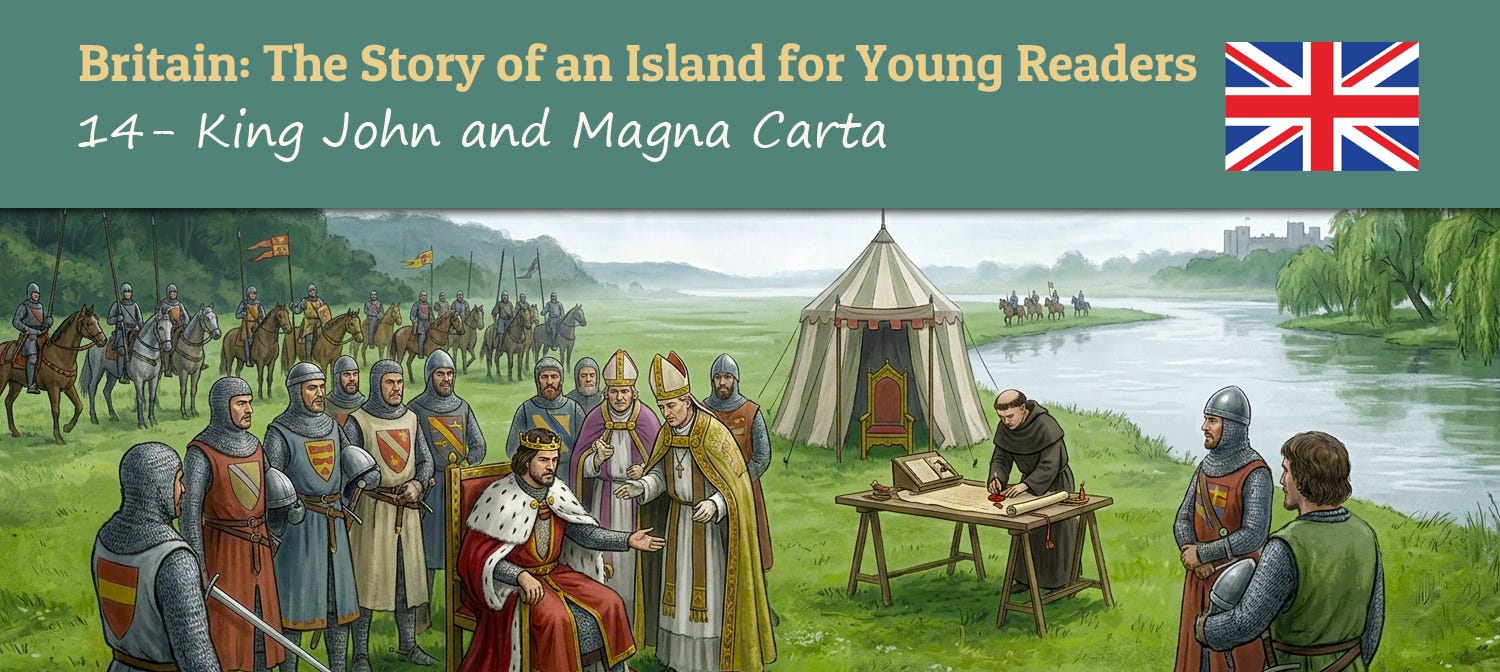
On a Monday morning in June 1215, on the great flat meadow at Runnymede, between Staines and Windsor, the barons and churchmen gathered and waited. They had set up a small throne and a tent. Their armed retainers stood at a distance, because armed rebellion against the crown was the supreme crime of the feudal world, and no one wanted to make it look worse than it was.
Then a small group of riders appeared from the direction of Windsor. King John, the Papal legate, and the Archbishop of Canterbury, along with several bishops. They dismounted without ceremony, and the process began. Someone, probably Langton, stated the terms and John agreed at once, sealing and confirming his agreement in a single document.
The document is called Magna Carta, and it is not what you might expect.
It is not a ringing declaration of human rights or democratic principles. It is a long, detailed legal contract of sixty-three clauses, most of them dealing with the particular complaints of the feudal barons, matters of taxation, inheritance fees, wardships, and the procedures of the royal courts. The word ‘freeman’ in its pages was a technical feudal term that probably did not include even the richer merchants, let alone the ordinary people of England. It was a deal struck between a king and his nobility, and the nobility took care of themselves first.
And yet what Magna Carta said, beneath the feudal detail, was something that had never been said quite so plainly before. It said that there was a law above the king. That the king was not free to do whatever he pleased. That even a crowned and anointed sovereign was bound by rules he could not simply ignore. The idea was not invented at Runnymede, it was already old, buried deep in the customs and traditions of the English people. But at Runnymede, for the first time, it was written down, sealed by the king himself, and made into a promise that could be held up and pointed to whenever a future king tried to ride roughshod over the rights of his people.
But Magna Carta was just the seed, and what grew from it, over the centuries, was almost everything we now mean by freedom under law: Parliament, trial by jury, the idea that a government answers to its people. But that was a long way off, and the barons who stood on that meadow would not have recognised it. They were not democrats, and they were not thinking about the rights of common men and women. They were thinking about their own land, their own money, and their own power. But the principle they forced King John to accept, that government must mean something more than the will of one man, that custom and law must stand even above the throne, proved impossible to put back in the box once it was out.
King John died the following year, still fighting, still scheming and never reconciled to his nobles. He is buried in Worcester Cathedral, and his tomb effigy, carved in Purbeck marble and said to be a true likeness of the man. It can still be seen there today, and is the oldest royal effigy in England.
The meadow at Runnymede is still there too. It is a quiet place now, flat and green, with the Thames running beside it and the trees standing where they have always stood. There is a memorial there, paid for not by the British but by the American Bar Association, because the lawyers of America understood, perhaps more clearly than anyone, what had begun in that field. When the men who wrote the American Constitution sat down to build the governing laws of the United States, they were building on a foundation that was laid on a June morning more than five hundred years before, by a handful of angry and frightened barons who forced the worst king England ever had to put his seal to a document he had no intention of honouring.
In the year before his death, King John did not honour Magna Carta, but it outlived him and the age that created it. And the idea at its heart, that no one, not even a king, is above the law, is one of the foundations of freedom under law in both the United Kingdom and the United States.