
15 - King Edward I - The Hammer of the Scots
He built the law, broke the Welsh, and reached for Scotland.

The great grey horse surged through the trees, its rider low in the saddle, cloak streaming behind him. Ahead, the stag was tiring, its breath coming in ragged gasps, its hooves slipping on the wet ground. Most kings would have reined back and left the kill to the hounds, or at the very least to the hunting spear. Not this one. King Edward I spurred forward, drew alongside the exhausted animal, and cut it down from the saddle with his own sword.
That was how King Edward I did everything.
Edward I of England was thirty-three years old when his father, the weak and hapless Henry III, died in November 1272. By that age he had already lived through a civil war, fought against the brilliant rebel Simon de Montfort at the battles of Lewes and Evesham, and learned, through bitter defeat and hard-won victory, what it took to hold a kingdom together. He had carried his father’s government on his own shoulders for years, doing the work Henry could not or would not do, and waiting for the crown with a patience that surprised everyone.
When the news of Henry’s death reached him, Edward was not even in England. He was in Sicily, on his long way home from crusading in the Holy Land, where he had fought with courage and nearly died from a wound that some said was from a poisoned blade. Without waiting for him, the great magnates of England, along with the whole country, proclaimed him king at once. It tells you something about the man, and about the country’s desperate need for him.
He was enormously tall, a head and shoulders above most men, and his long legs gripped the saddle so tightly that he earned the nickname ‘Longshanks’. His arms were sinewy and powerful, a swordsman’s arms, and his hair, which had been yellow as a boy and jet black as a young man, would eventually turn snow-white. He had his father’s drooping left eyelid, and he stammered slightly, though when he chose to speak he could be devastating. The motto he chose for himself was ‘To each his own’, and he meant it. Justice, as Edward understood it, was not a gentle thing. It was something to be measured, weighed, and enforced, and it applied to everyone, including the greatest lords in the land.
His first great act as king was to find out what was wrong with England, and to fix it.
Within weeks of his return in 1274, Edward sent commissioners riding out across the land armed with a list of forty questions. They were to visit every county, every town, every corner of the realm, and to ask: what are the King’s rights here, and who has stolen them? Which officials are corrupt? Which sheriffs have taken bribes, or turned a blind eye to crime ‘for prayer, price, or favour’? The questions were blunt, and the answers, when they came back, were damning.
What followed was an extraordinary period of lawmaking. Over the next eighteen years, year after year, statute after statute, Edward reshaped the government of England. He was not, for the most part, inventing anything new. He was sorting out what previous reigns had left in chaos. He told his barons, through the writs of Quo Warranto, to prove their right to hold their own courts and dispense their own justice, or lose the privilege. He told the Church, through the Statute of Mortmain, that it could no longer quietly swallow up English land through gifts and bequests without the King’s permission. He told the whole country, through law after law, that there was a rule above any lord’s whim, and that he intended to enforce it.
This was not tyranny. Edward was not seizing power for himself. He was building a broader foundation for the crown, one that rested not on the loyalty of a handful of great barons but on the interests of the whole people. The merchants, the lesser landowners, the ordinary folk who had spent generations being ground between a grasping Church above and predatory lords below, found in Edward a king who noticed they existed.
His officials and inspectors were everywhere. He travelled the country ceaselessly himself, arriving in towns unannounced, asking questions, writing things down in careful, legalistic detail. If you were a corrupt sheriff in 1280, the sound you dreaded most was hoofbeats.
Behind Edward, the king lawmaker and soldier, there was a marriage.
Eleanor of Castile had come to England from Spain as a girl of around thirteen to marry the young prince Edward, and for thirty-six years she was at his side. She travelled with him to the Holy Land on crusade. She bore him at least fourteen children, and endured the grief of burying most of them in infancy. She was, by every account, the centre of his world.
In the autumn of 1290, while the court was travelling through the Midlands, Eleanor fell ill, and Edward stayed with her. She died around the age of 48 in the village of Harby, near Lincoln, on the twenty-eighth of November, and King Edward was devestated
What followed tells you more about King Edward than any statute or any battle.
The Queen’s body was carried in a slow funeral procession from Lincoln to Westminster, a journey of nearly two hundred miles through the grey of an English winter. At every place where the procession stopped for the night, Edward ordered a magnificent stone cross to be raised in her memory. Twelve crosses in all, marking the twelve resting places of her last journey south. At Lincoln, Grantham, Stamford, Geddington. At Northampton, Stony Stratford, Dunstable, St Albans. At Waltham. And finally, at the village of Charing, just outside the walls of London, where the last cross stood at what we now call Charing Cross.
Most of those crosses are gone now. Three survive, weathered and worn, at Geddington, Hardingstone, and Waltham. But the grief that raised them has never quite faded from the English landscape.
In the same year that Eleanor died, King Edward committed what may be the darkest act of his reign.
For generations, the Jewish community in England had occupied an impossible position. They were forbidden from owning land. They were forbidden from entering most trades. What they were permitted to do, and what made them useful to kings and lords who needed ready money, was lend. And lend they did, filling a role that the Church forbade Christians from performing, and being despised for it.
As land began to change hands more freely in England, some of it had passed to Jewish moneylenders through mortgages and debts. It was not a great deal of land, but it was enough to be noticed, and enough to make people angry. Small landowners struggling under mortgages, nobles who had borrowed recklessly and did not wish to repay, and everyone found it easier to blame Jewish money lenders than themselves.
King Edward saw his opportunity. Italian bankers had arrived in England who could serve the same financial purpose, and the King had awkward debts of his own that might quietly disappear. In 1290, he ordered every Jewish man, woman, and child expelled from England. They were stripped of almost everything they owned and driven from the country, taking with them only what they could carry.
The expelled families made their way to France, to Spain, to North Africa, beginning again with nothing. It was a pattern that had repeated itself across Europe and would go on repeating for centuries to come. England’s doors would not reopen to Jews again for over three hundred and fifty years, until Oliver Cromwell quietly allowed their return in the 1650s.
Churchill called it ‘the simple and well-trodden path of anti-Semitism’. Unfortunately, even today, it is all too familiar.
In any event, King Edward had come to the throne with unfinished business in the west.
Wales had never been truly conquered. Not by the Romans in any lasting way, not by the Saxons, and not by the Normans. For centuries the Welsh princes had held their mountain country against all comers, raiding when they were strong, retreating into the hills when they were pressed, and emerging again as soon as the pressure eased. The current prince, Llywelyn ap Gruffudd, grandson of the great Llywelyn, had caused serious trouble during King Henry III’s reign, and King Edward I was not a man who left problems unsolved.
King Edward went about it with cold, methodical patience. Over several years of persistent campaigning, using Welsh soldiers in his own pay alongside regular troops and one of the last musters of the old feudal levy, he wore the Welsh resistance down. His most devastating weapon was time. While previous kings had fought the Welsh in summer and gone home when the weather turned, Edward kept his armies in the field through the brutal mountain winters, cutting roads through frozen forests, hauling supplies along muddy tracks, and denying the Welsh the breathing space they had always depended on. It was miserable work for the soldiers who had to do it, sleeping in the open in December with the rain driving sideways off the mountains. But it was effective, and KIng Edward was not a man who counted the cost in other people’s comfort.
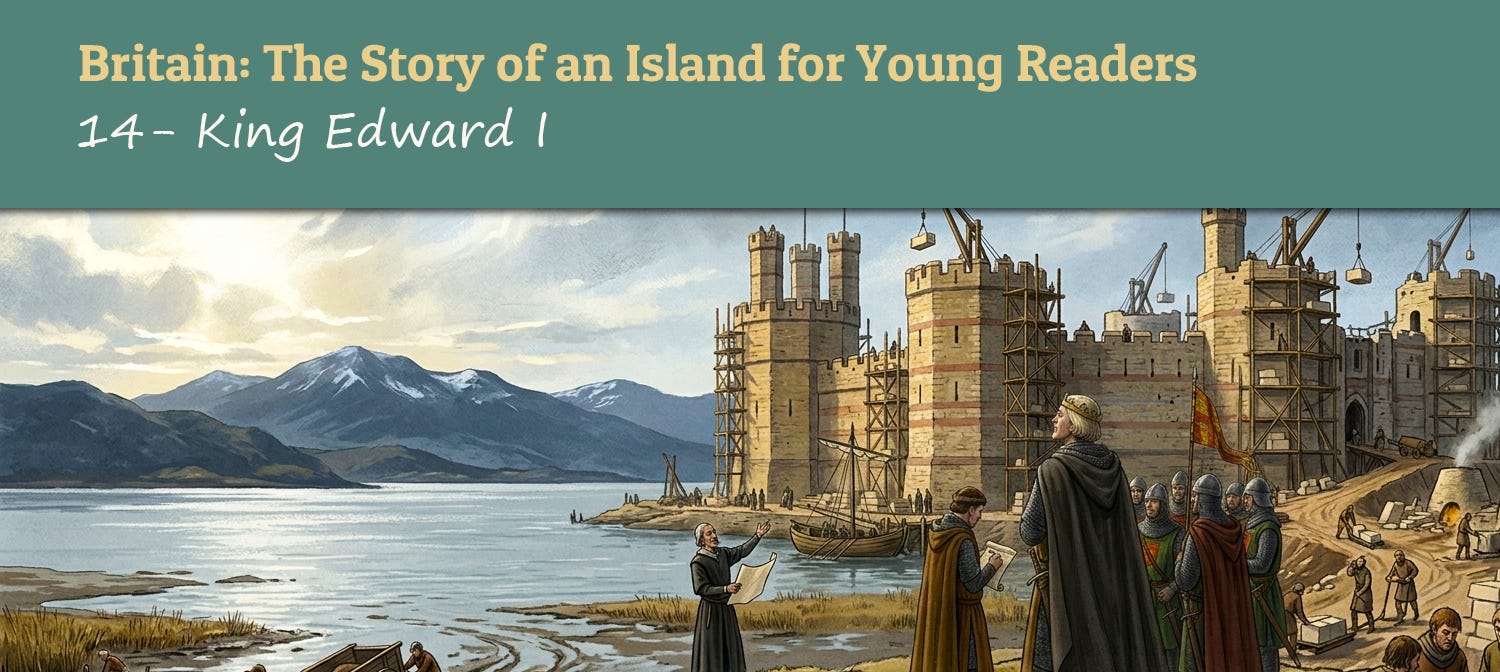
When the fighting was done, King Edward built castles. Not the simple motte-and-bailey fortifications of the early Normans, but enormous stone fortresses with towered walls and sea-supplied garrisons, designed to hold down a conquered people permanently. Caernarfon, with its banded masonry and eagle-topped towers. Conwy, perched above its river. Harlech, on its rocky outcrop. Beaumaris, the last and most perfectly symmetrical castle of them all. They ringed the Welsh heartland like a chain of iron, and several of them still stand, more than seven hundred years later, and they are amongst the most formidable military buildings in Europe.
At Caernarfon, in 1284, the King’s son Edward was born, and he was proclaimed the first English Prince of Wales, a title that has been given to the heir to the English throne ever since.
But something else came out of the Welsh wars, something that would change the nature of warfare itself. In South Wales, the English encountered the longbow.
The Welsh had been using it for generations. It was drawn not to the chest, as other archers drew their shorter bows, but all the way back to the ear, unleashing an arrow with tremendous force over a great distance. One of the English Marcher lords left a record of what the weapon could do. A Welsh arrow, he wrote, had pierced a knight’s mailed shirt, then his mailed breeches, then his thigh, then the wooden frame of his saddle, and finally buried itself deep in the flank of his horse. A single arrow, through five layers of protection.
Nothing like it had been seen in warfare since the fall of Rome. For the first time, ordinary foot soldiers possessed a weapon that could punch through the armour of mounted knights. King Edward recognised what he was looking at – a powerful new weapon. He recruited Welsh longbowmen into his own armies and began training English archers in the same technique. The longbow would not reach its full devastating glory until the next century, at the great battles of Crécy and Poitiers. But it was King Edward who understood its power first, and it was King Edward who made it an English weapon.
Then came Scotland, and the tragedy that would define the rest of his reign.
For as long as anyone could remember, England and Scotland had lived in peace. The border was quiet. The two kingdoms traded freely, and their royal families were linked by marriage and alliance. It was the longest unbroken peace the island had known, but in in March 1286, it ended with a stumble in the dark.
Alexander III, King of Scotland, had dined that evening at Edinburgh Castle. Against the advice of his companions, who warned him that the night was wild, he insisted on riding home to his young wife at Kinghorn, across the Firth of Forth. The storm was fierce, and somewhere along the cliff path on the Fife coast, in the wind and the blackness, his horse missed its footing. The King’s body was found on the beach the next morning, his neck broken.
King Alexander left behind a single heir: his granddaughter Margaret, a little girl of three, known as the Maid of Norway because her mother had married the Norwegian king.
A bright and hopeful idea took shape. Margaret would inherit the Scottish throne, and she would marry King Edward’s son, the young Prince of Wales. The two kingdoms would be joined in peace, by marriage rather than by war, and the ancient quarrel between England and Scotland would be laid to rest. Almost everyone agreed it was a fine plan. The Scottish lords accepted it, King Edward accepted it, and the Pope approved of it.
Margaret, the Maid of Norway set sail in 1290. She was seven years old, but she never reached Scotland. Somewhere on that crossing, in rough autumn seas, the little girl died, and the dream of a peaceful union between Scotland and England died with her.
Scotland was left with no clear heir, and the question of who should be king threatened to tear the country apart. From a crowd of claimants, two men stood out: John Balliol and Robert Bruce. Balliol had the stronger legal claim through primogeniture – firstborn child inheritance. And Rober Bruce argued that he was closer in blood to the old royal line. Neither man would yield, and behind each stood a powerful faction of Scottish lords ready to fight for their candidate.
King Edward stepped forward. His reputation as a lawmaker was unmatched in Europe. He had already arbitrated a succession dispute between Aragon and Anjou, and the Scots, seeing no better option than civil war, agreed to accept his judgement. King Edward consented, but only after extracting a formal acknowledgement that the English crown held overlordship of Scotland. The Scots, in their desperation, agreed.
In 1292, King Edward pronounced in favour of John Balliol. It was the right decision. Later scholars have not seriously disputed it, but unfortunately King Edward had not settled the issue of the Scottish crown, he had inadvertently made matters worse.
Now King John Balliol owed his crown to King Edward, but Edward treated him not as a fellow king but as a servant, summoning him to English courts, overriding Scottish law, and making plain at every turn that Scotland’s independence was finished. The Scottish lords were furious, and appointed a council of twelve to govern alongside King John Balliol and protect their country’s rights.
And then Scotland made the move that brought King Edwards fury upon them. Faced with an impossible position, the Scots allied themselves with France, England’s great rival, whose king Philip the Fair was already at war with King Edward over the English territories in Gascony.
King Edward was enraged, and he summoned King Balliol to answer for it, but the Scottish lords refused to let their king go, and from that moment, the talking was over.
King Edward struck Berwick first.
Berwick-upon-Tweed was, in 1296, one of the great trading towns of northern Europe. It was rich, busy, and prosperous, and it was entirely unprepared for what was fell upon it. A century of peace had left it without proper defences. When King Edward’s army appeared before its walls, the townspeople threw up wooden palisades and grabbed whatever weapons they could find, but it was not enough.
The English swept through the makeshift defences within hours, and what followed was a slaughter that shocked even that brutal medieval age. Thousands of men, women, and children were killed, and the most determined resistance came from only thirty Flemish merchants who had barricaded themselves inside their trading depot, a building called the Red Hall. The merchants fought until the building was burned down around them.
Berwick, which that morning had been one of the busiest ports in Britain, was destroyed. It never recovered, and the prosperous medieval town became the quiet border settlement that exists today.
And then, with the blood barely dry, King Edward changed his manner entirely. To every Scottish town and lord that now came forward to submit, he offered forgiveness, easy terms, and gentle treatment. Perth surrendered. Stirling surrendered. Edinburgh surrendered. King John Balliol gave up his throne and English officials moved in. English law replaced Scottish custom. The conquest of Sccotland, King Edward believed, was complete.
He was wrong.
Scotland’s nobles had failed, and its king had been humiliated, but the people of Scotland had not surrendered. They had watched the slaughter at Berwick. They had watched their lords give in. And somewhere underneath, out of sight, in the forests and glens of the south-west, where the English writ did not run and the wild country offered shelter, something else was stirring. A figure was rising, an outlaw knight with a burning hatred of English rule and a gift for war that nobody had yet suspected.
His name was William Wallace.