

In May 1297, in the small settlement of Lanark in the Scottish lowlands, a young man walked into the house of the English sheriff and killed him, but nobody knows exactly why. Later stories said it was revenge, because the sheriff had murdered a woman the young man loved. Now the story may be true, or it may have been invented afterwards by people who wanted a reason for what came next, which was an uprising.
The reason for the uprising? Scotland’s lords had surrendered, but nobody had thought to ask the Scottish people what they thought about surrendering sovereignty.
Within weeks, men were coming down out of the hills, out of the woods, and the market towns of southern Scotland to join forces with this young man. Within months, the English administration of Scotland had begun to come apart, and inside a year, King Edward I had been forced to abandon his war in France and come north to deal with a man he had never heard of. That young man was William Wallace.
And to understand why the uprising happened, you have to understand what had happened in Scotland in the previous year.
In 1296, King Edward I of England had marched north and taken the country apart. He had destroyed the great trading town of Berwick and killed thousands of its people. He then went on to defeat the Scottish army at Dunbar, and had forced King John Balliol to surrender his crown. Then he had stripped King Ballioil of his royal arms in a humiliating public ceremony that earned the deposed king the mocking nickname ‘Toom Tabard’, the empty coat.
After that, King Edward I started to organise Scotland. He replaced Scottish sheriffs with English ones. English garrisons occupied Scottish castles, and English clerks began the work of assessment and taxation. All Scottish landowners were required to sign a document acknowledging King Edward I as their rightful king, and most of them signed it. Then King Edward stole the Stone of Destiny, the ancient stone on which Scottish kings had been crowned for centuries, from the village of Scone, and took it back to Westminster Abbey. He then had a chair built to hold it, so he could sit on top of it
It was, on paper, a complete conquest, and King Edward had every reason to believe the Scottish matter was closed. He went home, appointed officials to run Scotland and England, and then turned his attention to his war with France.
But a conquest is only complete when the conquered agree and cooperate. The Scottish people didn’t agree and they were not about to cooperate, even though the Scottish lords and nobles had given in, and now had estates on both sides of the border, along with family connections in England, and they had a great deal to lose. But the Scottish people had no estates to lose. All they had was the Scottish land under their feet and an English tax to pay.
So when the uprising came, it did not come from the council chambers or the Scottish lords and nobles. It came out of the farms and the small settlements, down from the mountains, and out of the forests, and the man who lead it came from the same place, which is probably why so little is known about him.
Almost everything we know about William Wallace comes to us either through chroniclers who hated him or through poets who loved him, and neither group was very concerned with accuracy.
William Wallace was probably born around 1270, somewhere in the west of Scotland. His family were minor gentry, one of the lower rungs of the knightly classes, which meant he had been trained to fight and to ride but he had no wealth, no title, and no political importance. He was not a lord, and was not summoned to councils. When the great men of Scotland gathered to argue about the succession, nobody sent for William Wallace.
By all accounts he was physically a very big man, but this may have been an exaggeration of the chroniclers and poets. What is not in doubt is that he was a soldier of extraordinary ability, and even though he had never been in command of anyone until the uprising, when he was handed an army of untrained farmers and townsmen, he knew exactly how to lead them.
He was also, from the very beginning, uninterested in compromise of any kind.
This was the thing that made him different, and dangerous. Scotland’s nobles were negotiators. They had spent generations balancing their loyalties, taking oaths and finding reasons to break them, playing England and Scotland against one another to their own advantage. William Wallace did not negotiate. His goal was simple, the English out of Scotland – permanently, and at no point in his life did he ever indicate that he would settle for anything less.
And he was not alone. In the north, at almost the same moment, another uprising had begun, lead by Andrew Moray.
Andrew Moray was a young nobleman from Moray in the far north-east, the son of a Scottish knight who had been captured at Dunbar and was rotting in an English prison. Andrew had been captured too, but he had escaped. He went home, raised his father’s tenants in rebellion, and began systematically taking English-held castles across the north, one after another, in a campaign of remarkable skill.
By late summer of 1297 the two uprisings had joined together. Moray from the north. Wallace from the south. Together they had something that had not existed a year earlier, a Scottish army.
The English response was slow and contemptuous, which is the response that experienced armies usually give to peasant uprisings, and it is usually correct. Peasant uprisings are typically crushed when the professionals arrive, and the mob discovers that courage is not the same as training, and it always ends badly.
That is what everyone expected to happen at the Scottish town of Stirling.
In the east of Scotland, the sea cuts deep into the country, the Firth of Forth, a great tidal barrier splitting the lowlands of the south from the north. To get an army across it, you had to go inland, right to the head of the estuary, where the river narrowed enough to be bridged. That crossing was at the town of Stirling, watched over by its castle on its volcanic crag. Whoever held Stirling controlled the road north. There was no other way through to the north.
In September 1297, an English army came up the road to take Stirling.
It was commanded by John de Warenne, Earl of Surrey, an experienced soldier who had beaten the Scots comprehensively at Dunbar the year before and had no reason to expect a different outcome this time. With him was Hugh de Cressingham, the Treasurer of the English administration in Scotland, a heavy, unpopular man whose job was collecting the money and who was anxious that this campaign should not cost more of it than necessary.
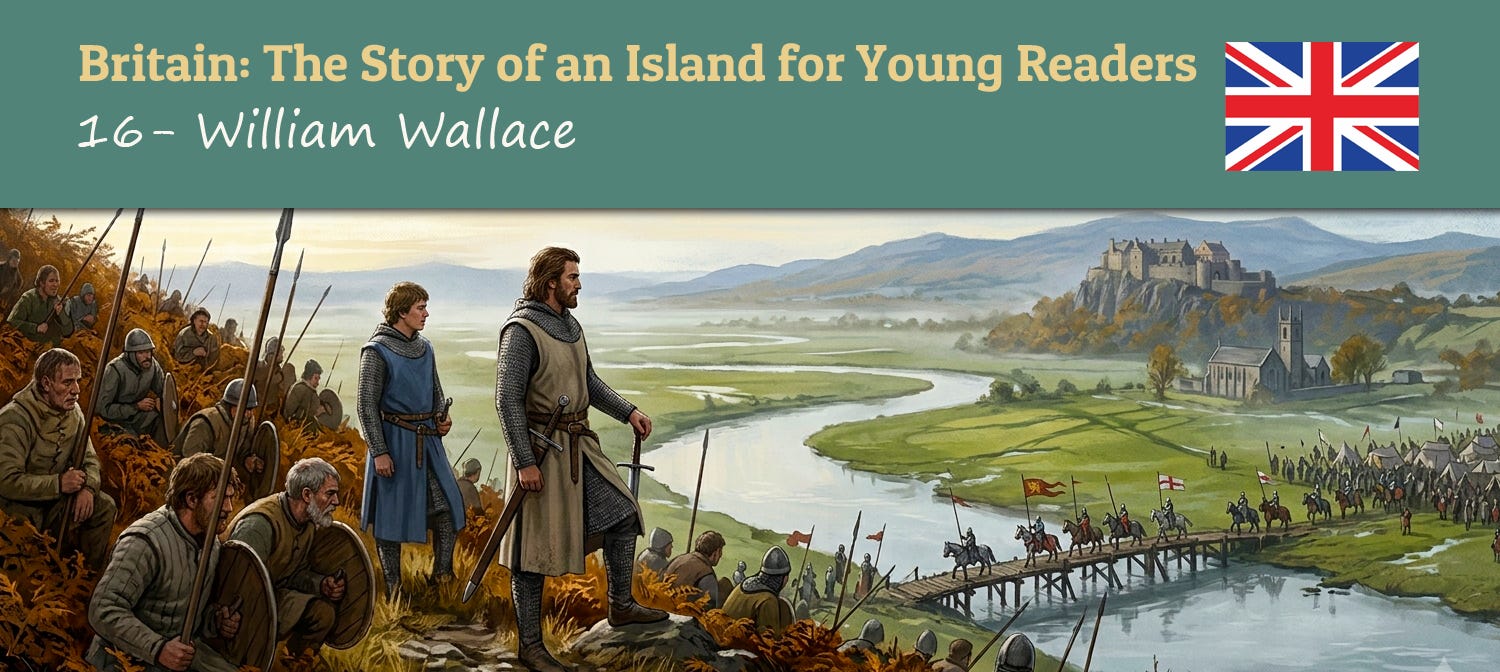
Wallace and Moray were watching and waiting for the English on the far bank, on the Abbey Craig hill.
The bridge across the river at Stirling was made of wood, and it was narrow. Two horsemen could cross it side by side, but no more. Beyond it, on the northern bank, the ground was a loop of soft flat marshy ground enclosed by a bend in the river. It was a place where an army coming over the bridge would arrive slowly, in small numbers, with water on three sides and nowhere to go.
At least one man in the English camp could see this perfectly clearly. A Scottish knight in English service, Sir Richard Lundie. He told John de Warenne plainly what would happen. It would take eleven hours, he said, to move the whole army across that bridge. What did the Earl imagine the Scots would be doing during those eleven hours? He knew of a ford further upstream where sixty horsemen could cross abreast. Give him a force, and he would go around and come at the Scottish position from the flank.
It was excellent advice, but Hugh de Cressingham refused it. Every delay cost money, and the Treasurer had had enough of the expense. The army would cross the bridge at Stirling.
So they began to cross, two by two, and William Wallace stood on the slope above and watched them come.
Wallace was not in a hurry. This is the thing that is genuinely remarkable about Stirling Bridge, and the thing that tells you Wallace was not simply a brave man with a grievance, he was clever and calculating. He let the English army come. He let the vanguard cross and form up on the meadow below him. He let more follow. He waited while the column crawled over the narrow timbers and spread out on ground it could not get off, and he kept waiting until precisely the moment when there were enough Englishmen across the bridge to be worth destroying and not yet enough to fight back.
At the right moment he sent his spearmen down the hill to take the bridgehead.
What happened next was not a battle. It was an annihilation. The Scots drove straight for the northern end of the bridge and seized it, and the moment they held it the trap closed. The English on the north bank were cut off from their own army. They could not retreat, because the way back was in Scottish hands. They could not be reinforced, because nothing could get across. They could not manoeuvre, because the river was behind them and the ground was soft and marshy under the horses.
Hugh de Cressingham was among them. He was killed in the press on the meadow, and the Scots, who hated him more than they hated any other Englishman in Scotland, did something to his body afterwards that is impossible to justify. They flayed the skin from his corpse and legend says that William Wallace took a strip and made it into a belt for his sword.
That detail is worth pausing on, because it tells you what kind of war this had become. It was a war without limits, in which ordinary decencies had stopped applying on either side, and it would get worse before it got better.
John de Warenne, watching from the south bank, could do nothing. When the slaughter was over he ordered the bridge destroyed and rode for the border, and he did not stop until he reached the town of Berwick. Behind him, the English garrisons across Scotland began to fall one by one. By the end of the year the English held almost nothing north of the river Tweed.
After the battle of Stirling, Andrew Moray was carried from the field badly wounded, and he died some weeks later, and Scotland lost the other half of its command at the very moment of its greatest victory, which left William Wallace entirely in charge.
He was knighted, probably by one of the Scottish earls, and appointed Guardian of Scotland. It is worth stopping to appreciate how extraordinary this was. A man of no rank, no lands and no name had been made ruler of a kingdom, entirely on the strength of having won a battle nobody thought he could win. There is no other example quite like it in medieval British history.
William Wallace governed in the name of King John Balliol, the deposed king, who was at that point a prisoner in England and had no prospect of ever returning. Wallace never claimed the crown for himself, never showed the slightest interest in it, and never wavered on this point. He was fighting for his country and not to enrich himself.
He then did the thing that guaranteed King Edward I would come for him personally.
In the winter of 1297, Wallace led the Scottish army south across the border into Northumberland and Cumberland, and burned everything he found. Mills, barns, villages, churches. A chronicler writing at the time recorded that between Newcastle and Carlisle the church services simply stopped, because the priests had gone and so had almost everybody else. It was a deliberate, systematic devastation of the northern English counties, retaliation for what had been done to Berwick and to Scotland, and it was carried out with a thoroughness that emptied whole districts. Refugees fled south. Fields went unsown, and the north of England was still recovering from it years afterwards.
Wallace was not a gentle man and this was not a gentle war, and it does no service to him or to the reader to pretend otherwise. He did to England something close to what England had done to Scotland, and he did it because he believed it was the only language King Edward I understood.
He may have been right, as it certainly got King Edward’s attention.
The King came north in the summer of 1298 with an army unlike anything Scotland had ever faced before. It had one purpose, to utterly destroy the Scottish army.
King Edward had learned something during his wars in Wales. He had seen what massed archery could do, and he had spent years recruiting and training longbowmen, and he brought them with him now in numbers no Scottish commander had ever faced. He also brought the full heavy cavalry of England, thousands of armoured knights. He had assembled the most expensive and formidable striking force in Europe.
Wallace tried to avoid him. He knew perfectly well that his army could not beat King Edward’s in open battle, and his strategy was the correct one for a weaker force facing a stronger, which was to withdraw, burn the country behind him, and let hunger do the work.
It nearly succeeded. King Edward’s army, marching through a deliberately stripped landscape, came close to starving. The supply ships did not arrive, and there was nothing left in the fields to take, because the Scots had already taken it. And when the King gave his Welsh infantry wine instead of the food he did not have, they drank it and then fought a pitched brawl with his English troops in which men were killed. The Welsh threatened to change sides altogether. King Edward, who was not easily rattled, said he would be glad if they did, since he could then beat the whole lot of them at once.
But he was beaten, and he knew it, so he gave the order to fall back towards Edinburgh.
Then two Scottish earls rode into his camp, betraying Wallace and telling King Edward where he was, twenty miles away, near Falkirk, and everything changed.
Now Wallace had to fight. Not because he wanted to, but because he no longer had a choice. His army was infantry. Edward’s was cavalry. Men on foot cannot outrun men on horses, and the moment the English knew where the Scots were camped, withdrawing was no longer an option, as they would simply be ridden down and crushed in the open.
So William Wallace chose his ground instead. He drew up his men on rising ground with a wood behind them and boggy ground in front, and he arranged his spearmen in the formation Scotland had made its own, the schiltron.
A schiltron was a great ring of men, hundreds strong, packed shoulder to shoulder and bristling outwards with twelve-foot spears in every direction. Against cavalry it was very nearly perfect. A horse will not run onto a wall of spear points, whatever its rider wants, and a schiltron that held its nerve simply could not be broken by a mounted charge. It was a hedgehog made of men.
It had one weakness, and Edward found it inside an hour.
The English knights charged first, and the schiltrons stopped them exactly as they were designed to. The cavalry came on in successive waves, hit the spear points, and were flung back with heavy losses, and for a while it looked as though Wallace’s formations might hold all day.
Then Edward pulled his cavalry back and brought up the archers.
A schiltron cannot move quickly and cannot spread out. It is, from the point of view of an archer, an enormous stationary target packed so tightly that every arrow that falls into it hits somebody. Edward’s longbowmen were placed in the gaps between his horsemen and told to shoot into particular points in the Scottish schiltrons. They did so, and for as long as it took.
Wallace and his army had nothing to fight back with. The Scots had few archers of their own and almost no cavalry, so there was no way to drive the bowmen off and no way to close the distance. The schiltrons could only stand and endure it. And they did stand, for a long time, while the arrows came down and the rings of men grew thinner and thinner, until in places there were more dead and wounded men than living ones. Gaps began to open in the wall of spears.
Then the English knights charged through the gaps, and it was all over.
The Scottish army broke and ran for the woods, but thousands were killed in the pursuit. William Wallace escaped, but everything he had built at Stirling Bridge was destroyed in an afternoon, and the reputation that had carried him to the Guardianship went with it. Within months he had resigned, or been removed, and the Scottish nobles took the leadership back into their own hands.
What Wallace did for the next seven years is largely unknown. It is thought he went abroad for some of it. There is good evidence that he travelled to France and possibly to Rome, trying to win diplomatic support for Scotland from the French king and the Pope, which suggests a man with a considerably better grasp of the wider world than the wild highland outlaw of later legend suggests.
And he came back, and he fought on. Not as a commander of armies now, but in the older, harder way, in small bands ambushing and raiding and vanishing, while the war ground on year after year. The Scots called it a war in which every winter undid every summer’s work. King Edward would come north in the campaigning season, take castles, receive submissions, and go home. The moment he left, it would all come apart again.
Most of the great men of Scotland made their peace with King Edward during those years, at one time or another. Robert Bruce did. John Comyn did. They submitted, were pardoned, and rebelled again when it suited them, which was the normal conduct of medieval politics and carried no particular shame.
But William Wallace never did. In seven years of defeat and exile and hiding, in a cause that any sensible man could see was lost, he never once submitted. It is the single most important fact about him.
Eventually he was betrayed, near Glasgow, in August 1305, by a Scottish knight in English service. He was captured and taken south in chains.
He was tried in Westminster Hall, in London, and it was not a trial in any sense we would recognise.
William Wallace was charged with treason, and Wallace made the only defence available to him. He could not be a traitor to King Edward, he said, because he had never sworn allegiance to him. He had never signed the roll, he had never taken the oath.
The court did not engage with the argument, because the verdict had been decided before Wallace arrived. He was crowned with a wreath of oak leaves in mockery, on the grounds that he had called himself king of outlaws, and condemned.
William Wallace was then dragged through the streets of London to Smithfield and put to death that same day, on the twenty-third of August 1305. It was a terrible death, a punishment reserved for traitors. It was designed to be as prolonged and as public and as humiliating as human ingenuity could arrange, and it was carried out in front of a crowd. He was hanged, drawn and quartered.
Afterwards his body was cut into four parts and sent to Newcastle, Berwick, Stirling and Perth, to be displayed in each. His head was set on a spike on London Bridge.
The message was crystal clear. King Edward wanted Scotland to see what happened to men who would not submit to his rule, but it did not work. What King Edward had actually done was take a defeated guerrilla leader, a man the Scottish nobility had quietly discarded, and handed him back to Scotland as a martyr. The pieces of him nailed up in four Scottish towns did not serve as a warning, all they did was galvanise an already angry people.
William Wallace had lost every battle but one, and he had held power for less than a year, and he died beaten, betrayed, and alone, and for a cause he refused to abandon, but he had shown the Scottish people something that its lords and nobles, with all their lands and their titles had never managed to show them. He had shown them the English army could be beaten. He had shown them that a country did not have to consent to its own conquest simply because the people at the top had already agreed to it, and the revolution William Wallace started did not end with his execution at Smithfield, it continued under the leadership of Robert the Bruce.