

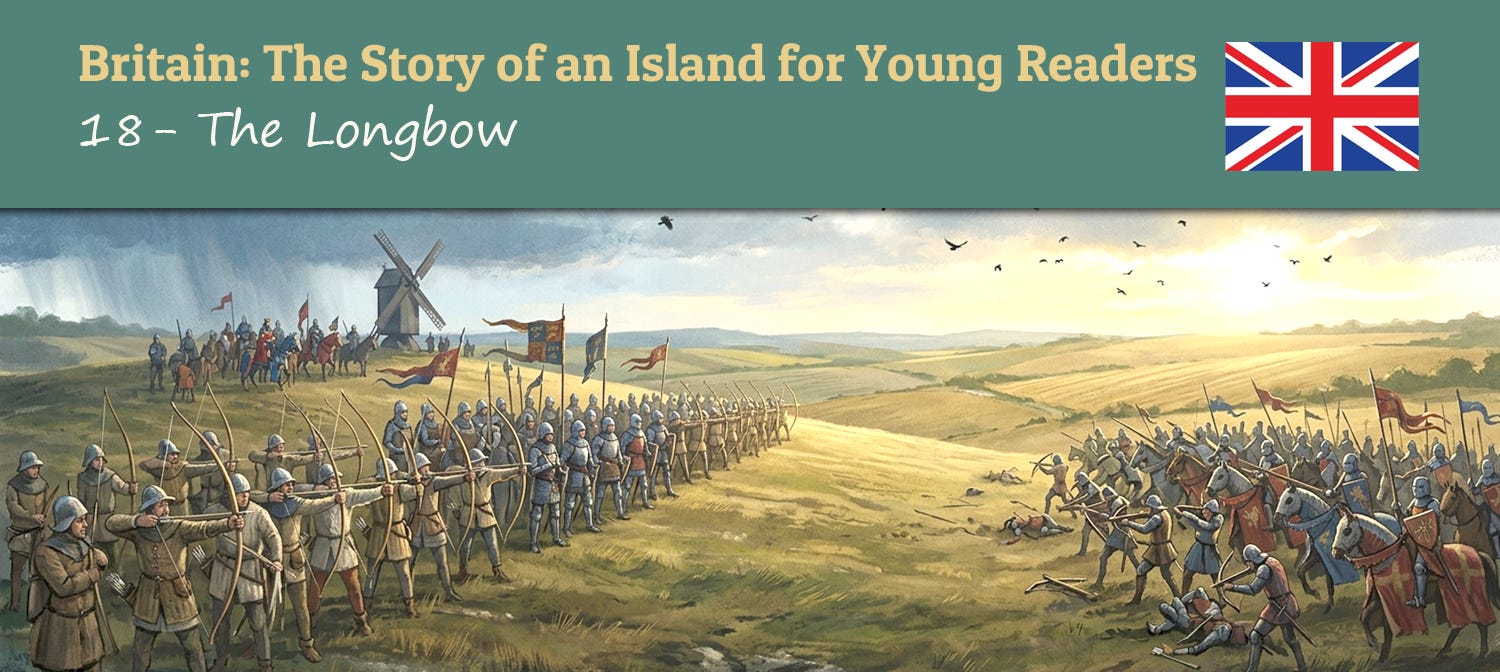
Behind a church, on a Sunday afternoon, a man picked up a bow that was taller than he was and went off to practise. The bow was a longbow.
It was made from a single piece of yew, and it was extremely powerful. The arrows it fired were a yard long, and tipped with a slim iron point, and made for one purpose only – to go through armour.
To bend this incredibly powerful bow the archer did not pull with his arm. He laid his whole body into it, pushing with the left hand and hauling with the right, and the effort came up through his back and his shoulders. The men who did this could do it time and time again, perhaps ten times in a minute and for as long as their arrows lasted.
How did these men become strong enough to draw those bows? The law said that a free man of a certain amount of property must keep a bow and arrows in his house, and be ready to bring and use them when the king called, which meant he had to know how to shoot, and be strong enough to do so. So archery practice became a Sunday afternoon pastime. In villages all over England, in fields behind churchyards and wherever else there was room, generation after generation of ordinary men grew crooked shoulders and thickened arm bones and became incredibly strong and expert in the use of the longbow.
This was England in the 1330s. A country that had spent fifty years fighting in the mountains of Wales and the hills of Scotland, whilst in France, the finest heavy cavalry and mounted knights in Europe had ruled every battlefield they had ridden onto for three hundred years, and who regarded foot soldiers as the lowest sort of soldier, but they had never yet encountered the English longbow.
Yet what the English archers could do was not a secret. News of them had crossed the water to France again and again, but it made no difference because the men who ran France were knights, and a knight thought that battles were decided by the charge.
The king who would prove otherwise was a complete surprise. His father, King Edward the Second, had been a disaster: beaten by the Scots at Bannockburn, ruled by his favourites, despised by his barons, and finally pushed off the throne by his own wife. Queen Isabella came back from France with an army and a lover, a Marcher lord named Roger Mortimer, and between them they took the crown and gave it to her fourteen year old son. In September 1327 the old king died in Berkeley Castle. He was almost certainly murdered, but nothing has ever proved.
For three years Queen Isabella and Roger Mortimer ruled England in the boy’s name. However, Scotland was a problem. They could not beat the Scots, so they paid them instead, recognising Robert Bruce as king north of the Tweed in a treaty people were calling shameful before the ink was dry. Effectively they gave Scotland away.
In October 1330 the young King Edward took his kingdom back. Nottingham Castle sits on rock, and under the rock there is a passage that comes up inside. A small band of men went up it in the dark and took Roger Mortimer in his room, and he was hanged in November.
King Edward the Third was seventeen, and what he wanted was everything his grandfather had wanted. King Edward the First had hammered at Scotland for a decade, and his grandson picked that hammer back up to continue.
He did it carefully, and at first through somebody else. Robert Bruce had died in 1329 leaving a son of five, and the Scots who had lost when Bruce won had been living in England ever since, calling themselves the disinherited and asking anybody who would listen for their lands back. They were listened to by Edward Balliol.
In August 1332 he landed in Fife with fifteen hundred men and marched on Perth, and the Scottish army that came to meet him was ten times that size. Its commander, the Earl of Mar, had been made Regent nine days earlier and was so certain of winning that he set no proper watch, and in the night the English crossed the river below him unopposed. In the morning the Scots army meet the English at Dupplin Moor. The English archers shot into them from both flanks, and the army could not go forward and could not get out or go back. Mar was killed and Balliol was crowned at Scone in September. However, before the year was out, he was surprised at Annan and chased back over the border.
In 1333 King Edward III came north himself to besiege Berwick, the Scots came down to relieve it, and the two armies met at Halidon Hill.
Bannockburn, nineteen years earlier, had been a disaster for the English. The Scots had stood in their schiltrons, tight blocks of men with long spears, hedgehogs of iron that no horse would go near, and the English had thrown cavalry at them until there was nothing left to throw. At Halidon the schiltrons formed up again and came on across boggy ground and up a slope, but this time the archers were placed where they could shoot into them, and they did. The blocks fell apart before they ever reached the English line.
In Scotland it was noticed. In France it was filed away as something that had happened a long way off, to people who did not matter.
Then King Edward pressed too hard, as he often did, and made Balliol hand over the eight counties of south-eastern Scotland, which finished Balliol in the eyes of every Scot alive and sent the followers of Bruce across the sea to ask France for help. France gave it. That, more than any claim to any throne, is what turned England and France against each other.
Although there was already a claim to the French throne. The King of France had died in 1328 without a son, and King Edward’s mother was a French king’s daughter, so he could argue a thin case that the crown could be allowed to pass through a woman, and he would raise the case when it was useful and drop it when it wasn’t.
A claim a king picks up and puts down a claim is not the reason he goes to war. The real reason was wool. English wool was the best in Europe and it went across the Channel to the weaving towns of Flanders, which depended on it for their living. But the lords who ruled those towns looked to France, and it was the lords Edward meant to hurt. In 1336 he stopped the wool. All of it.
He hurt the towns instead. Looms stood still, weavers had no work and no bread, and the townspeople rose against their lords. Within two years a merchant of Ghent named Jacob van Artevelde was governing much of Flanders in all but name, and the Flemish, thrown into a fight with France and surrounded by enemies, looked across the water for a friend. England was delighted to be asked.
So when King Edward asked Parliament for money he did not have to argue. The wool merchants wanted the war because their trade depended on it, and the knights of the shires wanted it because there was profit and ransom in it. Parliament said yes.
In May 1337 King Philip declared King Edward’s lands in Gascony forfeit, that autumn King Edward renounced his homage, and the war began. No treaty ever ended it. English kings went on calling themselves kings of France, on paper, until the first day of 1801.
King Philip’s answer was the sea. Stop the English crossing and there would be no war on French soil. He gathered every ship in France, hired galleys from Genoa, and in Normandy men began talking cheerfully about doing to England what William the Conqueror had done. The fleets met in June 1340 in the crowded harbour of Sluys. Sea fighting then was land fighting on unsteady ground: ships lashed together, grappled and boarded, nine hours of it, watched from the shore by Flemish townsmen who made sure that any Frenchman who swam for it did not get far. Jean Froissart, the chronicler who wrote down more of this war than anyone, said battles at sea are worse than battles on land because there is nowhere to run.
The French admirals had been told they would lose their heads if the English got across. They fought well and were beaten anyway, and the Channel belonged to England.
What followed was a lesson in the difference between winning a battle and winning a war. King Edward landed, joined his allies, and besieged the walled city of Tournai. He could not get in. The city held, and while it held, everything behind him came apart. The great tax he had raised on wool brought in a fraction of what he had promised his allies, and men who are not paid stop being allies. King Philip brought his army up in September, looked at the situation, and refused to fight, because he could see that King Edward’s coalition was falling to pieces without any help from him.
Unexpectedly, the fighting stopped with a family visit. King Edward’s mother-in-law, Jeanne of Valois, was King Philip’s sister, and she was a nun. She came out of her convent, went to her brother and then to her son-in-law in his tent, and asked them both to stop. On the twenty-fifth of September 1340 they signed a truce and everybody went home. The first invasion of France had achieved nothing at all.
It took six years before King Edward could try again, and the six years went on finding the money, which came, as English money did, out of sheep. Every sack of wool that left the country was taxed on its way through the port. Kinng Edward revived a system called the Staple to control it, in which a favoured group of merchants held the sole right to export through one town of his choosing. He taxed what passed through and they lent him money in return for being favoured, which Parliament disliked intensely, because a king with his own income is a king who does not need to ask.
However, in the spring of 1346 a French army came down into Gascony and laid siege to the town of Aiguillon, and the English commander there was writing home for help. Parliament agreed to the raising of money for the men. But the army that gathered was something new: not a feudal levy, the old system where lords owed the king so many days of service by the men on their land. This was a paid force of chosen men. Twenty-four hundred cavalry, thousands of archers, and a body of other foot soldiers boarded ships to cross the Channel, and on the twelfth of July 1346 the army came ashore, unopposed, at St Vaast on the Normandy coast.
Whether King Edward ever seriously meant to take Paris is argued about to this day, and there is a good case that he had chosen Normandy in advance precisely because it would force King Philip to come out and fight him somewhere in the north. What is certain is that he went east and he went fast. Caen fell in July, with the army burning its way through the Norman countryside until it was close enough for people on the walls of Paris to see the smoke rising up from the villages.
And then the whole strength of France came upon King Edward. An army perhaps three times the size of Edward’s, every knight in the kingdom, gathering north of the city. King Philip sent a message inviting the King of England to choose which bank of the river he would like to be destroyed on.
King Edward turned and ran for the coast. Sixty miles in four days, with the French army marching on a line beside him, and keeping between him and the crossings.
Ahead lay the river Somme. It is a name that would become well known again, but for different reasons, and in 1916. In 1346 the river ran out to the sea through wide marshes, crossable only at bridges and causeways, and every bridge and causeway was broken or held by the French. Four times the English tried to cross and four times they were turned back. Part of the French army reached Amiens behind them. Now there was the river in front, the sea on the left, and the French army closing in on the right.
And then the English were saved by a prisoner. Somewhere in the countryside the English army had picked up a Frenchman who knew the coast, and he told them, in exchange for his freedom, about a ford near the river’s mouth called Blanchetaque: a long shallow crossing over hard sand that could be used for a few hours at low tide, but at no other time.
The next day the English army was on the move before dawn and they reached the ford at sunrise, but the tide was in, and they had to wait for the tide to go out.
When the water finally dropped, King Edward ordered his men to cross. On the opposite side, three and a half thousand Frenchmen held the far bank, and the knights of Picardy came out to meet the English in the shallows in chain mail, which is a terrible thing to be wearing when you fall over in water. Also, from the French side, Genoese crossbowmen shot into the English column as it tried to cross, holding it up. But then on the English bank, the archers, armed with longbows, came into range and shot the crossbowmen off the bank. French horsemen came down into the water to drive the archers back, and English knights waded up through their own men to meet them, and for a while the fighting was in the river itself, in a foot of water and moving sand, with more English crossing behind all the time. Then the French broke and ran for Abbeville, and by the time King Philip arrived the tide was in again and the English army were across.
Up to the ford, King Edward had been running, but once he was on the far bank he stopped running. He regrouped and rested and fed his army. Then the English army marched through the forest of Crécy and assembled on a slope, waiting for King Philip and the French army to come to them.
The next morning, on Saturday the twenty-sixth of August 1346, King Edward drew up about eleven thousand men on the open downland outside the village of Crécy. He ensured that the wood was behind them, so that if the battle went badly there was somewhere for them to make a last stand. The English king then rode along the line on a small horse with a white stick in his hand, and wearing crimson and gold over his armour, and he asked his men to look after his honour. Then he told them all to sit down, eat and rest so they would be fresh for when the French arrived.
Then the French army arrived, but it was tired.
King Philip had begun the day by sending out four knights to see what the English were doing. When they came back and told him the English had stopped running and meant to fight, he gave the order to halt, close up the army, and attack in the morning.
But nobody obeyed the order. The roads from Abbeville were thick with men who had been chasing King Edward and his army for weeks and they were not going to be told to wait another night in case he slipped away again. Those at the back pushed the ones in front, and the ones in front could not stop, and the whole enormous army poured up to within sight of the English lines and stood there in the late afternoon, tired, unfed and in disarray.
At the head of the French were the Genoese crossbowmen. The crossbow is a fine weapon. It punches harder than a longbow, it can be aimed by a man with little training, but it is slow, because after every shot the string must be hauled back with a hook or a windlass. Crossbowmen normally sheltered behind a pavise, a tall shield propped on the ground whilst they reloaded, but the shields were somewhere in the baggage train, miles back down the road.
Not unreasonably, the Genoese said that they had marched all day under the weight of their weapons and were tired and in no state to fight, but the Count of Alençon, the French king’s brother, who had made the journey on a horse, said something cutting about hiring scoundrels who fall away the moment there is work to be done, and sent them forward.
As they threaded through the horsemen the sky went dark and a short heavy rainstorm came over, soaking the crossbow strings, which, now wet, stretched. The English archers, so the story goes, had taken their strings off and put them under their hats to keep them dry. When the storm cleared, the sun, now low in the sky, was at the backs of the English and in the faces of the French and Genoese crossbowmen.
The crossbowmen shouted, advanced, shouted again, advanced again, and then shot. Their bolts fell short.
The English lines, however, didn’t make a sound. On the army’s flanks six to seven thousand archers took one step forward, drew their longbows and let fly a storm of arrows. They did not fall short.
In minutes thousands of Genoese crossbowmen were killed, and the survivors turned and ran back into the ranks of French cavalry waiting behind them. King Philip, watching his own front line dissolve, shouted at his knights to kill the scoundrels who were blocking the road.
So the flower of French chivalry rode down its own crossbowmen with swords, and in doing so came inside the deadly range of the English archers, and so another storm of arrows fell on them.
After that it stopped being a battle. Squadron after squadron of men came up into the arrow storm. Horses screamed and reared with arrows in them, men in mail going down under the flailing hooves, and behind them more men riding forward into the same place because they could not see and would not stop. Welsh and Cornish foot soldiers slipped out between the ranks of archers with long knives and went among the fallen, killing earls and barons and knights on the ground. King Edward was furious about it afterwards. A live nobleman was worth a fortune in ransom and a dead one was worth nothing, and as far as he was concerned, a great deal of money was thrown away in the mud that evening.
Among the dead was the King of Bohemia, who was blind. He had come to fight for King Philip, and when he understood how the day was going he asked his knights to tie their bridles to his so that he could strike one blow with his own hand. They did it. The next morning the bodies were found still tied together.
The French charges went on after dark, men groping forward through the night to strike their blow, and being killed for it, because the English were in no mood to take prisoners whatever their king wanted. When the fighting finally stopped, King Philip of France had sixty knights left around him, an arrow wound, and a dead horse. One of his commanders took his bridle and led him off the field by force, on the sound principle that a live king can fight another day. King Philip reached Amiens the next morning with five barons.
The next day, Sunday, there was a fog. King Edward sent out a strong force to see what was in front of him, and he found the rest of the French army, the columns still marching up from Rouen and Beauvais who had not heard that there had been a battle. They were destroyed piecemeal in the mist. Froissart was told that more foot soldiers from the French towns died that Sunday morning than in the whole of Saturday’s fighting.
Then the English army marched north, through Montreuil and Étaples and Boulogne and the forest of Hardelot, and on the fourth of September they arrived in Calais.
Calais was a nest of privateers. It was the port that had fitted out the raiders who had preyed on English shipping and burned English coastal towns, and King Edward had wanted it for years, but it was also a walled town with the sea on one side and marsh on the others, held by a garrison under an experienced soldier called Jean de Vienne, who had no intention of opening the town gates.
The English longbowmen had decimated an army in an afternoon, but they could not knock a hole in a stone wall. King Edward tried the walls more than once, from the land and from the sea, and failed, so the army sat down outside and waited for the people inside to run out of food. That would take eleven months.
In the meantime they built a town of their own and called it Villeneuve-la-Hardie. Timber houses laid out in streets, with market halls, so that an army could live through a winter in the mud. They dragged up bombards, the early cannon, which were loud, but otherwise ineffective. They also drove lines of piles into the sea bed so that French supply boats could not creep out along the coast under the cover of darkness.
And the army stayed. Through the autumn, through the winter, through the spring, through the following summer. In that time, the English soldiers wanted to go home, and they came close to mutiny, but they held.
The Scots had promised France that they would help, and in October 1346, with King Edward stuck outside Calais, King David the Second of Scotland brought an army over the border, but the English had expected it. He was met and beaten at Neville’s Cross, just outside Durham, and taken prisoner, and spent the next eleven years in England until an enormous ransom was raised for him.
Meanwhile inside Calais, food was running out, and Jean de Vienne put out the people who could not fight and could not stop eating: the old, the sick, the women, the children, about seventeen hundred of them, driven out of the gates into the open ground between the walls and the English lines. King Edward would not let them through. They had what they could carry and then they had nothing, and they began to die where they sat, in sight of both armies. Then he changed his mind and let them pass, and they were fed and sent on their way.
Months later it happened again, but this time those people stayed under the walls until they were dead.
By the summer of 1347 the people still inside had eaten the horses and the dogs and the rats. Jean de Vienne wrote to his king to say so, and to say that when those were gone there would be nothing left to eat but each other. The letter got out through the English lines and to King Philip, and in July King Philip finally came with an army, and camped within sight of the town, but he did not attack. He thought about what to do for a few days, and let it be known that he preferred to be careful. Then he took his army away again.
The men on the walls of Calais watched their king leave and that was the end. On the third of August they opened the gates.
King Edward, after eleven months in a hut in the mud, was in no mood to be generous. He said he would spare the town if six of its leading citizens came out to him bareheaded and barefoot in their shirts with ropes round their necks, carrying the town keys. They were to be executed as he pleased.
Six of them came. The chronicle names the first as Eustache de Saint-Pierre.
King Edward ordered them beheaded. His own commanders argued with him and told him plainly that history would remember it, but he would not be moved. Then, Froissart the chronicler says, Queen Philippa, who had followed him to the war and was expecting a child, went down on her knees in front of the whole company and begged for their lives. He gave them to her. Whether the two of them had arranged the scene beforehand is a question that has been asked for six hundred years, and most historians now think they probably had. It is also possible that a man who had been cold and angry for eleven months needed a way to stop being angry without losing face, and his wife knew it.
The burghers lived. The rest of the town did not do so well. Almost the whole French population was turned out and Calais was resettled with English families, a wool port and a garrison town on French soil, and it stayed in English hands for two hundred and eleven years.
Then, in the summer of 1348 a ship arrived on the Dorset coast carrying something that no wall and no bowman could stop. The plague.