
2 - The Vikings
They came from the sea, and nothing could stop them.

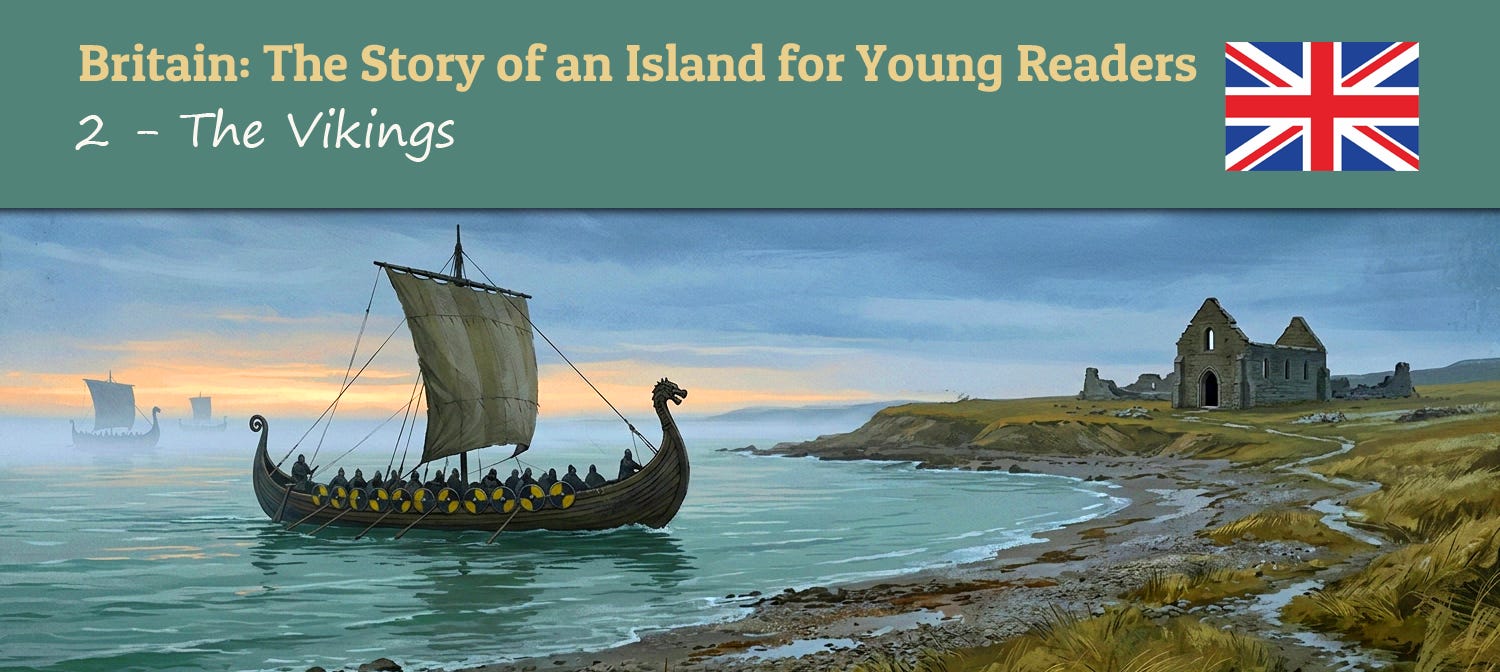
One summer day in the year 789, three ships appeared off the coast of Dorset.
They came from the north, from a place called Hordaland on the western coast of Norway, and they were unlike any vessels the people on shore had ever seen. Long and low, with high carved prows and rows of painted shields along their sides, they slid through the water like dark, narrow fish.
A man named Beaduheard, the king’s reeve, a local official whose job was to greet foreign merchants and direct them to the royal town, rode down to the harbour at Portland with a few of his men. He assumed the strangers had come to trade. He spoke to them with the authority of his office and ordered them to accompany him to see the king.
They killed him and all his men there and then, and they returned to their boats and left.
No one in England knew it yet, but this small, violent encounter on a summer afternoon in Dorset was the beginning of something that would tear the country apart for the next two hundred and fifty years. It was the first recorded arrival of the people the English would come to call the Danes, or the Norsemen, or simply – the Vikings.
To understand why the Vikings came, you have to look north.
Far beyond Britain, across the cold grey waters of the North Sea, lay the lands of Scandinavia, the countries we now call Norway, Sweden, and Denmark. These were hard countries, much of them covered in forest, rock, and ice. The growing seasons were short and the winters were long and brutal. The people who lived there were tough, practical, and very good at building things, especially ships.
Nobody drove them out. Unlike the Saxons centuries before, who had come to Britain partly because other peoples were pressing on them from the east, the Scandinavians moved of their own accord. Their population was growing. There were too many sons and not enough land. The younger ones, the ones without an inheritance, looked outward, to the sea, to the horizon, and to whatever lay beyond it.
What lay beyond it, as they soon discovered, was a great deal of wealth, most of it sitting in churches and monasteries with no walls around them and no soldiers to guard them.
The Viking expansion was extraordinary in its reach. One group of raiders and settlers pushed south from Sweden into the heart of what is now Russia, sailing down the great rivers all the way to Constantinople, which is today the city of Istanbul in Turkey. Another group sailed from Norway into the Mediterranean, raiding the coasts of Spain and North Africa. A third group carried the Norsemen westward, to the Scottish islands, to Ireland, to Iceland, to Greenland, and eventually, five centuries before Columbus, to the coast of North America.
One of these groups travelled westward. They came to the British Isles and they fell upon it like ravenous wolves.
Four years after the killing of Beaduheard, the storm broke.
In June of year 793, four years after the killing of Beaduheard and his men, a fleet of Viking ships appeared without off the coast of Northumbria and landed on the island of Lindisfarne, Holy Island, one of the most sacred places in all of Christian England.
Lindisfarne was a monastery, founded over a hundred and fifty years earlier by the Irish monk Aidan, and it had become the spiritual heart of the north. It was the place where the great saint Cuthbert was buried, a place of pilgrimage and prayer, and it was rich. Over the decades, kings and nobles had given it treasures, gold crosses, jewelled reliquaries, fine metalwork, and beautifully illuminated manuscripts. The monks lived quietly, studying and praying, on a windswept island connected to the mainland only at low tide.
They had no weapons. They had no walls. They had no warning.
The Vikings sacked the place. They killed monks, threw others into the sea, and carried away everything of value, the gold, the jewels, the sacred vessels, along with any monks young and strong enough to be sold as slaves in the markets of Europe.
The news of the attack sent a wave of horror across Christendom. Alcuin, a scholar from Northumbria who was living at the court of Charlemagne, the great King of the Franks, whose empire stretched across most of western Europe, wrote home in anguish. In almost three hundred and fifty years, he said, nothing so terrible had ever happened in Britain. That the heathens could sail across the open sea and destroy a place as holy as Lindisfarne seemed impossible, monstrous, a sign of God’s anger.
The following year, the raiders returned and struck at nearby Jarrow. This time the local people fought back. The weather turned against the Vikings, many were killed, and their leader was captured and put to a cruel death. The survivors carried such a grim report back to Scandinavia that the English coasts were left in peace for nearly forty years.
But it was only a pause. The taste for raiding Britain had spread, and the profits were too good to abandon.
But the Vikings could not have attacked Britain (or much of Europe), without one extraordinary object – the longship.
Over many generations, the shipbuilders of Scandinavia had developed and perfected a vessel that was unlike anything else on the water. It was built to do two things superbly well: to cross the open ocean in the worst weather, and to sail up shallow rivers far inland where no deep-keeled vessel could follow.
We know a great deal about these ships because several have been dug up almost complete. The most famous was discovered in 1880 at a place called Gokstad, in Norway, buried in a great mound of earth as part of a chieftain’s funeral. It had lain there for nearly a thousand years, preserved in thick blue clay.
The Gokstad ship was about twenty-four metres long and five metres wide, roughly the length of a tennis court, but narrow and low in the water. She was built of oak, plank by plank, each one overlapping the next and fastened with iron rivets. The planks below the waterline were astonishingly thin, no more than two or three centimetres, which made the hull light and flexible. In heavy seas, the whole ship could bend and twist with the waves rather than fighting them. She had sixteen oars on each side and a single square sail of heavy wool, and she could carry a crew of around thirty-four, with their weapons, food, and supplies, for weeks at a time.
In 1893, a group of Norwegians built an exact copy of the Gokstad ship and sailed it across the Atlantic Ocean from Norway to America. It took them twenty-eight days. The captain reported that the ship moved through the water beautifully, and that even in storms the flexible hull rode the waves as though it were alive.
Imagine that ship approaching your coastline. A low, dark shape gliding out of the morning mist, the carved prow cutting the water without a sound, the rows of painted shields, black and yellow, alternating, catching the early light. Then another ship behind it. Then another. Then a dozens and then hundreds.
That is what the people of England saw, and feared, for year after year, throughout the ninth century.
For a long time, the Viking raids followed a pattern. The longships would appear in spring or summer, the warriors would attack a monastery or a coastal town, take everything of value, and sail home again before winter. It was piracy, brutal, efficient, and immensely profitable.
But as the decades passed, something changed. The raiders began to stay longer. They wintered on the English coast, fortifying their camps with ditches and ramparts, bringing their horses ashore and riding inland to strike at targets that had thought themselves safe. And eventually, behind the raiders, came their families. What had begun as plunder was becoming settlement. What had begun as theft was becoming conquest.
The English were poorly prepared for this kind of enemy. Their system of defence relied on the fyrd, a call-up of local men, who were expected to serve as soldiers for about forty days when summoned by their lord. These men fought bravely enough, but they were part-time warriors with fields to tend and families to feed. When their forty days were up, they went home, regardless of whether the enemy had been defeated. Against an enemy who never went home, who moved fast, who fortified their camps and fought with professional discipline, the fyrd was hopelessly outmatched.
The Vikings were also cunning. They used tricks and stratagems that the straightforward English were slow to counter. One favourite was the feigned retreat, falling back in apparent panic, drawing the English forward into broken ground, then turning and cutting them to pieces. On one famous occasion, a Viking leader besieging a town announced that he was dying and begged the local bishop to give him a Christian burial. The bishop, delighted at the thought of a deathbed conversion, agreed. But when the body of the ‘deceased’ was carried through the town gates for burial, the mourners threw off their cloaks. They were armed warriors, and the sack and slaughter began at once.
The Viking sagas are full of legendary figures, and none is more famous than Ragnar Lodbrok, Ragnar ‘Hairy-Breeches’, a semi-legendary Viking king of Denmark whose story weaves through the royal families of Scandinavia. He was a raider from his youth. In 845 he led a fleet up the river Seine and attacked Paris. Later he turned his attention to Northumbria, but here his luck ran out. According to Scandinavian tradition, he was captured by King Ella of Northumbria and thrown into a pit full of venomous snakes. As the serpents coiled around him, Ragnar sang his death-song to the end.
His final words, so the skalds tell us, were a warning: ‘The little pigs would grunt now if they knew how it fares with the old boar.’
Ragnar had sons, and the stories say each one received the news of his father’s death in a different way. One gripped his spear so hard that the print of his fingers remained on the shaft. Another was playing chess and clenched a pawn until blood started from under his nails. A third was trimming his nails with a knife and kept cutting until he reached the bone. But the fourth son was the one who mattered.
His name was Ivar. They called him Ivar the Boneless.
Whether the story of Ragnar’s death is true, and many historians doubt it, its consequences were terribly real. In the autumn of 865, a vast Viking army landed in East Anglia. The Anglo-Saxon Chronicle calls it the Great Heathen Army, and it was led by Ivar and his brothers. This was not a raiding party. This was an invasion.
The Great Heathen Army was organised on the basis of ships’ companies, but once ashore the warriors seized every horse they could find and became a fast-moving mounted force. They did not fight from horseback – they used the horses for speed, riding hard across country and then dismounting to fight on foot. The Anglo-Saxon Chronicle records the moment with quiet dread: ‘a great heathen army came to the land of the East Angles, and there was the army a-horse.’
Ivar was a commander of brilliance and ruthlessness. He did not simply raid. He planned, he manoeuvred, and he conquered.
The army moved north in the autumn of 866. They crossed the Humber and seized York, the ancient city that had once been the Roman fortress of Eboracum, and was now the capital of Northumbria. The Northumbrians had been fighting among themselves, squabbling between two rival kings, and the Vikings took the city with little resistance.
But in the spring of 867, the two Northumbrian kings put aside their quarrel and united in a desperate attempt to drive the invaders out. They attacked the city in March and at first broke through the walls. For a moment it seemed as though the counter-attack might succeed. But in the narrow streets the Northumbrians lost their advantage of numbers, and the experienced Viking warriors overwhelmed them. Both Northumbrian kings were killed in the slaughter.
That was the end of Northumbria as an independent kingdom. The north of England, the land that had produced Bede, the Lindisfarne Gospels, and the great stone crosses of Anglian art, sank back into darkness. The monasteries were destroyed, the scholars scattered, the libraries burned. A kingdom that had stood at the front of European learning and culture was broken in a single afternoon.
Ivar set up a puppet king in the ruins and moved south.
His next target was Mercia, the great kingdom of the Midlands, which for nearly a century had been the strongest power in England. Ivar brought his army before Nottingham and laid siege to it. The King of Mercia sent desperately for help, and help came, from Wessex. King Ethelred and his younger brother Alfred marched to Nottingham and offered to attack the Viking lines.
But the Mercians chose to negotiate instead of fight, and a treaty was agreed that left Ivar in possession of Nottingham. It was the beginning of the end for Mercia.
Ivar was a strategist who used politics as skilfully as he used his sword. In York and Ripon he had not harmed the churches – he understood that terror was a tool, but so was restraint. He was content to set up obedient puppet rulers in the kingdoms he conquered, draining their wealth and their strength without the expense of holding every field and village by force.
After breaking the treaty of Nottingham, Ivar turned on East Anglia and subjected its king, Edmund, to a dreadful martyrdom. Edmund was later made a saint, and the town where he was buried, Bury St Edmunds, still carries his name.
Then, suddenly, Ivar left England for ever. He returned to Ireland and to Dublin, a city the Vikings themselves had founded, laden with spoils and seemingly invincible. The Irish chronicles record that the king of the Norsemen of all Ireland and Britain died there in 873, struck down by a sudden and terrible disease.
But the army Ivar had built did not leave with him. It stayed, and it grew.
The Danish warriors who had come to raid now settled on the land they had taken. They fortified a chain of towns across the east and the Midlands, Stamford, Nottingham, Lincoln, Derby, Leicester, and these became the strongholds of a new power in England. The soldiers of one decade became the farmers and landowners of the next. They divided the conquered territory among themselves, carved out estates, and planted themselves deeply in the English soil.
One by one, the old Saxon kingdoms fell. Northumbria was gone. East Anglia was gone. Mercia was broken and obedient, its puppet king doing as he was told. The Danes controlled the entire eastern half of England, from the Humber to the Thames and beyond.
Only one kingdom remained. In the south and west, behind the forests and the downlands, Wessex still stood, battered, frightened, but unbroken. Its young king was a man who had already ridden to war at his brother’s side, who had already seen what the Vikings could do. He had watched the other old kingdoms fall, one after another, and he knew that Wessex was next.
His name was Alfred. And in the story of what happened next, the fate of England, the idea of England itself, would hang by a thread.