
3 - Alfred of the Marshes
A king with nothing left but the water and the mud

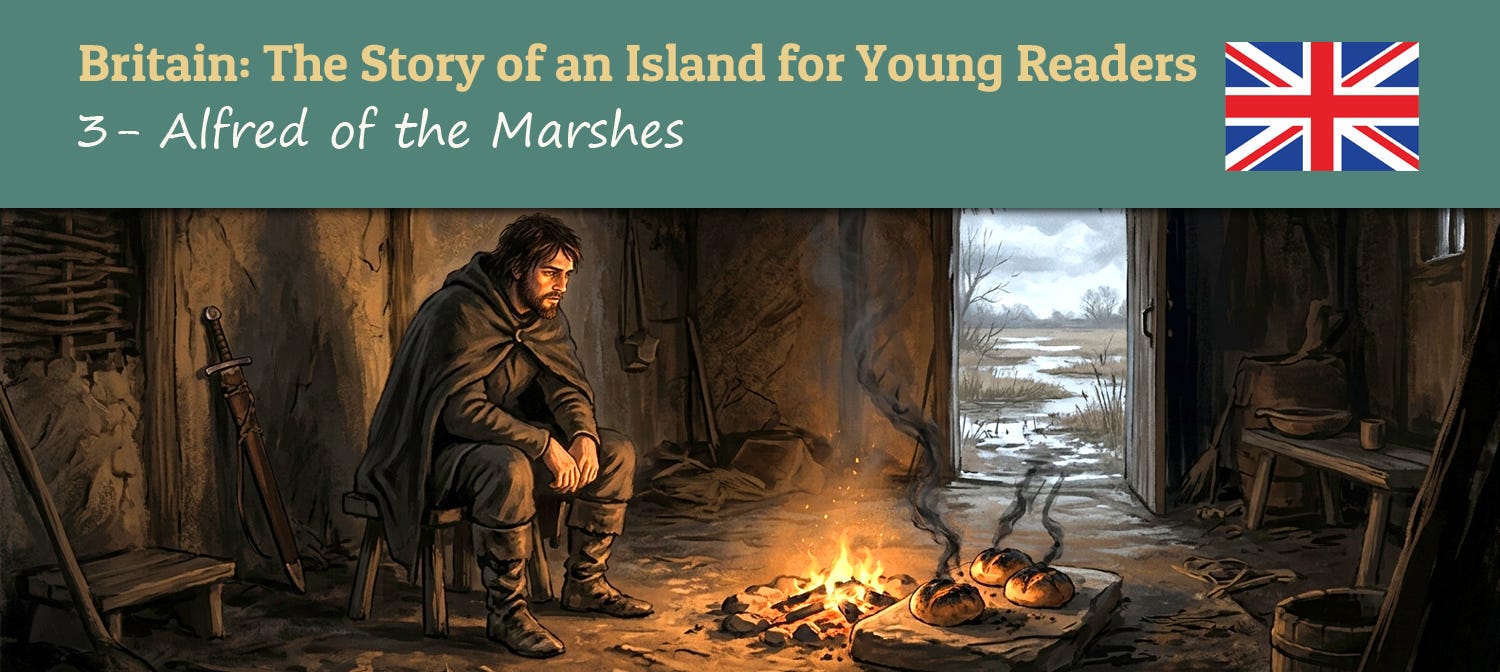
It had been continuously raining for months.
The rain fell on the marshes of Somerset in great grey curtains, hammering the shallow water, drumming on the dead reeds, turning the world into a flat, drowned wilderness where land and water were no longer two separate things. There were no roads here, no villages, no church towers on the horizon. Just water and mud and the low black shapes of alder trees standing in the flood like sentries who had forgotten what they were guarding.
Somewhere in this desolation, in the early weeks of 878, a small group of men moved through the wetland, knee-deep in freezing water, carrying what little they had on their backs. They were exhausted, miserable and hungry. Some of them were wounded, and they had been walking for days, sleeping where they could, and eating what they could find or steal.
At the centre of the group was a man of about twenty-eight. He was not tall, not especially strong, and he had been ill on and off for most of his adult life with a painful condition that could strike him at any moment. He was the King of Wessex, the last Saxon kingdom left standing, and at this moment he was the most hunted man in England.
His name was Alfred.
To understand how a king came to be wading through a swamp with a handful of followers, hiding from an enemy that had conquered almost everything, we need to go back seven years.
Alfred had never expected to be king. He was the youngest of four brothers, the fifth son of King Ethelwulf of Wessex, and in the ordinary way of things the crown would have passed through all of his elder brothers before it ever reached him. But these were not ordinary times. The Great Heathen Army, which had landed in East Anglia in 865, had torn through one Saxon kingdom after another, and the fighting had killed Alfred’s brothers one by one.
His eldest brother, Ethelbald, had already died before the full attack came. His brother Ethelbert ruled briefly and died. His brother Ethelred became king in 866, just as the Viking army was ravaging the north, and Alfred rode at his side as his second-in-command.
They were different men. Ethelred was deeply devout, a king who believed that faith and prayer were the weapons that would defeat the heathens. Alfred believed in God too, but he placed his trust in policy and arms. He was practical, clear-eyed, and willing to act outside his Christian faith.
In January 871, the two brothers faced the Viking army on the Berkshire Downs, at a place called Ashdown. The Vikings had fortified themselves at Reading and were moving westward into the heart of Wessex. Both armies divided their forces into two commands, and the two sides advanced towards each other across the chalk hills.
The Vikings came up the slope with their brightly painted shields and golden arm-rings, clashing their weapons and raising long, defiant war-cries. They looked fierce and amazing. In comparison, the West Saxons, looked plain and weak.
Meanwhile, Ethelred was in his tent, praying. He had been praying for some time.
The two armies were closing in, and King Ethelred’s commanders sent urgent messages. The battle was about to begin, and the King must come. Ethelred replied that he had not finished his prayers. God came first.
Alfred, commanding the other half of the army, watched the Vikings getting closer and made his decision. He could not wait any longer. According to Bishop Asser, who had the account from people who were there, Alfred charged forward like a wild boar and led his men into the Viking lines before his brother arrived on the battlefield.
The fighting raged for hours around a single stunted thorn tree that stood alone on the hilltop. Asser saw the tree himself years later, and noted its position. The two sides hacked at each other with sword and axe, the Saxons pushing uphill, the Vikings holding the higher ground. When Ethelred finally arrived, his prayers completed, the battle intensified further.
At last the Vikings broke. They fled back towards Reading, and the Saxons pursued them through the night, right across the Berkshire hills. Among the dead, they found a Viking king and five of his earls.
It was the very first time the invaders had been beaten in open battle, and Alfred had proved that the Saxons could stand against the Vikings and win. But it was not enough.
All through 871, the fighting went on. Battle after battle, month after month. The Vikings were reinforced from overseas, fresh warriors arriving hungry for land and silver. The Anglo-Saxon Chronicle records seven or eight engagements that year, and the Vikings won the battle more often than not. At Wilton, barely a month after Alfred became king following Ethelred’s death from illness, the Saxons were defeated in the heart of their own country, tricked by the Vikings’ favourite tactic of a feigned retreat.
Alfred was barely twenty-two years old, newly crowned, and already losing.
He did something that must have been agonising for a proud man. He made peace with the Vikings and paid them to leave. The Anglo-Saxon Chronicle records it with blunt brevity: the Saxons made peace with the heathen on the condition that they should depart, and this they did. But they took three or four months before leaving, waiting for the money to be counted and handed over.
It was not a victory. It was a purchase of time. Alfred had bought five years, and he used every one of them.
During those five years of uneasy peace, the shape of England changed.
The Vikings who had come to raid were now settling. The warriors of one decade became the farmers and landowners of the next. They divided the conquered land among themselves, built fortified towns across the east and the Midlands, and planted themselves deeply in the English soil. The whole eastern half of England, from the Humber to the Thames, became Viking territory, and the people who lived there learned to live under Viking law.
The old kingdoms were gone. Northumbria, which had once stood at the forefront of European learning and culture, was broken. East Anglia had been conquered and its king martyred. Mercia, the great kingdom of the Midlands, had been reduced to a puppet state, with its king doing as he was told.
Only Wessex remained.
Alfred used the five year breathing space to strengthen what he had. He studied the problem of defence with the careful, practical intelligence that would mark everything he did. The old system of the fyrd, the part-time militia of farmers who served for forty days and then went home, had been proved hopelessly inadequate against a professional enemy that never went home . Something had to change.
But the full scale of Alfred’s reforms would come later. For now, the truce held, the Vikings farmed their new lands, and Alfred watched and waited.
Then, in the last months of 877, a new Viking war-leader named Guthrum brought his army to the borders of Wessex. He had been probing Alfred’s defences for two years, and what followed was a campaign of treachery and broken oaths that pushed Alfred to the very edge.
First, Guthrum occupied Wareham, close to Portland Bill on the Dorset coast, where a sea army joined him in Poole Harbour. Alfred hemmed in the land army and offered terms. The Vikings took his gold, swore peace on their most sacred object, the Holy Ring, and promised to depart.
Then, in the middle of the night, they broke every oath and rode for Exeter.
Alfred, gave chase, but arrived too late. The Vikings had locked themselves inside a fortress and could not be reached. But a storm smashed the Viking fleet as it tried to round the coast to join them. A hundred and twenty ships were wrecked near Swanage, and perhaps five thousand men were drowned. Guthrum, trapped in Exeter without his fleet, agreed to another peace, this time with oaths of still greater solemnity.
He kept the peace for five months.
In January 878, in the dead of winter, Guthrum struck.
Alfred’s court was at Chippenham in Wiltshire. It was Twelfth Night, the feast of Epiphany, and the Saxons were celebrating. Whether they were feasting, or praying, or simply exhausted after the long months of tension, they were not ready for what came next.
The Viking army attacked Chippenham without warning. The army of Wessex, the only force left in England that could resist the Vikings, was shattered in a single night. Men were killed where they stood. Others fled to their homes. Some abandoned the country altogether, crossing the sea to seek refuge at the court of France.
Alfred, with a handful of his closest men, escaped into the countryside.
This was the lowest point. The kingdom that had held out for seven years against the Vikings was broken. The Vikings controlled Wessex. Alfred was a fugitive in his own land, moving through forests and marshlands with no army, no fortress, and no certainty that anyone would follow him again. He had nothing.
He made his way to the Somerset Levels, the great expanse of waterlogged marshland that stretched between the Quantock Hills and the Mendips. In the middle of this wilderness, barely rising above the flood, lay a small patch of higher ground called Athelney, the Isle of Athelney, surrounded by impassable bogs of alder and willow.
Here Alfred hid.
For several months, through the worst of winter and into the early spring, the King of Wessex lived as an outlaw. He and his small band survived on whatever they could find or take, hunting in the marshes, raiding Viking supply lines, stealing from anyone, Viking or English, who had submitted to the enemy. Bishop Asser, who knew Alfred and wrote his life, described it plainly: the king led an unquiet life in great tribulation, for he had nothing except what he could seize, either by stealth or by force, from both the heathen and the Christians who had submitted to their rule.
It is from this desperate time that the most famous story about Alfred comes. The tale first appears in a later edition of Asser’s biography, and it has been told and retold for over a thousand years.
The story goes that Alfred, wandering in disguise, took shelter in the cottage of a cowherd. The cowherd’s wife, not knowing who he was, left him by the fire and asked him to watch her bread while she was busy elsewhere. Alfred, deep in thought about his kingdom and his plans, his mind far away from the cottage and the hearth, forgot the bread entirely. When the woman returned she found it burning, and she scolded him furiously.
The words she used, recorded in the original account in Latin verse of all things, were sharp and practical: why have you not turned the bread when you see it burning, especially as you are so fond of eating it hot?
She did not know she was shouting at the King of England.
Nobody knows whether the story is true. It may be a folktale that attached itself to Alfred because he was the kind of king around whom stories gathered. But true or not, it has lasted because it tells a deeper truth. Here was a king so reduced, so stripped of everything, that an ordinary woman could shout at him for burning bread, and he could do nothing but sit there and take it. The distance between the throne at Chippenham and the hearthside at Athelney was the distance between a kingdom and a cooking fire.
But Alfred was not finished. Even in hiding, he kept contact with his people, sending messengers through the marshes to the men of the western shires. He was planning.
While Alfred waited, the Vikings suffered a serious blow in Devon. Twenty-three shiploads of Vikings, having raided the Welsh coast, sailed east and attacked a Saxon stronghold on Exmoor. The garrison was outnumbered and the Vikings expected an easy victory. They laid siege to the place, confident that hunger and thirst would force a surrender.
Instead, the defenders came out at dawn and charged downhill into the Viking lines. They killed the Viking commander and most of his men. Eight hundred Vikings fell. Among the spoils was a banner called the Raven, said to have been woven in a single day by the three daughters of Ragnar Lodbrok. It was believed that the raven embroidered on it would flutter its wings before a Viking victory. On this day, the raven hung limp and still.
The news reached Athelney. Alfred must have felt a surge of hope, but he could not act on hope alone. He needed an army, and for that he needed the men of the western shires to believe he was alive, to believe he could still lead them, and to leave their farms and families and come.
Towards the end of May, Alfred sent out the call. The fyrd , the militia, was summoned. Come to Egbert’s Stone, near Selwood, where the borders of Somerset, Wiltshire, and Hampshire meet.
They came.
The men of Somerset came. The men of Wiltshire came. The men of Hampshire came. They came out of the fields and the villages and the forest clearings, carrying their spears and their shields and whatever weapons they had, and when they saw Alfred, alive and standing before them, the Chronicle tells us they received him as one risen from the dead, and they were filled with great joy.
It is one of the great moments in English history. A king given up for lost, stepping out of the marshes to rally his people for one final battle. Alfred had no certainty that he would win. He knew only that if he did not fight now, while the will to fight still held, the men would drift back to their farms and the chance would be gone.
He marched at once. The Vikings were still at Chippenham, resting on their plunder, and Alfred led his army to Edington, on the edge of the Wiltshire downs, where the two forces met on the bare, open hillside.
Everything depended on this battle. If the Saxons lost, there was nowhere left to fall back to. There would be no more retreats to the marshes, no more truces bought with gold. If Wessex fell, the last Christian Saxon kingdom in England would be gone.
Both armies dismounted. The horses were sent to the rear. The shield walls were formed, two long lines of men with their shields overlapping, packed so close together that they could feel the heat and the breath of the men on either side. And then they walked forward into each other.
The fighting lasted hours. It was the brutal, grinding, exhausting work of the shield wall, pushing, stabbing, hacking with sword and axe, each side trying to break through the other’s line, each side holding, stepping over the fallen, pressing forward into the terrible noise and stink of close combat. The Vikings had not lost the favour of battle in years. The Saxons had everything to lose and nothing behind them but empty country.
Finally, the Vikings broke.
They fled from the battle field, pursued by the Saxons, all the way back to their camp at Chippenham, where they locked themselves behind their walls. Alfred followed and surrounded them. For fourteen days he held them there, and this time there was no escape. No fleet would come. No reinforcements would arrive. The Vikings were starving, freezing, and, as Asser says, full of despair.
Guthrum sued for peace. He offered hostages, as many as Alfred wanted, and promised to leave Wessex immediately. It was the complete surrender of the most powerful Viking army in England.
But Alfred did not do what most men would have done. He did not slaughter the Vikings. He did not even humiliate them. Instead he did something extraordinary.
He invited Guthrum to be baptised.
Three weeks after the surrender, Guthrum and thirty of his leading warriors came to Alfred’s camp at Aller, near Athelney, the very marshes where Alfred had hidden as a fugitive. There, in a small Saxon church, the Viking warlord knelt and received the waters of Christian baptism. Alfred stood as his godfather. He lifted Guthrum from the font, called him his son, and gave him a new Christian name, Athelstan.
For twelve days, Alfred entertained Guthrum and his men. He gave them costly gifts. He treated them not as defeated enemies but as new brothers in the faith.
It was an act of extraordinary imagination. Alfred had Guthrum entirely in his power. He could have starved the Vikings into total submission and executed their leaders. Many of his own people, who had suffered years of burning and killing and plundering at Viking hands, must have wanted exactly that. But Alfred understood something that few leaders in any age have grasped: that a defeated enemy who is destroyed simply creates a space for the next enemy, while a defeated enemy who is brought into the fold may become a lasting neighbour.
Alfred did not try to drive the Vikings out of England. He accepted that they were there to stay. What he wanted was peace, a real and lasting division of the island between the two peoples, with agreed borders, agreed laws, and a shared faith. The conversion of Guthrum was not a humiliation. It was an invitation, and a handshake, and a promise.
In 886, after Alfred had recovered London, a formal treaty was drawn up between them. On Alfred’s side, the document names the counsellors of the English nation. On Guthrum’s side, it speaks of the people who dwell in East Anglia. A line was drawn across the country, running up the Thames, up the river Lea, and then straight to Bedford and beyond by the Ouse to Watling Street. Everything to the east and north of that line became the Danelaw, where Danish customs and Danish law prevailed. Everything to the south and west remained English.
It was not a perfect peace. There would be more fighting in the years to come, more raids, more broken promises. But the treaty of 886 was the foundation on which everything that followed was built. Two peoples, who had spent a generation trying to destroy each other, agreed to live side by side.
And in the terms of that treaty, something new had appeared. For the first time, the document does not speak of Wessex, or of the West Saxons. It speaks of the English. Alfred was no longer just the King of Wessex. He was becoming something larger, something that had not existed before.
He was becoming the king of the new English nation.