
9 - The Conqueror's Peace
Conquest, castles, and the book that counted everything

It was Christmas Day, 1066. Westminster Abbey smelled of candle smoke and damp stone and the icy breath of winter coming through the great door. Outside, London waited in uneasy silence. The battle at Hastings had been in October, less than three months before, and the streets were still in shock, the city still trying to understand what had happened. Men who had been Englishmen when they woke up in September had found themselves, by November, living under foreign rule.
Inside the Abbey, the most powerful man in England was about to be crowned.
William, Duke of Normandy, knelt before the altar as Archbishop Ealdred of York placed the crown of England upon his head. It was the same crown that had sat on King Harold’s head in the same place barely a year before. The Norman knights standing in the abbey were armed, their hands on their sword hilts, their eyes scanning the crowd. They had fought their way here, and they were not yet sure the fight was over.
When the congregation were asked to shout their assent, their approval, to the coronation – in the Norman manner, the sound startled the Norman guards outside. They heard what sounded like a commotion inside the Abbey and panicked. Within minutes, the houses around Westminster were burning, and frightened Londoners were running into the streets. Inside the Abbey, the ceremony continued as smoke began to drift in, and the congregation scattered.
William was crowned King in a half-empty church, with his new capital city on fire outside. It was not the most promising beginning.
William was forty years old when he took England and became king, give or take a year, and he had been fighting for most of his life. He had survived a childhood in which three of his guardians were murdered in quick succession. He had fought off a rebellion when he was barely twenty, riding for his life through the night, and then turning to smash his enemies before they could regroup. He had conquered the county of Maine, on Normandy’s southern border, beaten back the King of France, invaded England with a borrowed army, and killed his rival King Harold. William was not a man who stopped to rest when there was still work to be done. And there was plenty of work to be done.
England in 1066 was not a kingdom that had simply switched rulers at the top and would now carry on as before. What the newly crowned King William had won was a country in shock, a country with powerful earls in every corner who had spent years fighting each other and were not necessarily willing to stop fighting just because a new Norman King had taken power. King Harold was defeated and dead, but England was still England. Its people still spoke English, its laws still Saxon laws, and its great landowners still powerful men with armed followers who had not been asked whether they wanted to be conquered and ruled by a foreign king.
King William’s first moves were careful ones. He kept some of the old Saxon earls in their positions, at least for a while. He kept the old Saxon laws in place, at least officially. He promised to govern as King Edward the Confessor had governed, and he wanted England to understand that this was not destruction but replacement, and that life would go on. Powerful Saxon men could remain powerful if they behaved themselves. It was a sensible plan, but it only lasted about three years.
The rebellions began in the west, in the north, and in the east. Some were led by Saxon earls who had submitted after the Battle of Hastings but could not stomach the reality of Norman overlordship. Some rebellions were stoked by the Danes, who were watching events in England with hungry interest, remembering the days when their own king had ruled the island. In 1069, a Danish fleet sent by King Sweyn of Denmark sailed into the north of England, and the whole of Northumbria erupted into open revolt.
It was the rebellion in the north that brought out the worst in King William, and the worst of what a conquest can become when a king decides that the only way to keep order is to make sure there is nothing left to support a rebellion.
King William marched north in the winter of 1069, into the coldest months, when no sensible army went to war. His men moved through Yorkshire in the snow, and wherever they went they burned. Not just settlements that had harboured rebels. All of them. The crops in the fields were set alight, though there was little left by winter. The livestock were slaughtered. The ploughs and tools were destroyed. The stores of grain that families had gathered to see them through the winter were tipped into the mud or taken. Village after village was left as a smear of ash on frozen ground.
It was thorough. It was deliberate. And it was terrible.
An early twelfth-century chronicler named Orderic Vitalis, himself half-Norman, wrote about it with horror. He recorded that King William’s campaign killed more than a hundred thousand men, women and children, most of them not through the sword, but through the famine that followed. Modern historians treat that figure as an exaggeration from a chronicler writing a generation after the event, but even so, there is agreement that the death toll ran into the tens of thousands, in a country whose entire population numbered no more than two million people. The Domesday Book, compiled sixteen years later, still recorded vast stretches of Yorkshire as wasteland, empty and untaxed, too sparse to count.
Even Orderic, who admired much of what King William had done, could not bring himself to defend the Harrying of the North – as it came to be called. He wrote that in his dying weeks, King William himself repented of it. Whether that is true, no one can say. But the fact that a loyal Norman writer felt the need to say it, tells you something about what the Harrying looked like to those who lived through it, and to those who came after. After the north was broken, there were no more rebellions.
England was now truly conquered, and King William set about remaking it from the ground up. The change began with the land.
In the old Saxon system, great earls had held their estates by tradition and inheritance, owing the king service and loyalty but otherwise ruling their own lands in their own way. King William swept almost all of that away. He distributed the land of England as he saw fit, and he saw fit to give most of it to other Normans.
Not just any Normans, his Normans. The men who had crossed the Channel with him, who had fought at Hastings in the October rain, who had marched north in the winter cold. These men were now rewarded with something more lasting than silver. They were given England itself, in pieces, to hold as their lord’s tenants in return for military service.
This was feudalism, (society structured around a strict hierarchy of land ownership and reciprocal obligations to the king) and King William understood it with a soldier’s clarity. The king was lord of all. Below him, the barons held their allotted portion of land, gifted to them by the king. In turn, the barons owed the king a fixed number of knights for when the king called for them. Below the barons, the knights held their own portions of the barons’ land and owed arms and men to the baron in turn. Below the knights, the peasants worked the land, and owed their labour and a portion of their harvest to whoever sat above them in the chain.
It was a pyramid, and William sat at the top of it.
By the time his survey was completed, (the Domesday Book) the land of England looked like this: where two thousand Saxon thanes and landowners had held estates in 1066, around two hundred Norman barons held all the estates by 1086. The old Saxon aristocracy had not merely lost power. It had almost ceased to exist.
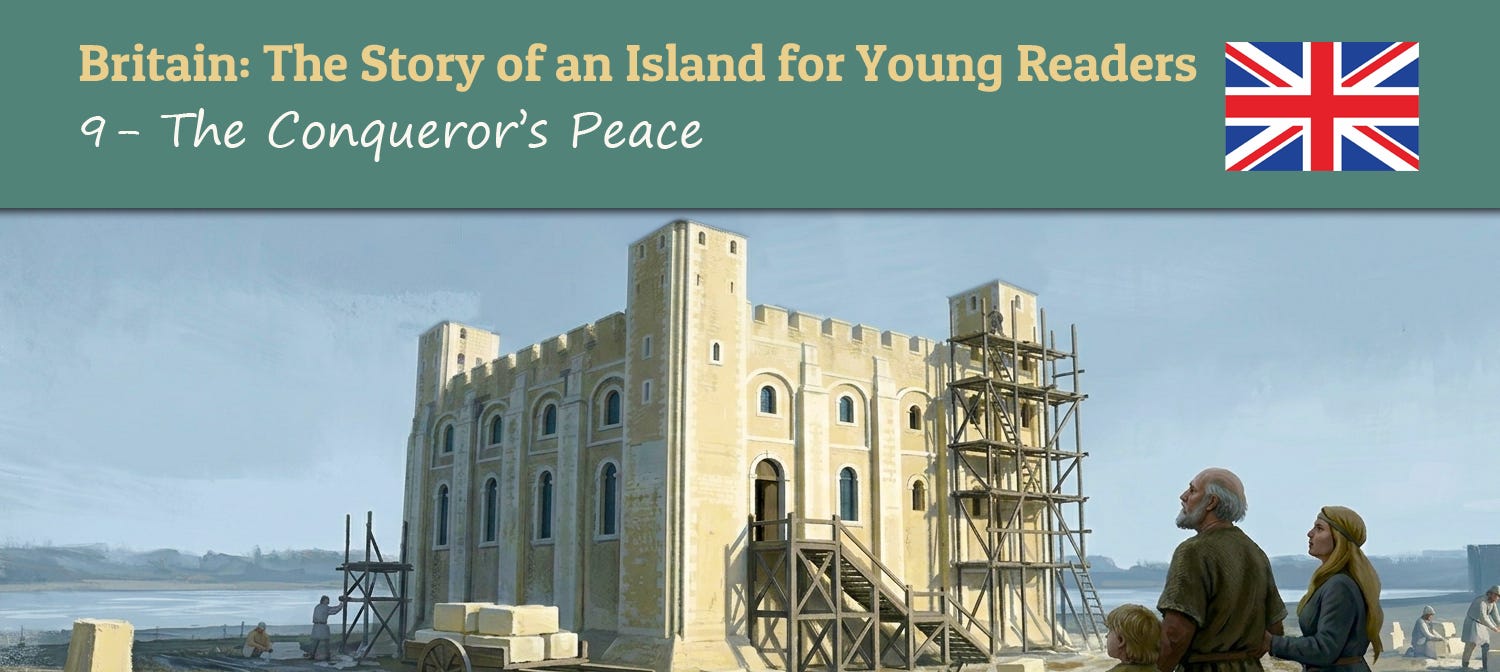
The new Norman lords started to build in stone right across England. Castles went up, first in wood on earthen mounds, then in stone, as time and money allowed. They were not houses. They were statements of power, and amongst England’s first stone castles since the Romans. Every Norman castle said the same thing to the population around it: we, the Normans, are here. We are the new masters of England, and we are not leaving. By the end of King William’s reign, more than eighty castles had been built across his new kingdom, each one the centre of a lord’s authority, each one a garrison from which the surrounding land could be controlled. The villages that lay in the shadow of those castles did not easily become rebellious again.
Norman French was the language of power now. It was spoken at the royal court, in the law courts, and in the great Norman households. English went on being spoken, of course, in the fields and the markets and the homes of ordinary people, because you cannot conquer a language any more than you can conquer the weather. But the English who wanted to rise in the new order would have to learn French, and over the next two centuries the two languages pressed against each other and mingled, until the language that came out on the other side, was something new and strange and rather wonderful, full of Old English bluntness and Norman elegance, of Saxon words for the animals in the field and French words for the meat on the plate. The modern English we speak today carries both of those languages inside it.
The Church changed too. King William brought in Norman bishops and abbots to replace the English ones, slowly but deliberately. He was a religious man in the practical Norman way, building churches and abbeys, observing the forms. He was a king who understood that the Pope and the Church was a power he needed to keep on his side.
In 1085, a threat from Denmark reminded King William that England was only as secure as he kept it. King Canute IV of Denmark was raising a fleet and an army with the intention of pressing an old claim to the English throne. But King Canute IV never sailed. He was murdered by his own men, who were less enthusiastic about the venture than he was. But the threat from across the sea had been real, and it reminded King William of something he already knew: that he could not defend his kingdom if he did not know what it contained.
In December of 1085, King William called a great council at Gloucester and gave an order that had never been given before in the history of England. He wanted to know everything.
Not just which lord held which estate. Everything. A complete survey of the entire kingdom. Every farmer, every mill, every fishpond. Every ox, every cow, every pig. Who had held it before the Conquest, and who held it now. What it had been worth in King Edward the Confessor’s day, what it was worth when the surveyors arrived, and what it might be worth if it were properly managed. The Anglo-Saxon Chronicle recorded the scope of the thing with barely disguised indignation, noting that King William’s surveyors left nothing out, not a single yard of land, ox, cow, nor pig.
Commissioners — the surveyors — rode out across England early in 1086, divided into circuits, each circuit covering a region. They called the local people before them, the barons and the priests and the village reeves, and questioned them under oath. The information flowed back to Winchester, where clerks compiled it into a vast written record.
They called it the king’s survey. The people of England, knowing that it was final and beyond appeal, called it the Domesday Book. Doomsday, the day of judgement, when everything is known and nothing can be hidden. The name has lasted.
The Domesday Book was finished in 1086, all of it compiled in a single year. It remains one of the most extraordinary feats of medieval administration ever attempted. The book records over thirteen thousand places across England, though it left out some significant gaps: London and Winchester were not included, probably due to their size and complexity, and the far north, still raw from the Harrying, barely appears. But for everything else, it is there, every field and mill and villager, a frozen snapshot of a single year, but King William did not live to make much use of it.
In the summer of 1087, King William was campaigning in France, in the border region between Normandy and the French royal lands, and he attacked the town of Mantes in the Seine valley. The town burned, and as he rode through the smouldering ruins, his horse stumbled over debris in the ashes and lurched forward, throwing King William hard against the pommel of his saddle, hurting him internally. Injured and unable to continue, King William was carried to the priory of Saint Gervase outside Rouen and put to bed, and there he stayed, growing more ill through August and into September.
King William died on the ninth of September, 1087, aged about fifty-nine, having reigned in England for twenty-one years.
His end was not dignified. The men who had attended him at his deathbed, servants and courtiers alike, left the moment he died, stripping the room and taking everything they could carry. King William’s body had to be carried to Caen for burial at the abbey he had built there, and the ceremony went wrong. The grave was too small for a man who had grown very big and heavy in his later years, and those present had to press the body down into it. The smell of the king’s decaying body on that warm September day was never forgotten.
History judges William the Conqueror as a great and terrible man in the same breath. When he became King, William found England to be a country of competing powers. On his death, England was a unified feudal kingdom under a single crown. King William brought architecture, administration, and a new language. He also brought devastation, dispossession, and the Harrying of the North.
The Domesday Book is his most famous legacy. The original two volumes of the book still exist, and its home is the National Archives in Kew. The entries for English towns or villages, if they existed in 1086, can still be read in the original Latin today.