
7 - King Edward the Confessor
The king who gave England away

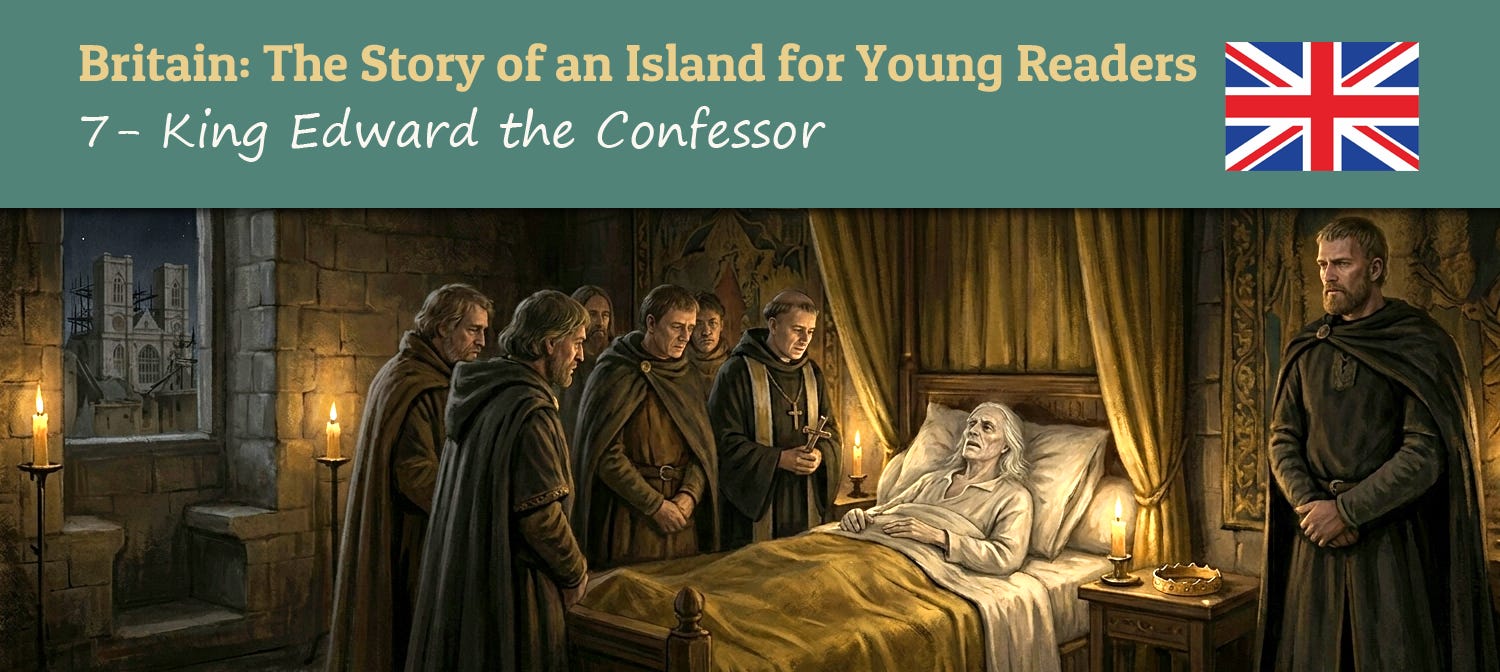
The Palace of Westminster stood on a low marshy island at the bend of the Thames, a few miles upstream from the city of London. In the first days of January 1066 in a room in the new palace, it was very quiet. Candles burned low, and around a bed in this room stood the men who had run England for the last twenty years: earls, thanes – nobles, and churchmen. They had come to hear the last words of King Edward the Confessor, the last of the old Saxon kings.
King Edward was old, grey, and very frail. He had been sick for some time, drifting in and out of wakefulness, and in his fever he had spoken of things that frightened the men who listened. He had spoken of a time of evil that was coming upon the land. He had described green trees cut down and replanted, but bearing no fruit. The words made no obvious sense, but they landed on the listeners like the tolling of a bell. On his deathbed, the king seemed less like a man and more like a prophet, muttering warnings that no one could fully understand and no one dared to ignore.
Only one man in the room remained unmoved. Archbishop Stigand was a survivor, a churchman who had served three kings and knew a political performance when he saw one. He leaned across to the Earl of Wessex and whispered in his ear. ‘The king was old and sick. Age had robbed him of his wits. His words meant nothing.’
The Earl of Wessex listened, and nodded. His name was Harold.
On the fifth of January, 1066, King Edward of England died. He had been king for twenty-four years.
His title ‘The Confessor,’ had been given by the Church because the man had spent his life in devotion and piety. And King Edward the Confessor had been genuinely, deeply, almost entirely concerned with God. In a time when England needed a warrior, it had been given a monk.
To understand why Edward came to sit on the English throne at all, we need to step back from that candlelit room and follow a stranger story.
When the great Danish king Cnut died in 1035, the empire he had built – England, Denmark, Norway – crumbled almost at once. He left three sons, and they were nothing like their father. They were boorish, cruel, and short-lived. Within seven years of Cnut’s death, all three were gone. One died fighting in Norway, one was dead within a year of taking the English throne, and the last, Hardicanute, who was Cnut’s chosen heir for England, died suddenly in 1042 at a drinking feast in Lambeth, collapsing in the middle of a toast. He was in his mid-twenties. There was no warning. He just dropped dead.
England had a problem. Who was the king?
The answer, when it came, surprised everyone. There was still a man alive who could claim descent from King Alfred the Great and the ancient West Saxon line. He had been living in exile in Normandy, across the Channel, for nearly thirty years. He had grown up there, had been educated in Norman monasteries, spoke French as naturally as he spoke English, and had spent so long away from his homeland that he was more Norman than Saxon in almost every way that mattered.
His name was Edward, son of King Ethelred the Unready and his Norman wife Queen Emma.
Bringing Edward back to England was the idea of the most powerful man in England at the time, Earl Godwin of Wessex. Godwin was not royal. He was a nobleman, not a king, the son of a thane who had risen through his own ability and shrewdness to become the greatest earl in the kingdom. He had served Cnut loyally, taken a Danish wife, and accumulated land and power until the territory he controlled stretched from the Thames in the east to the Bristol Channel in the west. He had sons who were already earls. He was, in everything but name, the ruler of England.
Godwin could have chosen almost any candidate for the throne, but he chose Edward because Edward could be managed. A king who had been away for thirty years, who had no army and no English allies, who owed his throne entirely to Godwin’s support – was a king who could be kept in check.
Godwin’s terms were simple. Edward could be king, but he must marry Godwin’s daughter, Edith. Also, he must keep Godwin and his sons in their earldoms. And he must remember who had put him there.
Edward had little choice. He agreed, was welcomed home, and was crowned King of England in Winchester on Easter Day, 1043.
Edward was about thirty-seven years old when he became king. He was slight, pale and quiet, a man who had spent his youth in Norman monasteries rather than riding to war. One account of the time describes him as a kindly, gentle, chubby figure, with an almost otherworldly appearance. His Norman education had given him a genuine and deep religious faith, an appreciation of Norman architecture and Norman learning, and absolutely no experience of governing a kingdom.
He married Godwin’s daughter Edith as agreed. The marriage was, by all accounts, entirely formal. Edward seems to have regarded it as a duty rather than a union. This was not unusual for a man of Edward’s piety. He treated his queen respectfully enough, but his heart was elsewhere – in his prayers, in his devotions, and above all in the great project that would be his life’s real work.
He was going to build a church.
The church – or rather, the abbey – was to be at Westminster, on the marshy island where the Thames bent south. There had been a modest monastery there for some years, but Edward intended something altogether different. He wanted a building in the new Norman style, with great round arches and thick stone walls and a soaring nave that would fill the eye and lift the spirit. He poured money, energy, and attention into it for the rest of his life. Westminster Abbey was consecrated just days before Edward died, but he was too ill to attend the ceremony for a building that he had spent his entire reign building.
That was the man. Quiet, devoted, happiest among his monks and his mason’s drawings, increasingly withdrawn from the rough, treacherous world of earls and councils. He was not stupid. He was not entirely without cunning, but he was profoundly unsuited to the time and the place in which he found himself, and he knew it.
Meanwhile, England was being run by Godwin.
Earl Godwin of Wessex was one of the most able men of his age, and one of the most dangerous. He had helped raise Edward to the throne, and he intended to keep his hand on its back. His sons were given earldoms. One son, Sweyn, received Herefordshire and part of the west. Another son, Harold – the same Harold who would one day stand at Edward’s deathbed – became Earl of East Anglia. A third, Tostig, was given the north. The Godwin family, between them, controlled most of England, with a puppet king sitting quietly in the palace at Westminster, commissioning his stone carvings and praying his prayers.
Not everyone was content with this arrangement.
The Normans, who had sheltered Edward during his long exile, had followed him to England in considerable numbers. Norman priests appeared in the English Church. Norman clerks came to work in the royal household. Norman landowners began to acquire English estates. To the old Anglo-Danish nobility, this was an invasion of a different kind, creeping in through the doors of the king’s favour rather than storming up the beaches.
The arrangement between the two worlds – the Norman party around the king, and the great English earls, Godwin and his sons at their head – could not last forever.
The agreement broke in 1051.
A Norman archbishop, Robert of Jumièges, had been appointed to Canterbury, the most important position in the English Church. Godwin objected. A dispute broke out over the town of Dover, where local men had brawled with some of the king’s Norman guests. The king ordered Godwin to punish the town. Godwin refused. Suddenly what had been a long-running quarrel became an open crisis.
The earls gathered their forces. So did the king. For a few weeks England teetered on the edge of civil war. But Godwin, calculating that the odds were not in his favour, chose to withdraw. He and his sons crossed the Channel to Flanders, a region on the northern coast of what is now Belgium, and for the first time in twenty years the most powerful family in England was gone.
It was the moment King Edward had been waiting for. Norman influence flooded in. Robert of Jumièges remained as Archbishop. The Norman party strengthened its grip. And according to some accounts – though this is where history becomes uncertain, and the mists thicken – William, the Duke of Normandy, visited England around this time, received as an honoured guest at King Edward’s court.
William was a remarkable figure. His father, Duke Robert of Normandy, had spotted a tanner’s daughter washing linen in a stream near the town of Falaise and had fallen instantly in love with her, carrying her to his castle and keeping her there until she gave him a son. William was that son, born without the blessing of marriage, carrying the mark of illegitimacy that his enemies would never let him forget. His childhood had been dangerous: his father died when William was seven, leaving the boy a duke in name only, surrounded by great noblemen who saw a fatherless child as an opportunity rather than a ruler. Three of his guardians were murdered. For years his survival depended on luck, speed, and the occasional intervention of the King of France, who preferred a weak Norman duke to a strong one.
But William survived, and more than survived. By the time he came to King Edward’s court, in his mid-twenties, he was already proving himself a formidable soldier and ruler. William had broken his enemies, secured his borders, and looked across the Channel at England with the clear, calculating eyes of a man who was accustomed to taking what he wanted to and holding it.
What William wanted, it appears, was the English crown.
The story that King Edward promised the crown to William during that visit is Norman in origin, and the Normans had excellent reasons to tell it. King Edward had no children, no clear heir, and a king who had no children had to think about who would rule after him. William was his cousin, of a sort – the connection ran through KIng Edward’s Norman mother Emma and the family of the Norman dukes. And Edward trusted Normans. He had grown up among them.
Whether the promise was made or not, the matter was not yet settled. Because twelve months later, the Godwins came back from Flanders.
Earl Godwin had not wasted his year in Flanders. He had raised a fleet, called in favours, and gathered allies. His son Harold had done the same, raising ships in Ireland. In the autumn of 1052 they sailed for England from opposite directions, gathered their forces, and confronted King Edward with an army at their backs.
Edward looked at what was ranged against him, and did what a wise man does when he cannot win. He negotiated.
Godwin and his sons were restored to their earldoms. Most of the principal Norman agents were expelled. The Norman archbishop Robert of Jumièges fled the country. The king was back in his palace, back to his building works and his prayers, but the world around him had rearranged itself, and the Godwin family were stronger than before.
Seven months later, Earl Godwin was dead.
He died in 1053, at the king’s table during a feast at Winchester, suddenly stricken, carried from the hall, and dead within a few days. He had been in public life for over thirty-five years, and he died as he had lived: at the centre of power. His eldest surviving son Harold stepped into his earldom, his lands, and his authority.
Harold Godwinson, now Earl of Wessex, was about thirty years old. He was tall, strong, experienced, popular with the English nobility, and, in the view of almost everyone who dealt with him, extremely capable. For the next thirteen years, while the king prayed and planned his church, Harold governed England in his name.
Earl Harold was not always without opposition. His brother Tostig, Earl of Northumbria, resented his power. The Anglo-Danish earls of the north – Morcar and Edwin – were rivals, and the Normans never disappeared entirely from court. Harold navigated all of this with patience and skill, and the country held together. England, under Harold’s hand, functioned.
But under the surface, the questions were growing. King Edward was ageing and unwell. He had no children, no declared successor, no settled plan for the future. And across the Channel, William of Normandy had not forgotten whatever had passed between him and the king in 1051.
In 1064, Harold made a mistake. The exact reason for his journey across the Channel is not known. He may have been on a diplomatic mission. He may have been trying to secure the release of hostages. Whatever the reason, his ship was blown off course by a storm and he was wrecked on the coast of northern France, in the territory of the Count of Ponthieu.
The Count was not sympathetic. A shipwrecked man was, by the custom of the time, the property of whoever found him, and valuable for ransom. Harold found himself a prisoner, and his chances of ever leaving France grew uncertain.
It was William of Normandy who secured his release. He sent word to the Count – politely at first, then with rather more authority – that the Earl of Wessex should be delivered into Norman hands. The Count complied. Harold was escorted to William’s court.
What followed was both a friendship and a trap.
The two men liked each other. They are described hunting together, campaigning together against the Bretons, riding side by side with hawks on their wrists. Harold was honoured, feasted, and knighted by William. But William had not rescued Harold from the Count of Ponthieu out of generosity. He had rescued him because Harold was the most important man in England, and William had a use for him.
William put his proposal plainly. When Edward died – and King Edward, clearly ailing, would not live much longer – William intended to claim the English throne. He was offering Harold a share of the arrangement. Harold would become Earl of all Wessex, holding it under William as king. Harold would marry William’s daughter. William would be England’s king.
Harold swore an oath to this agreement.
The exact circumstances of that oath have been argued about ever since. Norman accounts say Harold swore willingly and knowingly on holy relics, giving the oath the most solemn weight it was possible for any promise to carry. English accounts say the terms were forced upon Harold, and that he swore under duress, with no real freedom to refuse. The relics, according to some later writers, were concealed beneath the altar, hidden from Harold until after the oath was taken, and Harold not fulling understanding what he was agreeing to.
What is certain is that Harold swore the oath, and that he went home. And equally certain is that in the autumn of 1065, the north of England rose in revolt against his brother Tostig. The Northumbrians had had enough of Tostig’s harsh rule and drove him out, calling for Morcar in his place. Harold, faced with the choice between his brother and a peace settlement, chose the settlement. Tostig was stripped of his earldom and sent into exile.
Tostig never forgave Harold. He sailed for Flanders, and there, burning with fury, began to look for allies who might help him take back what he had lost.
In December 1065, King Edward was too ill to attend the consecration of his beloved abbey at Westminster. He had spent the last years of his reign watching its stone walls rise, planning every arch and column, pouring the kingdom’s treasure into the building. Now it was complete, but he was very ill and took to his bed in the palace next door and did not rise from it.
In the first days of January 1066, the men of the kingdom gathered around him. They heard his confused, drifting words about green trees and blighted harvests, about a time of evil coming upon the land. The candles burned low. Beside the bed, Archbishop Stigand leaned towards Harold and whispered that the king had lost his mind.
But it was said that with his dying breath, Edward turned to Harold, the vigorous, competent man who had governed England in his name for thirteen years, and commended him to the kingdom’s care.
On the fifth of January, 1066, King Edward the Confessor died.
Within hours, Harold was made king.
It was the beginning of the most extraordinary year in the long history of England. The year of Halley’s Comet, blazing across the sky like a warning written in fire. The year of three battles – at Gate Fulford, at Stamford Bridge, and at a hill in Sussex that would change everything. Across the Channel, a Norman duke was sharpening his sword. Far to the north, in Flanders and beyond, a bitter exile was plotting his revenge.
And in Westminster, the new king stood in the newly consecrated abbey and received the crown that a Norman duke across the Channel believed had been promised to him.
King Edward the Confessor is one of the most puzzling figures in English history, not because we cannot understand him, but because he does not quite fit any of the usual shapes. He was not a warrior, not a statesman, not a clever politician playing the long game. He was exactly what he appeared to be: a man of genuine faith, more comfortable in a monastery than a council chamber, who happened to be a king.
He left behind a building that still stands. Westminster Abbey, rebuilt and added to over the centuries, has been the site of every coronation since William the Conqueror was crowned there on Christmas Day 1066 – nine hundred and fifty years of kings and queens receiving their crowns in a church that King Edward built.
King Edward also left behind a crisis – no clear successor.
There was disputed promise to a Norman duke. There was an English earl who had just taken the crown with the whispered blessing of a dying king. There was Tostig, Harold’s embittered brother, seething in exile in Flanders and already looking for someone to help him take his revenge. And, although no one in England yet knew it, a Norwegian king named Harald Hardrada who believed the English throne was rightfully his, and was already making plans to come and take it.
The lights of Saxon England, as one historian memorably put it, were going out. In the gathering darkness, a gentle man had murmured his warnings, and no one had truly listened. And now, in the cold January of 1066, those who had been standing around the bed turned from the dead king to the living one, and wondered what was coming next.
They would not have to wait long.