

The civil war was over.
For nineteen years, since King Stephen had seized the crown that the great lords had sworn to Matilda, England had been tearing itself apart. Castles sprang up without permission, barons stole what they pleased, and ordinary people suffered so terribly that it was said Christ and his saints slept. But now King Stephen was dead, and the country that had been falling to pieces was about to be put back together by the most restless pair of hands it had ever known – Henry of Anjou, who only six weeks after the death of King Stephen would cross from France to England.
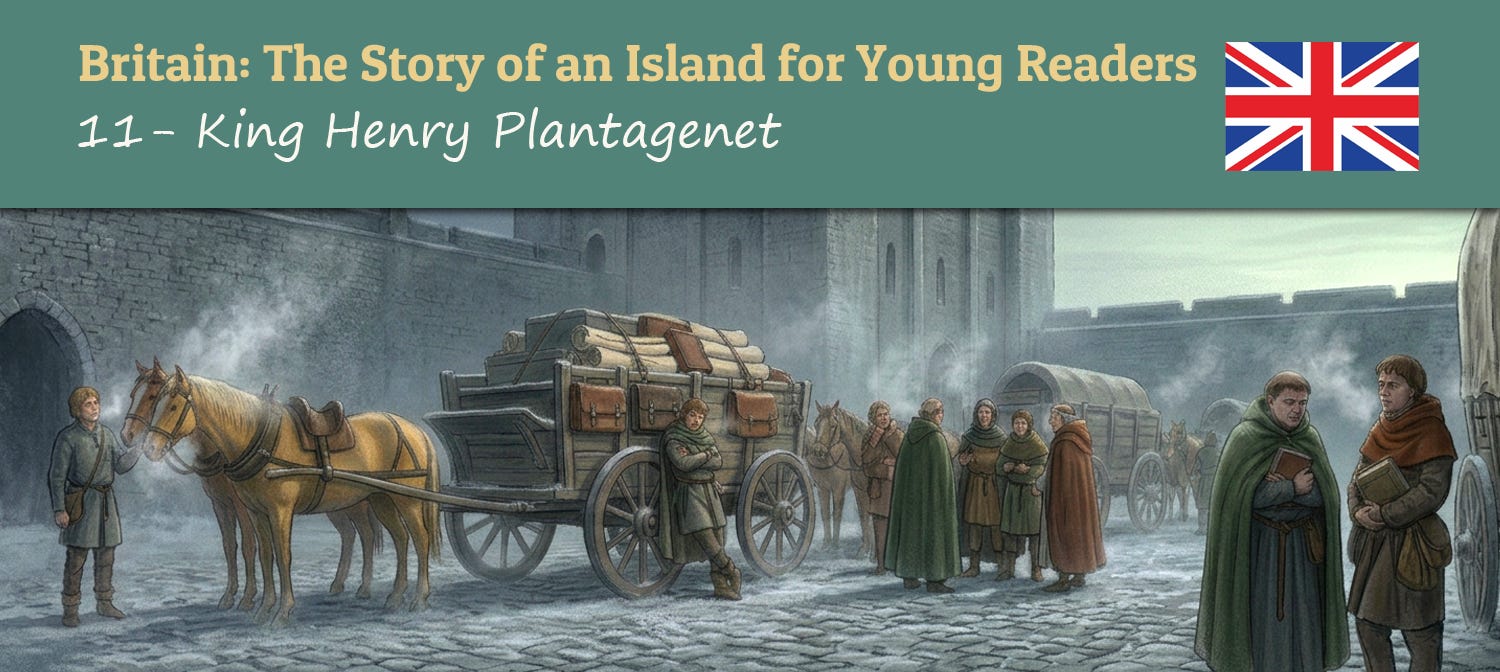
In December of 1154, in a courtyard of a castle in Normandy, in the grey half-light before dawn, the wagons were loaded, the horses saddled, and the whole court was ready to leave, exactly as Duke Henry had ordered.
There was just one problem. The Duke was still in bed.
This was what it was like to serve him. One morning he would announce an early departure and then sleep until noon, while his entire household stood around in the cold with the pack-horses steaming and stamping and the heavy rolls of parchment that served as his office already lashed to the wagons. The next morning, without warning, he would be up and gone hours before the appointed time, riding hard into the dark, and everyone from his treasurer to his chaplain would have to scramble after him as best they could.
Nobody knew which morning it would be. Nobody dared ask.
Duke Henry was twenty-one years old when he was crowned King of England, and he would become known as Henry II – King Henry Plantagenet, and he would rule for thirty-five years. In that time he would govern more of France than the King of France, reform English law so thoroughly that its outline still stands today, and quarrel so bitterly with his closest friend that the quarrel would end in murder on the stone floor of a cathedral. But all of that was ahead of him. For now, in the cold December of 1154, he was still in bed.
So how did a twenty-one-year-old Frenchman come to be King of England?
Matilda, King Henry I’s daughter, the woman the great lords had sworn to accept and then betrayed, had lost the war with Stephen. But she had one thing he did not. She had a son.
His name was Henry, and he was the child of her second marriage, to a French count named Geoffrey of Anjou. Geoffrey was a handsome, energetic man who, the story goes, had a habit of wearing a sprig of yellow broom flower in his hat, a plant the French called planta genista. From that bright little flower came the family name that would mark one of the most powerful dynasties in English history. The Plantagenets.
Young Henry grew up in France, restless and ambitious. While still a teenager he had already crossed the Channel more than once to fight against Stephen’s forces. He was not yet king, but everyone could see what was coming. Stephen’s own son Eustace died suddenly in 1153, and with that death the last real obstacle fell away. Stephen, old and tired, agreed to a deal. He would remain king for the rest of his life, but when he died the crown would pass to Matilda’s son, Henry. It was called the Treaty of Winchester, and it was the price of peace after nineteen years of misery.
Stephen died the following year, in October 1154. Henry crossed the Channel and was crowned at Westminster Abbey on the nineteenth of December, and a new age began.
What did this new king look like? The people who knew him left a vivid picture, and it is not the picture you might expect of the most powerful ruler in western Europe.
He was not tall, but he was powerfully built, square and thick-set, with a bull neck and strong arms. His hands were coarse and rough, the hands of a man who spent his life outdoors. His legs were bandy from so many years in the saddle that he looked as though he had been shaped by the horse. He had a large, round head, closely cropped red hair, and a freckled face. His voice was harsh and cracked. He dressed plainly, ate simply, and cared nothing for the fine robes and elaborate feasts that other kings enjoyed.
What he cared about was work, and hunting, and power, roughly in that order.
King Henry was always moving. He rode from one end of his territories to the other with a restlessness that wore out everyone around him, arriving without warning in places where he was not expected, turning up in England when people were certain he was still in the south of France. Behind him, strung out along whatever road he happened to be on, came the heavy wagons loaded with the rolls of parchment that were his government. His court and household gasped and stumbled in his wake. The servants dreaded him, and the nobles complained. Nobody could keep up.
His moods were as unpredictable as his schedule. In times of real danger he was calm, steady, even gentle. But when the crisis passed and the pressure lifted, he became bad-tempered and impossible, snapping at anyone who came near. He had a fierce energy that needed something to push against, and when there was nothing to push against, he pushed against the people closest to him.
Yet for all his roughness, Henry was no brute. He was very well educated, sharp-witted, and genuinely interested in ideas. He spoke French and Latin, and was said to understand several other languages, though he never spoke English. He was the Lord’s Anointed, a Christian king who feared damnation and hoped for heaven, and who swung between worldly ambition and sudden, violent fits of remorse. He could be generous and warm, but he could also be coldly ruthless. He was, in short, a complicated man, and he had inherited a complicated world.
His kingdom was enormous.
Through his mother Matilda he held England and Normandy. Through his father Geoffrey he held the county of Anjou and its neighbouring lands. And through his wife, he held more of France than any man alive.
His wife was Eleanor of Aquitaine, and she was one of the most remarkable women of the Middle Ages. She had been Queen of France, married to the cautious and pious Louis VII, and had accompanied him on the disastrous Second Crusade. The marriage was unhappy. Eleanor was clever, proud, strong-willed, and bored stiff by a husband who seemed more monk than king. She bore Louis only daughters, and in 1152 the marriage was annulled.
Within eight weeks, to the fury and astonishment of the French court, Eleanor married Henry of Anjou, who was eleven years her junior. She brought with her the vast duchy of Aquitaine, the richest territory in France, and suddenly Henry, who was not yet even King of England, controlled more French land than the King of France himself.
When Henry was crowned in December 1154, his subjects boasted that his authority ran from the Arctic Ocean to the Pyrenees. It was an exaggeration, but not by much. He was Duke of Normandy, Count of Anjou, Lord of Aquitaine, Brittany, Poitou, Maine, and Guienne. He held territory from the borders of Scotland to the foothills of the Pyrenees. After the Holy Roman Emperor, he was the most powerful ruler in Christendom.
But this vast empire was not as strong as it looked.
It was a patchwork, stitched together by marriage, inheritance, and luck, and it had no real unity. There was no common government, no shared law, no single treasury. The only thing holding it together was Henry himself, his energy, his will, and his ceaseless, exhausting travel. The empire existed because Henry existed. Without him, it would fall to pieces, and one day, that is exactly what happened.
The King of France understood this perfectly well. Louis VII was not a strong king, but he was a patient one, and he knew that the best way to fight King Henry was not to meet him on the battlefield but to encourage every quarrel, every grudge, every petty rebellion within Henry’s sprawling dominions. If he could not destroy the empire from outside, he could pick at it from within. He set one local lord against another, fed old resentments, and waited. It was a strategy that would take a generation to succeed, but in the end, with the help of Henry’s own sons, it would succeed.
Henry, however, was not a man who worried about things a generation away. He had a ruined country to fix.
The England he inherited in 1154 was in a wretched state. For nineteen years the law had meant nothing. Barons had built castles wherever they pleased, taxed the people however they chose, and answered to no one. The old system of royal justice, which Henry’s grandfather had carefully built up, had collapsed. If you were wronged, you could not look to the king’s court for help. You could only look to your local lord, and your local lord was very likely the one who had wronged you.
Henry set about changing this with extraordinary speed. He tore down the hundreds of unlicensed castles across the country. He dismissed the sheriffs who had grown fat and corrupt under Stephen and replaced them with men he trusted. He sent the foreign mercenaries who had terrorised the countryside packing. Within months, the country felt the grip of a real king again.
But tearing down castles and sacking bad sheriffs was only the beginning. What Henry did next was far more important, and far less glamorous, and it changed the world.
He began to build a system of law.
Before Henry, justice in England was a patchwork of local customs. Every manor, every lordship, every town had its own courts and its own rules. If you had a dispute with your neighbour over a strip of ploughland, you went to your lord’s court, and the judgement depended on whatever local tradition happened to apply in that place. There was no consistency, no appeal, and no guarantee that the same dispute would receive the same judgement twenty miles down the road.
King Henry changed this. He sent his judges out from the royal court to travel the country on regular circuits, holding courts in fixed places at fixed times. These travelling courts were called assizes, and the judges who ran them applied the king’s law, the same law applied in the same way wherever they went. For the first time, a farmer in Yorkshire and a merchant in Devon could expect the same justice for the same offence. The law was common to everyone.
It became known as the Common Law.
King Henry reformed the way disputes were settled too. Under the old system, arguments over land were often decided by trial by battle, where each side put forward a champion and the winner was assumed to have God’s support. King Henry replaced this, for some types of case, with a new method. Twelve local men, people who actually knew the facts of the dispute, were brought together to examine the evidence and give their verdict under oath. It was called a sworn inquest, and it was the seed of something that would grow, over the centuries, into the jury.
He reorganised the Exchequer, the royal treasury, until it became the most efficient system of taxation in Europe. Through his government, and through the work of his brilliant Chancellor Thomas Becket, the old tax of scutage was expanded and enforced as never before. Scutage allowed a lord to pay money instead of serving in person as a soldier. It sounded like a small change, a matter of convenience. In practice, it quietly undermined the whole feudal system from within. A lord who paid money instead of bringing his knights was a lord who mattered a little less to the crown with every passing year. The king no longer needed him in quite the same way. Henry may not have planned it as an act of revolution, but that is what it became.
And he did something else, something less dramatic but equally important. He gathered up the old Anglo-Saxon traditions of local self-government, the shire courts and borough courts that had existed long before the Normans came, and wove them into his new system. King Henry did not sweep away everything that had come before him. He took what worked, from Saxon and Norman alike, and built something new from both. The Anglo-Saxon idea that free men had a right to govern themselves in their own communities, under the king’s authority, survived because King Henry Plantagenet chose to keep it alive.
None of this sounds exciting. There are no battles, no arrows, no ships going down in the dark. But it mattered more than almost anything else in this story.
King Alfred, three hundred years earlier, had gathered together the old laws and written them down. That was the foundation. King Henry Plantagenet built the structure that stood upon it. What he created with his assizes, his travelling judges, and his Common Law was a system of justice that would spread, in time, to every corner of the earth where English is spoken. When the American colonists wrote their Constitution, they built it on foundations that a red-haired Frenchman had laid six centuries earlier. When a court sits today in Sydney or Toronto, it works on principles that trace their origins to a king who created an English justice system in the twelfth century.
It is one of the great quiet facts of history that almost everyone in the English-speaking world lives under the law he built.
King Henry could not have known any of this, of course. He was not thinking about centuries to come. He was thinking about the next county to ride to, the next dispute to settle, the next lord to bring into line. He was thinking about his French territories, which needed constant attention, and about the watchful King of France, who never stopped probing for weaknesses. He was thinking about Ireland, which he brought under English lordship in 1171 and added to his already staggering collection of lands and titles.
And he was thinking, increasingly, about a problem that no amount of energy or legal cleverness could solve.
The Church.
In medieval England, the Church was not simply a place where people went to pray. It was a power. It owned vast estates and collected enormous wealth. The Church ran its own courts under its own laws, answering not to the king but to the Pope in Rome. A bishop was not just a man of prayer. He was a great landowner, a political figure, someone who could raise soldiers and excommunicate his enemies. The question of who truly controlled the Church, the king or the Pope, was the most dangerous question in all of Europe, and it had no easy answer.
King Henry believed, as his grandfather had believed, that the king was master of everything in his realm, including the Church in its worldly affairs. He did not want to destroy the Church or deny its spiritual authority. But he wanted its courts to answer to his law, and its bishops to obey the crown. He saw the Church’s independence not as a sacred principle but as a gap in the system he was building, a hole in the Common Law through which powerful men could escape the king’s justice.
He needed someone in Canterbury, as Archbishop, who understood this. Someone who would work with him. Someone he trusted completely.
He thought he had exactly the right man. A friend. A companion. The cleverest, most capable, most loyal servant in his whole kingdom. A man named Thomas Becket.
What happened next would become the most famous story of the English Middle Ages.
But that is for next time.