

For the last years of the thirteenth century, and the beginning of the fourteenth, William Wallace had shown Scotland that England under Edward Longshanks could be beaten.
On the tenth of February 1306, less than six months after William Wallace was put to death at Smithfield, in London, two Scottish noblemen met in Greyfriars Church in Dumfries.
The two men were Robert Bruce and John Comyn, and they were the two most powerful men left in Scotland. They were rivals for the Scottish Crown, and they hated each other, but they had agreed to talk, and talk in a church, a sanctuary and a place where no man could lawfully draw a weapon against another.
Nobody knows what was said between them, and only one man came back out of the church – Robert the Bruce. To the men waiting outside for him he said, in the flat voice of somebody who could not believe what they had done, that he doubted he had killed John Comyn. One of Robert’s followers, Roger Kirkpatrick, said that he would make sure of it, and went back inside with a knife.
John Comyn was dead. It was sacrilege, a murder carried out in front of the high altar of a church. Repercussions were soon to follow. The Pope would excommunicate him, and the Comyn family would never forgive him. Their kinsmen spent the next twenty years looking for chances to bring Robert the Bruce down.
It was also, from that moment onwards, impossible for Robert to turn back. He had murdered the leader of a rival faction in a church. And on top of this, there would be no pardon from King Edward, no quiet return to his estates, no waiting to see how things turned out. He had one road left, and it went straight to the throne of Scotland.
He took it – fast.
The reason for the speed was that he knew the excommunication was coming and could not be stopped, and an excommunicated man cannot be crowned King. But a papal bull (an official public decree), had to be written in Rome and then carried all the way to Scotland, and that took time. If Bruce could get a crown on his head before the document arrived, he would be King of Scotland, and that could not easily be undone.
Seven weeks after the murder of John Comyn, on the twenty-fifth of March 1306, Robert Bruce was crowned King of Scotland at Scone.
It was a strange coronation. The Stone of Destiny was gone, taken to Westminster by King Edward ten years earlier, so he was crowned without it. The ceremony was performed by bishops who knew perfectly well they were defying an excommunication. And the man whose hereditary right it was to place the crown on a Scottish king’s head, the Earl of Fife, was a boy in English custody and could not come.
His sister Isabella came instead. She was married to a Comyn, she had taken her husband’s warhorses and had arrived at Scone a day late and missed the whole thing. Robert thought her presence mattered enough that he went through the entire coronation a second time, so that a MacDuff could put the crown on his head as a MacDuff always had crowned all the Scottish kings.
It cost her four years of her life, though nobody in the abbey at Scone knew that yet.
The rapid crowning of Robert the Bruce was an act of desperation dressed up as a coronation. And within four months, it had completely fallen apart.
To understand what Robert did next, you have to understand who he was, because he was not William Wallace and it does him no favours to pretend otherwise.
William Wallace was minor gentry with nothing to lose, and Robert was one of the greatest landowners in Britain, Earl of Carrick, lord of vast estates in Scotland and substantial ones in England, grandson of the Robert Bruce who had competed for the crown in 1290. He had been raised to inherit, to calculate, to survive.
And for the eight years before the murder in Dumfries, he had done exactly that. He had changed sides repeatedly. He had sworn loyalty to King Edward, broken it, and sworn it again. He had fought for the Scots, then submitted to King Edward, then been pardoned, then submitted again. When Wallace was Guardian of Scotland, Bruce was not at his side. When Wallace was hunted through the years of defeat, Bruce was making his peace with the English king.
This was normal conduct for a medieval nobleman and carried no particular shame. But it does mean that the man who was crowned at Scone in 1306 had no great record of loyalty behind him, and everybody knew it.
What Robert had instead was something Scotland had not yet had – authority. Wallace had been a soldier of genius who never held political power. The Scottish nobles had held political power and never fought. Bruce was a great lord who was prepared to fight, and that combination, once he committed to it, turned out to be the thing that mattered.
But first he had to survive.
King Edward I was sixty-six years old and frail, and the news from Scone of Robert the Bruce’s coronation made him incandescent with rage.
He sent an army north under Aymer de Valence, Earl of Pembroke, a cousin of the King and one of the greatest men in England. He was also the murdered John Comyn’s brother-in-law. Edward had chosen him deliberately, the one commander in the country with a private reason to want Bruce dead, and he sent him north with orders that were unusually explicit. Valence was to raise the dragon banner, which meant that the ordinary conventions of war were suspended and no quarter would be given to anyone, and Bruce’s supporters were not to be treated as enemies. They were to be treated as criminals.
In June of 1306, at the village of Methven, six miles west of Perth, Valence caught Bruce’s small army in a surprise attack and destroyed it. Bruce escaped with a handful of men. A few weeks later, at Dalrigh, he was attacked again by the MacDougalls of Lorn, who were John Comyn’s kinsmen, and he was beaten again.
What followed was the worst period of Bruce’s life, and it was worse for the people around him than it was for him.
His sister Mary, and the Countess Isabella, who had put the crown on his head, were each shut in what the records call a cage, Mary at Roxburgh and Isabella at Berwick. They were not the open birdcages of later storytelling. Each was a small chamber of timber lattice and iron, about eight feet across, built onto the castle wall with a privy in the corner. The cage and chamber had been designed that way because it was meant to be lived in for a long time.
Edward’s written order about Isabella survives. She had not struck with a sword, he said, so she would not die by one. But because of her unlawful crowning of Robert, she was to be kept at Berwick where everyone who passed could see her and know what she had done. She was fed, she had a servant, and she was not going to be killed, because a dead hostage is worth nothing. She was simply put where the entire town could look at her, and she was left there for four years.
Also, three of Robert’s brothers were caught and executed. The Earl of Atholl was hanged in London, and because he was a nobleman related to the royal house, Edward granted him the privilege of a higher gallows than the others.
Bruce himself vanished. In the autumn of 1306 he crossed to Rathlin Island, off the coast of Antrim, and spent the winter there, a crowned king with no kingdom, no army, and most of his family dead or in cages.
This is where the story of the spider belongs. Robert, at his lowest point, watching a spider try and fail and try again to swing its thread across a gap. What Robert learned from the spider was to keep going and not give up. It is a wonderful story, but of course there is no evidence at all that it happened. It first turns up five hundred years afterwards, in Sir Walter Scott’s Tales of a Grandfather, a history of Scotland he wrote for his young grandson and published in 1828. It was in a history book, aimed at children, by the most famous Scotsman alive, which is how a good story becomes a fact. Scotland has kept it because it is the right story for the moment, but it is not the same as being true.
What is true is that Robert spent that winter somewhere alone, with every reason to give up, but he didn’t.
He came back from Rathlin in the spring of 1307 with a very small force, landing on the Ayrshire coast at Turnberry, where he had been born and where his family’s castle now held an English garrison. And this time he did not repeat Wallace’s mistake.
William Wallace had won at Stirling Bridge and then, at Falkirk, had let himself be brought to a pitched battle against an army built to destroy him. Robert the Bruce had watched that happen, and for the next seven years he refused to fight any battle he had not chosen.
Instead he fought another kind of war, a guerrilla war. He moved constantly and lived rough. He struck at night, in small numbers, against isolated garrisons, and vanished before a response could be organised. He drove cattle away and burned the grass so English armies marching north would find nothing to eat, which was Wallace’s strategy at Falkirk, but Bruce made it the whole war rather than a prelude to one.
He had two lieutenants who made this possible. Thomas Randolph, his nephew, ran campaigns and took cities. Sir James Douglas ran the border.
Douglas was a small, dark man with a lisp, courteous and quiet in company, and by common account of the people who fought alongside him quite unrecognisable once a fight started. He raided English-held country for twenty years without ever really stopping. He took his own family castle back from the English on three separate occasions. The Scots called him the Good Sir James and the English called him the Black Douglas.
Robert also dealt with his enemies at home, and he did it with a cold efficiency. The Comyn lands in the north-east had never accepted Robert as King, and in the winter of 1308 he went through Buchan and destroyed it, burning the crops, the barns, the houses and the people’s means of living. The herschip of Buchan, it was called, the harrying, and the district was still visibly impoverished fifty years later.
Then he began taking castles, and the way he took them tells you how his mind worked.
The English held Scotland through a chain of stone fortresses, each with a garrison, each impossible to storm by an army without siege engines, which Bruce did not have. So he did not storm them. He took them by trickery, at night, by climbing.
The stories of how he did it came down to us from a poem written by a Scottish priest called John Barbour, but it was sixty years after the events, so they have had time to be improved in the telling. But they are the only account there is, and they are wonderful.
At Linlithgow a local farmer named William Bunnock, who supplied the garrison with hay, drove his cart into the gateway and stopped it dead under the portcullis so it could not be lowered, and armed men came out of the hay. At Roxburgh, Douglas’s men crawled up to the walls on their hands and knees at dusk with black cloaks over their armour, and the sentries above took them for cattle in the field. At Edinburgh, Randolph found a man in his own force whose father had served in the castle garrison, and who as a young man had climbed down the north face of the rock at night to visit a girl in the town. The man remembered the route. Thirty men went up the cliff in the dark behind him.
And then, every time, Bruce pulled the castle down. He did not garrison them. He destroyed them so that the English could never use them again, and no future Scottish lord could hold one against his king. By 1314 almost every major fortress in Scotland was either in Scottish hands or in ruins.
Stirling was one of the last castles to hold out.
The English governor of Stirling Castle had made an agreement with Robert the Bruce’s brother Edward, and it was the kind of agreement medieval knights found honourable and Robert found infuriating. If no English army came to relieve the castle by midsummer 1314, it would be surrendered.
It was chivalrous. It was also a public invitation to invade, with a date attached, and it handed the English exactly the thing Bruce had spent seven years avoiding, which was a fixed place and a fixed time to bring their full strength against him.
King Edward had died in 1307 on the road north, still trying to reach Scotland, and had asked his son to carry his bones at the head of the army until the Scots were beaten. His son did not. Edward II was a very different man from his father, and he came north seven years later in the summer of 1314 with an army that reflected it: enormous, magnificent, but badly led.
Approximately twenty-five thousand men crossed the Tweed, with at least three thousand armoured knights and men-at-arms. Against it Robert had perhaps ten thousand, mostly the same hard spearmen who had fought at Falkirk with William Wallace, along with a small cavalry force and few archers.
Robert had every reason to withdraw, and he very nearly did. But he had spent seven years thinking about Falkirk, and he had worked out three things.
The first was ground. He chose a position where his flanks were protected by dense woodland on one side and boggy carseland on the other, so that the English could not get round him. At Falkirk the archers had been walked into position and allowed to shoot at their leisure. Here there was nowhere for them to stand.
The second was the ground itself. Across his front, where the English cavalry would have to charge, Bruce’s men dug hundreds of small round holes about a foot deep, and covered them over with branches and turf so that they were invisible. A galloping horse that puts a foot in one goes down and brings its rider with it. They were called pottes, and they worked so well that English archers copied the idea at Crécy thirty-two years later.
The third was the one that mattered most. Robert kept his small force of mounted knights back, out of the fight, waiting. They had only one job, and it was not to charge the enemy. It was to wait for the English archers to be moved into a position where they could shoot into the schiltrons – the great rings of spearmen, packed shoulder to shoulder and bristling outwards in every direction – and then to ride them down before they could start.
Falkirk had been lost because the schiltrons could not answer the archer. Bruce had spent seven years designing the answer.
On the twenty-third of June 1314, the day before the battle, the English vanguard came up towards the Scottish position, but something happened that Scotland has never stopped talking about.
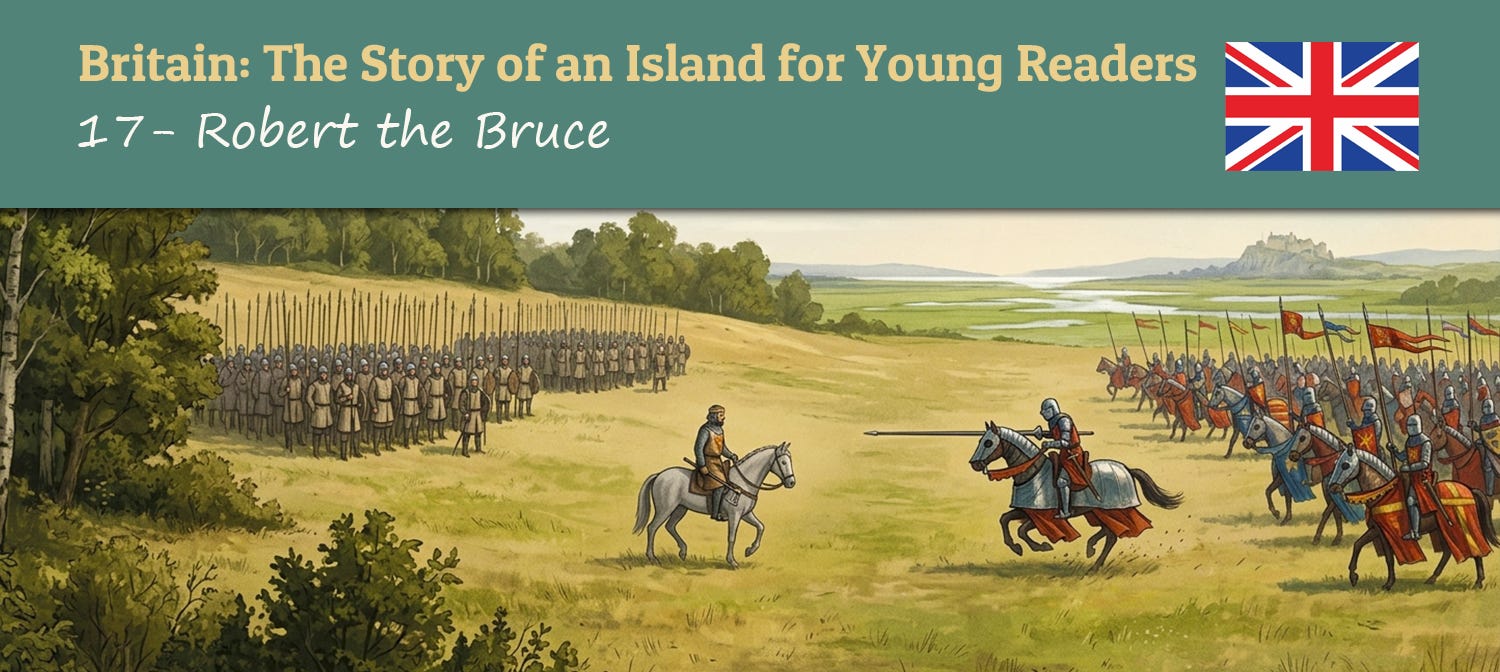
Robert was out in front of his lines on a small horse, a light horse rather than his heavy war-horse, wearing a gold circlet over his helmet so his men could see him. An English knight named Henry de Bohun saw the circlet, recognised what it meant, lowered his lance, and charged him.
It was a reasonable decision. Bohun was in full armour on a destrier war-horse, at the gallop, with a twelve-foot lance. Robert was on a pony with a battle-axe. Every man on both sides watched them come together.
At the last possible moment, Robert stood in his stirrups, turned his horse aside so the lance went past him, and then brought the axe down on Bohun’s head as he passed. It split the helmet and the skull beneath it, and Bohun was dead before he hit the ground.
Robert’s commanders, when they reached him, were furious with him for risking everything on a stunt. Bruce is said to have looked at the broken shaft in his hand and remarked that he was sorry about the axe.
The battle proper began the next morning, the twenty-fourth of June 1314, and it went exactly as Robert had planned it.
The English heavy cavalry came down the slope, across the Bannock Burn, and charged uphill towards the schiltrons. The pottes, the holes in the ground, broke up the charge before it arrived. What was left of it hit the spear points and stopped dead.
A contemporary account describes the noise of that first collision, the great horses driving into the Scottish pikes as into a thick wood, and the crash of splintering lances and screaming horses, and the two armies locked together and neither giving way.
And then, for a long time, nothing moved. Which was the point.
Because behind the fighting line, the rest of that enormous English army was arriving on a front barely two thousand yards wide, with a stream behind it and marshy ground on either side, and there was nowhere for it to go. Men kept coming forward into a battle they could not reach. The English archers tried to shoot over the top and hit their own men, exactly as the Norman archers had at Hastings. The most powerful army in Europe was jammed into a space too small to fight in.
Then somebody thought to move some of the archers around to the Scottish left flank, where they could shoot into the schiltrons from the side.
That was the moment Bruce had been waiting seven years for. He sent in the cavalry he had been holding back, and they rode straight through the archers before a single volley could be organised and drove the survivors back into the mass of their own army, which was already beginning to lose its shape.
After that, the battle came apart quite quickly. Somewhere on the hills to the English right, Robert’s camp followers, the servants and drivers and boys who had been left with the baggage, came over the crest waving whatever they had and yelling, and the exhausted English army took them for a fresh Scottish army. Edward II’s personal guard led him off the field. Once the King had gone, the army broke.
The schiltrons, which had spent the whole battle standing still, now walked forward down the slope into a mass of men who could not run, and the killing went on all the way back to the Bannock Burn and beyond it. Churchill’s judgement is that no worse slaughter of English chivalry ever took place in a single day, and that a Scottish army of spearmen destroying an army of cavalry and archers must be counted a prodigy of war.
The Scots claimed thirty thousand dead or captured, which was more men than the English army contained. But the scale of the exaggeration is itself evidence of the overwhelming victory, but winning the battle of Bannockburn did not win the war.
The battle was fought in 1314, but it took another fourteen years for England to admit Scotland was independent.
Robert spent those years making it impossible for the English to do anything else. He raided northern England until the northern counties were paying him protection money to be left alone. He sent his brother Edward to Ireland with an army of Bannockburn veterans, hoping to open a second front and export the whole model of resistance to another Celtic country under English rule. Edward Bruce was crowned King of Ireland in 1316, but the Irish chiefs would not unite behind him. Then a famine ruined the country he was trying to hold, and Robert’s brother Edward was defeated and killed at Dundalk in 1318.
And then in 1320, the barons and freeholders of Scotland sent a letter to the Pope.
They were trying to get Robert’s excommunication lifted and Scotland’s independence acknowledged. The letter was drafted at Arbroath Abbey by men making a legal argument. But somewhere in the middle of it they wrote a sentence that has outlived every other document of the period. They told the Pope that they were not fighting for glory or riches or honours, but for freedom alone, which no honest man gives up except with his life.
In the letter, called the Declaration of Arbroath, they also said something that is still being argued about today. They told the Pope that if Robert the Bruce ever submitted to the English crown, then they themselves would drive him out and choose another king. The letter was written to defend Robert’s kingship, and it contains the conditions under which his own subjects would be able to remove him. A king, it says, holds his crown from the community of the realm, and holds it only as long as he defends them.
Nobody in Europe was writing sentences like that in 1320.
Peace came in the end, and it came because Edward II fell. He was deposed by his own wife and her lover in 1327 and murdered at Berkeley Castle. The regency that governed on behalf of his young son had no appetite for the Scottish war, and in 1328 the Treaty of Northampton acknowledged what the Battle of Bannockburn had established fourteen years earlier: Scotland was an independent kingdom, and Robert the Bruce was its lawful king.
He had been fighting for Scottish freedom for twenty-two years.
Robert the Bruce died the following June, in 1329, at Cardross on the Clyde, of an illness the chroniclers called leprosy, although modern doctors reading the accounts are not convinced. He was fifty-four.
He had asked, since he had never managed to go on crusade as he had vowed to, that his heart be taken to the Holy Land after his death. So they opened his chest, took out his heart, sealed it in a silver casket, and gave it to Sir James Douglas.
Douglas set off in 1330 with a company of Scottish knights and the casket hung around his neck. Passing through Spain, he found a Christian army fighting the Moors at Teba and joined it, because that was the kind of thing Douglas did. He was cut off in the fighting, surrounded, and finished.
The story that has come down, from the French author Jean Froissart and through every Scottish schoolroom since, is that Douglas took the casket from his neck and threw it into the enemy ranks ahead of him, and shouted at it to go forward as it had always gone before, and that Douglas would follow it or die.
Douglas died. The heart was recovered from the field afterwards and carried home, and it lies at Melrose Abbey. Robert the Bruce’s body lies at Dunfermline.
His heart never made it to the Holy Land. But Scotland has kept the story alive for seven hundred years.
What William Wallace had proved was that the English could be beaten once. What Bruce proved, over twenty-two years of murder and exile and patience and burnt fields and stolen castles, was that they could be beaten permanently.
Scotland would not be conquered again for another three hundred years, and when the two kingdoms finally came together it would not be because of an English army attacking it, it would be because a Scottish king rode south to be crowned king of both Scotland and England.