
6 - The Danish Kings
A Viking prince became England’s greatest ruler since King Alfred.

The silver was weighed out at Southampton. Forty-eight thousand pounds of it, heaped on scales and counted and loaded into chests while Danish soldiers stood over the English and watched. It was the year 1012, and England was paying its enemies to go away. Again.
This was the Danegeld, the tribute that had become a national humiliation. King Ethelred had been paying it for twenty years, each time a larger sum, each time buying a shorter peace. Ten thousand pounds in 991. Sixteen thousand in 994. Twenty-four thousand in 1002. Thirty-six thousand in 1006. And now forty-eight thousand, wrung from a country that was already starving. To enforce the collection, the Danes had sacked Canterbury and seized its Archbishop, Alphege. When the old man refused to let his flock be squeezed for ransom, they killed him at Greenwich, pelting him with cattle bones at a drunken feast.
The money never worked. The Vikings took the silver, sailed home, spent it, and came back for more. They were not stupid. Why risk your life fighting for a kingdom when its king would hand you its wealth and ask only that you leave? And if you did leave, you could always return next year, when the barns had been refilled and the people had just enough left to be worth robbing again.
Everything that King Alfred had built – the fyrd, the burhs – army and fortified towns – the navy, the laws, the very idea of a united English kingdom – was crumbling. Not because the system had failed, but because the man at the top had failed the system. Ethelred, whose name meant ‘noble counsel’, was known to his own people as ‘the Unready’, which did not mean unprepared in the way we use the word today. It meant ‘poorly counselled’ – a king who took bad advice and followed it. The Anglo-Saxons, who loved a dark joke, noticed the irony. Noble counsel, the ill-counselled. Even his name mocked him.
Under King Ethelred, the English did not lack courage. At the Battle of Maldon in 991, the ealdorman of Essex, a powerful lord named Byrhtnoth, had faced the Viking army across the tidal causeway at the river Blackwater and refused to pay. He told them they would receive nothing but spears and swords. When the tide fell and the causeway was exposed, Byrhtnoth even allowed the Vikings to cross so that the battle could be fought fairly. It was magnificent, and it was foolish. The English lost, and Byrhtnoth was killed. A group of his thanes – his nobles – knowing that everything was finished, fought on around his body until every one of them was dead.
That was the spirit of the English people. But spirit alone could not save a kingdom whose king paid silver instead of drawing swords.
In 1002, King Ethelred did something far worse than paying tribute – panicked. Convinced that the Danish settlers living peacefully in England were plotting against him, he ordered a massacre. On the thirteenth of November, St Brice’s Day, his men turned on every Dane they could find in the south of England, and killed them. Among the dead was Gunnhild, the sister of Sweyn, King of Denmark.
Sweyn’s revenge was terrible. For years his armies burned their way across England, sacking Exeter, Wilton, Norwich, and Thetford. The English built a new fleet in 1009, a desperate effort by a broken and starving people, but its commanders quarrelled among themselves, some ships were lost in a storm, and the rest were abandoned. The Anglo-Saxon Chronicle recorded it with weary contempt: the naval commanders let the whole nation’s toil pass away.
By 1013, Sweyn returned with his youngest son, a prince named Canute. The Danes of Yorkshire and the Five Boroughs of the old Danelaw submitted at once. Oxford fell. Winchester fell. London held out for a time, but it made no difference. Sweyn was accepted as King of England, and King Ethelred fled across the Channel to Normandy, whose duke’s sister he had married.
It looked like the end. But King Sweyn died suddenly in February 1014, and the English turned back to their old king. They would have King Ethelred again, they said, if only he would rule them better than before.
He did not.
The last flicker of King Alfred’s blood burned on in King Ethelred’s son, a young man named Edmund. At twenty, he was already a warrior of startling ability. Though his own father declared him a rebel, Edmund gathered forces, struck hard at the Danes, won battles, and relieved London when it was besieged. The English called him Edmund Ironside, and for a brief, brilliant moment it seemed as though the house of Wessex might survive.
But in 1016, still not yet thirty, Edmund Ironside died. The cause of his death is uncertain. Some chronicles hint at murder. Whatever happened, the last defender of King Alfred’s line was gone, and England surrendered.
At Southampton, even before Edmund’s death, the chief men of England – bishops, earls, and thanes, both Saxon and Danish – had agreed to set aside King Ethelred’s family for ever and accept a new king. All resistance, moral and military, collapsed. The last sons of the house of Wessex fled into exile. The young Danish prince who received this surrender was still in his early twenties. His name was Canute.
What happened next is one of the most unexpected stories in the history of the British Isles. The English expected a conqueror. They expected the son of King Sweyn to rule them as a Viking war-lord, with axe and terror and tribute. They had seen nothing else from the Danes for forty years. The country lay exhausted, its silver bled away, its towns burned, its people starved and beaten. If Canute had been cruel, no one would have had the strength to stop him.
Instead, he did something astonishing. He chose to become English.
There were, as the chroniclers understood, three ways a man could become king. He could take the throne by conquest, and no one could argue with a drawn sword. He could inherit it by blood, if his family had held it before him. Or he could be chosen – elected by the great men of the realm, who agreed that he was the best man to rule. Canute did not rely on conquest alone, though he had the power to do so. He had himself recognised as king by the English leaders, bound himself by oath to rule justly, and began his reign not as a tyrant but as a man who intended to earn his crown.
The first thing King Canute did surprised everyone. He sent the great Danish army home. This was the force that had conquered England, the army whose soldiers expected land and plunder as their reward. King Canute paid them off with a final, enormous levy and then dismissed them. He kept only a small personal guard of household troops, and for the defence of his new kingdom he trusted not to Danish swords but to the loyalty of the English people he had just defeated.
It was an extraordinary gamble, and it worked.
He married Emma of Normandy, who had been King Ethelred’s queen. Emma was one of the most remarkable women of her age. She was the sister of the Duke of Normandy, and she had already lived through more than most queens would see in three lifetimes – married young to a failing king, driven into exile, widowed in a ruined country. Now she married the man who had conquered her first husband’s kingdom. It was a political masterstroke for King Canute, because with Emma as his queen, the Normans had no reason to interfere in England on behalf of King Ethelred’s exiled sons. But Queen Emma was no passive pawn. She understood English customs and English politics. She had lived in the country for years, she knew its people, and she would outlast King Canute himself, surviving into the reign of her own son and shaping events long after the Danish king was dust.
Then King Canute set about rebuilding everything King Ethelred had broken.
He ruled according to the law. Not Danish law imposed on a conquered people, but the old English law that had grown up over generations, the laws of King Edgar and King Alfred before him. He made it known that these laws were to stand above even the king’s own power. When he sat in judgement, he judged by the same rules as everyone else. He even submitted himself to the regulations of his own household troops, following the same discipline he expected of his men. For an eleventh-century king, and a conqueror at that, this was extraordinary. Most rulers made the law serve them. King Canute made himself serve the law.
Of all his kingdoms – and he had many – King Canute chose England as his home. He was already King of Denmark. He won the throne of Norway. Scotland offered him its submission. The old Viking power, though weakening, still stretched from Scandinavia through the Baltic to the coasts of North America. King Canute ruled an empire that reached across the known world. But it was in England that he chose to live, in English churches that he prayed, and in the English manner that he governed.
He wished, we are told, to be seen as the successor of King Edgar, whose peaceful reign still glowed in English memory like a lamp in a darkened room. King Edgar had been dead for forty years, but his name still meant order, justice, and prosperity. King Canute wanted to be that kind of king.
He built churches and gave lavishly to English monasteries. He honoured the memory of the English saints, including St Edmund and St Alphege – the very Archbishop whose murder at Greenwich had been one of the most shocking acts of the Danish wars. King Canute carried Alphege’s relics to Canterbury with great ceremony, honouring a man his own people had killed. It was an act of remarkable political skill, but it was more than politics. King Canute seemed genuinely moved by the faith he had adopted. Early records describe him entering monasteries with his eyes fixed on the ground, weeping freely, beating his breast, praying aloud that he might deserve God’s mercy. The English noticed. Whatever else this Danish king might be, he was not pretending.
In 1027, he travelled to Rome as a pilgrim. He attended the coronation of the Holy Roman Emperor, Conrad, and was treated as one of the great rulers of Christendom. From Rome he wrote a letter home to the people of England, promising to rule with justice and to protect the Church. The letter survives, and it reads like the words of a man who took his duties seriously. He wrote not as a foreign conqueror addressing his subjects, but as an English king speaking to his people.
Everyone knows the story of King Canute and the tide.
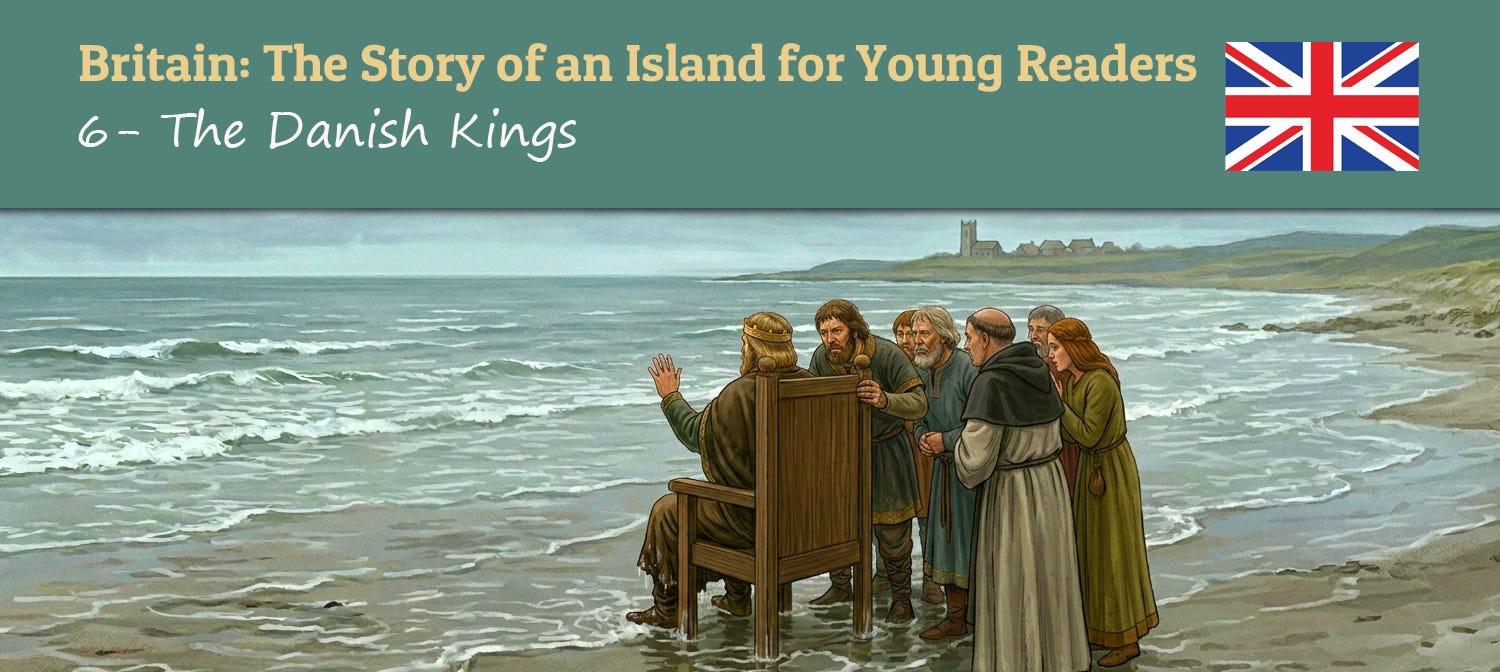
The king, so the tale goes, sat in his throne upon the seashore and commanded the waves to stop. The tide came in regardless, soaking his robes and his royal feet, and King Canute turned to his courtiers and said something they did not expect. He had not been trying to prove that he could control the sea. He had been proving the opposite – that he could not. The lesson was for his flatterers, the men who told him he was all-powerful and could do anything he wished.
No king, King Canute was telling them, is greater than the forces that govern the world. Only God commands the tide.
It is a good story, and it may even be true, though it was first written down by a chronicler named Henry of Huntingdon about a hundred years after King Canute’s death, so we cannot be certain. What matters is what the story tells us about how the English remembered their Danish king. They remembered him as a man who knew the limits of his own power, a king who was wise enough to be humble. In a century of arrogant fools and terrified weaklings, King Canute was something rare: a strong ruler who was not drunk on his own strength.
But King Canute was not a saint, and his court was not a peaceful place.
A story from the Norse sagas, written about two centuries after his death, gives a very different picture. One evening, so the saga tells us, King Canute was playing chess with his brother-in-law, Earl Ulf. The king made a bad move, and when Ulf captured one of his pieces, King Canute tried to take the move back. Ulf refused. King Canute insisted. Ulf, furious, knocked over the chessboard, stood up, and walked out.
‘Run away, Ulf the Fearful,’ the king called after him.
Ulf turned at the door. ‘You did not call me Ulf the Fearful at the river Helgeå,’ he said, ‘when the Swedes were beating you like a dog.’
Ulf went to bed. The next morning, King Canute sent a boy to kill him. The boy came back and said he could not do it because Ulf had gone to church. So King Canute sent a man called Ivar White, a Norwegian from his household, and Ivar went into the church, walked up to the choir, and ran his sword through Ulf where he stood.
When Ivar returned with the bloody sword, King Canute asked if the deed was done.
‘I have killed him,’ said Ivar.
‘You did well,’ said the king.
The monks closed the church and locked the doors. King Canute sent word that they should open them again and sing Mass. Then he gave the church a great gift of land, and those lands, the saga says, belonged to it ever after.
This is a saga, not a sworn account, and it was written long after the events it describes. But the story captures something true about the world King Canute inhabited. He was a Christian king who built churches and wept at the shrines of saints, and he was also a Viking war-lord who had men killed for defying him. He was both things at once, and neither cancelled the other out. The eleventh century did not ask its kings to choose.
What King Canute built, however, depended on King Canute. That was both the strength and the weakness of his reign. When the great man died in 1035, at Shaftesbury in Dorset, he was perhaps forty-five years old. And his empire died with him.
He left three sons. Two were by an earlier wife, Ælfgifu of Northampton: Harold, who was called Harefoot, and Sweyn, who was sent to rule Norway. The third was Hardicanute, his son by Queen Emma. None of them was fit to hold what their father had made.
Harold Harefoot seized England. Canute’s son Sweyn was driven out of Norway within two years. King Hardicanute, trapped in Denmark dealing with threats to his own throne, could not come to claim his English inheritance. The empire that had stretched from the North Sea to the edge of the known world fell apart in months.
In Normandy, two young princes watched and waited. They were Alfred and Edward, the sons of King Ethelred and Queen Emma, the last of the old West Saxon line. They had grown up in exile, guests at the Norman court, speaking French, learning Norman ways, remembering a country they had been forced to leave as children.
In 1036, the elder brother, Alfred, crossed the Channel. The chroniclers call him ‘the innocent prince’, and perhaps he was. He came, or so he said, to visit his mother. But England was a dangerous place for a son of King Ethelred. An earl named Godwin, the most powerful man in the country, had Alfred arrested. His companions were slaughtered. Alfred himself was blinded, and died soon afterwards in the monastery at Ely.
It was a crime that would echo through the next thirty years of English history. And it left only one surviving son of the old royal line: Edward, the younger brother, still waiting in Normandy, still watching.
Harold Harefoot died in 1040. King Hardicanute crossed from Denmark to claim the English throne at last, but he was a hard, joyless king who taxed the country savagely and achieved nothing of note. Two years later, at a wedding feast in Lambeth, King Hardicanute raised a drink and fell dead.
The sons of King Canute were finished. In seven years they had squandered everything their father had spent twenty years building.
And now the great men of England looked around for a king. The country was tired of Danish princes. The old West Saxon line, the line of the kings Alfred, Athelstan and Edgar, still carried a kind of magic in people’s minds, a sense of rightness that no amount of conquest could entirely destroy. Their eyes turned back across the Channel, to the last quiet prince of King Alfred’s blood. Edward, the son of King Ethelred and Queen Emma, came home to a country he barely knew and was crowned King of England. He would be remembered as King Edward the Confessor, and in the choices he made and the weakness he showed, he would set England on a path that led, thirteen years after his own death, to the most famous year in English history.
But that is another story.
King Canute’s body was buried at Winchester, in the Old Minster, the ancient church at the heart of the old West Saxon capital. His bones lay there for centuries, moved from place to place as churches were rebuilt and demolished and rebuilt again.
Today, in the medieval cathedral that replaced the Old Minster, there are six painted mortuary chests set high on the stone screens above the choir. They are old and battered, cracked by age and damaged by Parliamentarian soldiers who threw them to the floor during the Civil War, scattering the bones across the stone. The remains were gathered up and put back, but by then no one could tell which bones belonged to which king. Inside those chests, jumbled together by the carelessness of centuries and the violence of war, lie the remains of several Saxon and Danish kings. King Canute’s are said to be among them.
It is a strange ending for a man who held five kingdoms in his hand. But perhaps it is a fitting one. He came as a Dane and chose to become English. He was buried among English kings. And in the end, as the centuries passed and the bones were moved and muddled and forgotten, the conqueror became indistinguishable from the conquered. The bones of Denmark and the bones of Wessex lie together in the same quiet chests, in the same English cathedral, in the same ancient city where King Alfred himself once walked.