
5 - The Saxons
What King Alfred built, his heirs let fall

King Alfred died in 899, and the kingdom he left behind was the strongest it had ever been. The burhs – the fortified towns, guarded the coasts and river valleys. The fyrd – the army, could be called upon and kept where needed. The laws were written down, the schools were open, and the Anglo-Saxon Chronicle was being kept year by year in monastery after monastery, a running record of the life of a nation that had very nearly ceased to exist.
But south of the river Humber was not the whole of England. To the north and east, across the old boundary line that King Alfred and the Viking leader Guthrum had agreed, lay the Danelaw, where Viking settlers had put down roots, married into the local community, farmed the land, built their own towns, and kept their own customs and traditions. They were not the same raiders who had burned Lindisfarne and waded through blood at York. A generation had passed. Many of them were Christian now, but they were still Danish, still independent, and still a kingdom apart.
King Alfred’s son Edward, known to history as Edward the Elder, set about changing that.
Edward was not his father. He did not write books or translate Latin or sit up late worrying about the state of learning in England. He was a soldier, and a very good one. Where King Alfred had built the system, Edward used it. He advanced north and east, year by year, building new burhs as he went, each one a day’s march from the last, extending the chain of fortified towns that his father had begun until it covered not just Wessex but the whole of the English midlands.
And he did not do it alone. Beside him, and often ahead of him, was his sister.
Æthelflæd, the Lady of the Mercians, is one of the most remarkable figures in early English history, and one of the least remembered. She was King Alfred’s eldest daughter, married to Ethelred, the ealdorman (an official and local leader) of Mercia, and when Ethelred grew ill and could no longer lead, Æthelflæd took command. Not as regent, not as a temporary stand-in, but as ruler in her own right. The Mercians accepted her, followed her, and fought for her.
She built burhs of her own. She led armies. She captured Derby, storming the town in 917 and losing four of her most trusted thanes – her noblemen, in the fighting. The following year the town of Leicester surrendered to her without a battle. When an abbot under her protection was murdered in the Welsh kingdom of Brycheiniog, she invaded within three days, took the queen and thirty-four hostages, and forced the Welsh king to submit. She was negotiating with the Viking rulers of York when she died in June 918, at Tamworth, in the heart of Mercia. The Anglo-Saxon Chronicle records her death in a single line, without sentiment. But the Mercian Register, a separate record that someone cared enough to keep, tells us more. It tells us that the people of York had offered to place themselves under her protection. Had she lived a few months longer, a woman might have united early England.
Edward survived her. By the time he died in 924, the Danelaw south of the Humber had been reconquered. Every Danish settlement between the Thames and the Humber now recognised the authority of the English King Edward. It had taken a quarter of a century of patient, grinding work, burh by burh, town by town, and it was the direct continuation of everything King Alfred had planned.
King Edward’s son Athelstan went further still.
King Athelstan was the third of the great West Saxon warrior kings, and perhaps the most ambitious of them all. He marched into Yorkshire in 926, and the north submitted. The Kings of the Scots and of Strathclyde acknowledged him as their overlord. The Welsh princes agreed to pay tribute. For a brief, shining moment, one English king held authority over almost the whole island of Britain.
It did not last. In 937, every enemy Athelstan had beaten rose up at once. Constantine, the King of the Scots, was an old man by now, cunning and proud, who had ruled his kingdom in the north for more than thirty years, and he had no intention of bowing to an English overlord. He joined with Olaf, a Norse king who ruled Dublin and wanted to reclaim the Viking kingdom of York. Norwegian raiders joined them from across the sea, along with the remnants of the old Northumbrian resistance. Together they assembled the largest hostile force the English had faced since the Great Viking Army. They meant to break the power of Wessex for good.
King Athelstan met them at a place called Brunanburh.
No one knows for certain where Brunanburh was. Historians have argued about it for centuries, placing it in locations from the Wirral to Scotland, and no site has been proven beyond doubt. But the battle itself was remembered. A victory poem was composed and entered into the Anglo-Saxon Chronicle, and it is one of the oldest pieces of English war poetry that survives. It sings of shields hacked apart, of swords hammering at battle-shafts, of the field stained with blood. It sings of the sun passing over the slaughter like a bright candle, and of the aftermath, when the ravens and the wolves came to feed on the dead.
The English won and Constantine fled north. Olaf sailed back to Dublin with the shattered remains of his fleet. King Athelstan, King Alfred’s grandson, had become one of the most powerful rulers in Europe. He styled himself Rex totius Britanniae on his coins and charters, King of all Britain, and the courts of Europe believed him. His three sisters married into the royal houses of France and the Holy Roman Empire. No English king before him had stood so high.
He died just two years later, in 939. He was followed by his half-brother Edmund, who was only eighteen, and then by Edmund’s brother Edred. Both were fighters. Both held the kingdom together against fresh rebellions and fresh Viking incursions from the north. And both died young. But by 954, when the last independent Viking king of York was driven out and killed, the work was done. The whole of England, from the Channel to the Scottish border, was under a single English crown.
It had taken eighty years and five warrior kings, starting with King Alfred and ending with King Edred. They had beaten the invaders, reconquered the Danelaw, and built a nation, but the cost in blood and suffering was enormous. Hoewever, underneath all the fighting, something quieter and more important had happened. A country had been made. Not just conquered, but organised, administered, and given a shape that would last.
Under King Edgar, who came to the throne in 959, this long building reached its height.
King Edgar’s reign was peaceful, which is precisely why most history books skip over him. There were no great battles, no dramatic sieges, no narrow escapes. But peace, when it is used well, can achieve more than war ever does, and King Edgar used it brilliantly.
The shires, the districts of the country, were reorganised, each one governed by a sheriff, a royal officer who answered directly to the king. The hundreds, smaller divisions within each shire, were established as units of local justice and taxation. The towns were strengthened and defended. An elaborate system of courts, running from the borough up through the hundred to the shire, maintained law and order across the country. There was one coinage, one system of weights and measures, one written language that all educated men could read, a King’s English. If you had stood in any market town in Edgar’s England, you would have found the same silver penny bearing the king’s name in your hand whether you were in Winchester or York.
And alongside this political rebuilding came something else. A great revival of monastic life and learning swept through England, led by three extraordinary churchmen. The greatest of them was Dunstan, the Archbishop of Canterbury, a man of exceptional ability who had served as advisor to kings since he was young. Dunstan was not just a churchman. He was a silversmith who made church plate with his own hands, a musician who composed hymns, a painter who illuminated manuscripts, and a scholar whose learning was famous across Europe. Under his guidance, and with the help of Oswald, the Bishop of Worcester, and Ethelwold, the Bishop of Winchester, monasteries across England were reformed and renewed. Monks who had become lazy were called back to strict observance. New houses were founded. Old ones, some of which had lain in ruins since the Viking wars, were rebuilt.
And from these monasteries came the most beautiful illuminated manuscripts in Europe, works of art that were prized across the continent, their pages blazing with gold leaf and rich pigments ground from lapis lazuli and other precious minerals, their text written in ink made from oak galls and iron. Many of these books were written not in Latin alone, but in English. The Catholic Homilies of Ælfric, Abbot of Eynsham, are considered the first great achievement of English as a literary language, the earliest everyday language books in Europe to reach that distinction. What King Alfred had begun, with his patient translations by candlelight, had blossomed into a national literature.
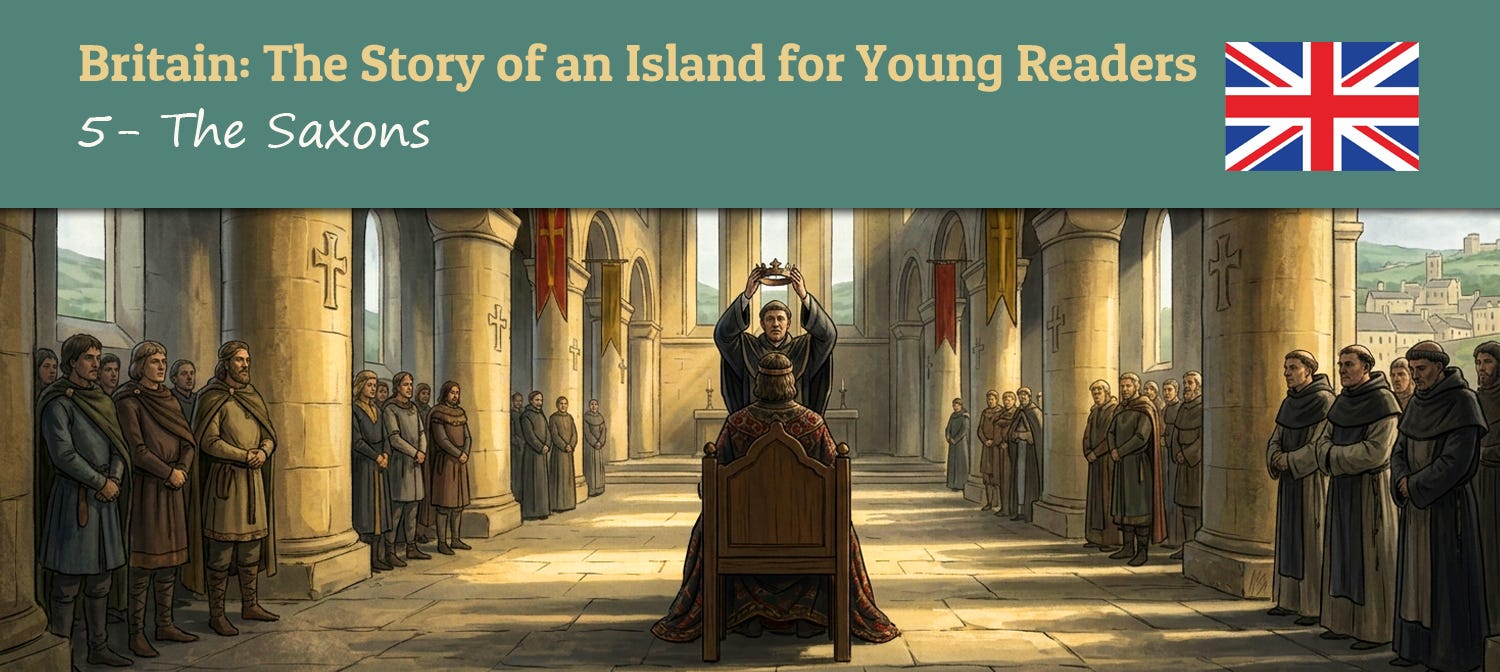
King Edgar’s magnificent coronation at Bath in 973, a ceremony on which every English coronation since has been based, seemed to set a seal on everything that had been achieved. The island was civilised, unified, and at peace. The arts of building and decoration were reviving. Learning was flourishing again. From whatever direction you looked at it, tenth-century England was a country that had pulled itself out of the fire and built something extraordinary.
And then it fell apart.
King Edgar died in 975, and the succession was disputed. His elder son Edward, still a teenager, was murdered at a royal estate in Corfe, Dorset in 978, probably on the orders of his stepmother, who wanted the crown for her own son. That son was a boy of about ten years old, and his name was Ethelred.
History remembers him as Ethelred the Unready. The nickname does not mean what it sounds like. In Old English, his name Æthelred means ‘noble counsel.’ The nickname Unræd means ‘ill-counselled’ or ‘without counsel.’ It is a bitter pun. The king whose name meant good advice was the king who never took any.
In 980, the raids began again.
This time the Vikings were not settlers looking for land. They were professionals, armed and organised, sailing from Scandinavia and Denmark in fast, well-built ships, looking for silver. And they found a country that had grown soft.
The town of Chester was ravaged from Ireland. The people of Southampton were massacred. Thanet, Cornwall, and Devon all suffered butchery and pillage. The raiders came, they burned, they killed, and they sailed away before anyone could stop them.
In 991 a large Danish force landed on Northey Island, a tidal island in the Blackwater estuary in Essex, near the town of Maldon. It is a bleak, flat place even now, surrounded by salt marsh and mudflats, the kind of landscape where the wind never stops and the sky is enormous. A narrow causeway, submerged at high tide, connects the island to the mainland. Facing the Danes from the southern bank stood an English army led by Byrhtnoth, the ealdorman – the local lord of Essex, a tall, white-haired warrior who had served England his entire life.
The Vikings called across the water. They offered the usual bargain. Pay us silver, they said, and we will go away. Buy off this storm of spears before we share the bitter war.
Byrhtnoth’s reply was magnificent. He told the invaders that the English would give them spears and swords, not silver. He told them that an earl stood here, not a coward, with men who would defend their homeland, their prince’s people and fields. The heathen would fall in battle.
And then Byrhtnoth made a terrible mistake. The causeway was flooded, and the Vikings could not cross. All he had to do was wait. But as the tide went out and the path appeared, glistening with mud and seaweed, Byrhtnoth, in a gesture of warrior honour that belonged to an older, simpler age, allowed the Danes to cross and form up on the southern bank so that the battle could be fairly fought.
It was a catastrophe. The English were overwhelmed. Byrhtnoth was killed. Many of his men fled. A small group of his thanes – noblemen, knowing that all was lost, fought on around their lord’s body until every one of them was dead. An Old English poem, ‘The Battle of Maldon,’ preserves their last stand, and it is one of the most moving pieces of writing to survive from this period. But courage and poetry could not save England from what came next.
King Ethelred’s answer to the crisis was money.
In 991 he paid the Vikings ten thousand pounds of silver to go away. They went. They came back. In 994 he paid sixteen thousand pounds. In 1002, twenty-four thousand. Each payment bought a shorter peace than the last. Each time the Vikings returned hungrier and bolder, because they had learned that England would always pay.
The money had to come from somewhere, and it came from the people. The Danegeld, as the tax was called, was wrung from a country that was already bleeding. Farmers, merchants, monks, ordinary families who had nothing to do with the wars of kings, all of them were stripped of whatever they had to fill the purses of men who would only come back for more.
And then Ethelred did something worse than paying. In 1002, on St Brice’s Day, the thirteenth of November, he ordered the killing of every Dane living in the south of England. Not enemy soldiers. Settlers. Families. People who had lived on English soil for a generation or more, who farmed English land, married English men and women, and lived in peace. The massacre was carried out. Among the dead was Gunnhild, the sister of Sweyn, the King of Denmark.
Sweyn swore revenge. For two years his armies ravaged the country, sacking Exeter, Wilton, Norwich, and Thetford. Only famine drove them away, and only for a season. They came back. By 1006, Sweyn was ravaging Kent, burning Reading and Wallingford. Ethelred paid again, this time thirty-six thousand pounds of silver, the equivalent of three or four years of national income, for another truce that would not hold.
In their desperation the English built a fleet. Poor, broken, starving people who had been pillaged to the bone somehow found the strength to construct an immense number of ships, and the new fleet was assembled at Sandwich in 1009. Then the commanders quarrelled. Some ships were sunk in the fighting between the English themselves. Others were lost in a storm. The rest were abandoned. The Anglo-Saxon Chronicle records the moment with quiet fury: ‘And then afterwards the people who were in the ships brought them to London, and they let the whole nation’s toil thus lightly pass away.’
The last recorded Danegeld payment, in 1012, was forty-eight thousand pounds of silver. To enforce its collection, the Vikings sacked Canterbury and took the Archbishop, Alphege, hostage. When Alphege refused to allow his people to be squeezed for his ransom, the Danes killed him at Greenwich, pelting him with bones and ox heads at a drunken feast before one of them struck him down with an axe.
In 1013 Sweyn came again, this time with his youngest son, a prince named Canute. The Yorkshire Danes submitted at once. The Five Boroughs of the Danelaw followed. Oxford and Winchester were sacked. London held out for a time, but it was no use. Sweyn was proclaimed King of England, and Ethelred fled across the Channel to Normandy, whose duke’s sister he had married.
Sweyn died suddenly at the beginning of 1014, and the English, with nowhere else to turn, sent for Ethelred, declaring that no lord was dearer to them than their natural lord, if only he would rule them better than he had done before.
He did not.
But at this darkest moment, one last flame of Alfred’s bloodline rose. Ethelred’s son Edmund, still barely twenty, took matters into his own hands. Though his father declared him a rebel and refused to support him, Edmund gathered forces and struck back. He won battle after battle. He relieved London when Canute’s army had it under siege. He fought with such ferocity and such stubborn, reckless courage that men who had given up all hope began to believe again. New forces sprang from the ruined land. When Ethelred finally died, worn out and useless to the last, Edmund was acclaimed king by the people of London. They called him Edmund Ironside, and for a few blazing months it seemed as though the spirit of King Alfred the Great had returned.
He was strong enough to force a partition of the kingdom, dividing England with the young Danish prince Canute. He was gathering his strength for the next round of the struggle when, in 1016, at the age of twenty-two, Edmund Ironside died. Some said he was murdered, but no one knows for certain.
With him died the last hope of the Saxon line.
The lords of England, gathered at Southampton, agreed to abandon the descendants of Ethelred for ever and recognise Canute as King. The last sons of the house of Wessex fled into exile. The people submitted. The long resistance, which had begun with King Alfred standing in the marshes a hundred and forty years before, was over.
Everything King Alfred had built survived, the shires, the courts, the coinage, the written language, the idea of England itself. These things were too deep in the soil to be uprooted, even by conquest. But the royal house that had built them, the warrior dynasty that had beaten the first Vikings and forged a kingdom from a patchwork of squabbling tribes, was finished. Its last prince lay dead at twenty-two. His surviving children were scattered across Europe, living on the charity of foreign courts.
England itself though endured. It had a name, a language, a law, and a shape on the map that no invasion could undo. But the men who created it were gone. And across the narrow sea, in a hard, well-organised duchy on the coast of France, a young duke was growing up who would one day claim that everything they had built belonged to him. He would go on to become William the Conqueror, but that was still decades away.