
8 - The Three Battles of 1066
Gate Fulford, Stamford Bridge and Hastings.

King Edward the Confessor was buried on the morning of the sixth of January, 1066, in the great church at Westminster, that he had spent the last years of his life building. Before the congregation had left the abbey, Harold Godwinson, the son of the great Earl Godwin and for thirteen years the real power behind King Edward’s throne, was crowned king. It was the fastest succession in English history.
King Edward’s body was barely cold, and Harold’s supporters had moved with a speed that suggests they had been planning for this moment very carefully. They had good reason to hurry. Somewhere across the Channel, the Duke of Normandy believed the English throne had been promised to him. And far to the north, beyond the grey waters of the North Sea, the King of Norway was already building ships.
Harold was not of royal blood but the Witan, the council of great men, accepted him. London cheered, and the Archbishop of York placed the crown upon his head. But Harold had become king at a particularly dangerous time.
Two men wanted the English crown for themselves, and they were both dangerous.
The first was William, Duke of Normandy. William was the bastard son of Duke Robert and a tanner’s daughter, and he had clawed his way through a childhood of murder, conspiracy, and civil war to become the most feared ruler in northern France. He claimed that Harold had sworn a sacred oath to support William’s right to the English throne. Whether Harold had sworn freely or under the kind of pressure is not known, but the oath existed, and in the feudal world, an oath was everything.
The second man was Harald Hardrada, the King of Norway. King Hardrada stood nearly seven feet tall and had spent his youth fighting as a mercenary in the imperial bodyguard at Constantinople. He was the most experienced warrior in Europe. His claim to England was old and thin, and rested on ancient agreements between the English and the Danish kings, but King Hardrada was not a man who spent much time worrying about the strength of his legal position. He had a fleet, he had an army, and he meant to use them.
King Harold knew they were both coming, but he did not know when, or who would come first.
Then, in the spring of 1066, a strange light appeared in the sky. It was a great star trailing a blazing tail, and it hung over England for weeks, bright enough to see at dusk. People stared up at it from fields and doorways and the dark lanes of market towns, and they were afraid. Lights in the sky meant something. The monks said it was a warning from God. But a warning for whom?
We know now that it was Halley’s Comet, following its long, slow orbit of the sun, as it had done many times before and would do so again. But nobody in 1066 knew that. They saw a blade of light in the sky, and they waited for whatever was coming.
All through the summer, King Harold waited with them.
He stationed himself on the south coast with his huscarls, his household troops, watching the sea for William’s fleet. The fyrd, the militia army, had been called out across the whole of southern England, and thousands of men stood ready along the Channel shore, watching the horizon, sleeping rough and eating whatever the local people could spare.
But the wind blew steadily from the north, and William’s ships could not cross the Channel. Week after week, the English waited. As the summer wore on, the men of the fyrd started to worry about their crops. They had fields and farms to harvest, but could not leave their posts.
Then, on the eighth of September, with no sign of an invasion, King Harold disbanded the fyrd and sent the men home to take in the harvest.
It was exactly the wrong moment.
A few days later, whilst King Harold was watching the empty English Channel, three hundred ships appeared off the coast of northern England. King Harald Hardrada had sailed from Norway, gathering warriors from Orkney, from the Scottish isles, and from the Isle of Man, and at his side was a man King Harold knew well. Tostig, Harold’s own brother, and driven out of his earldom of Northumbria the previous year. He had gone to the King of Norway with a grudge and a plan.
The Norwegian fleet sailed up the Humber and into the River Ouse, landing at Riccall, about ten miles south of the city of York. The northern earls, Edwin and Morcar, gathered what forces they could and marched out to meet the invaders.
On the twentieth of September, the two armies clashed at Gate Fulford, on the flat, marshy ground south of the city. The English fought bravely. Edwin and Morcar had brought a considerable force, and for a time they held their ground. But King Hardrada was an experienced commander with a larger army, and the English were pushed back into the marshes and the flooded ditches. The defeat was total. The northern earls escaped, but their army was destroyed.
The city of York was now open and undefended, so it submitted. In response, King Hardrada did not sack the city, but he demanded hostages and supplies, and he arranged to receive them at a place called Stamford Bridge, about eight miles to the east, where the old Roman road crossed the River Derwent.
King Hardrada and his army settled down to wait. The weather was fine. They had won their battle, taken the city, and the countryside was quiet. Many of the men left their armour on the ships at Riccall and lounged in the September sunshine in tunics and shirtsleeves.
They did not know that King Harold was already coming.
The news of the invasion had reached the king in London. Without hesitation, King Harold gathered his huscarls, his bodyguard, and rode north. The distance from London to York is nearly two hundred miles, and King Harold covered it in four days, calling out the local militia as he passed through each shire, and gathering men on the move. It was a punishing march. The men slept in their saddles, ate what they could find, and did not stop.
On the twenty-fifth of September, King Harold reached York. The city gates opened. He did not pause. He marched straight through and out the eastern side, heading for Stamford Bridge.
King Hardrada and his army saw the dust before they saw King Harold’s army, a great cloud rising on the road to the west, and beneath it, the glint of iron and the movement of thousands of men coming fast. The surprise was absolute.
What happened next is one of the famous stories of English history, though nobody can say with certainty how much of it is true. According to the Anglo-Saxon Chronicle, a single Norwegian warrior planted himself on the narrow wooden bridge over the Derwent and held it alone against the entire English army. He was a huge man, wielding a great axe, and he cut down every man who came at him. Behind him, on the far bank, his comrades scrambled to form their battle lines.
The lone warrior held the bridge until an Englishman floated beneath it in some kind of half-barrel or tub. Through the gaps in the planking, he thrust his spear upwards. The great Viking fell, and the English surged across.
The battle was savage. King Hardrada had been caught entirely off guard, but his men were experienced fighters, and even without their armour they formed their shield wall and held. The fighting raged around a great banner called Land-Ravager. Ultimately though, King Hardrada was struck in the throat by an arrow, and he went down.
Tostig took command. King Harold, in a gesture that tells you something about the kind of man he was, sent his brother an offer of peace and a full pardon, along with restoration of his earldom. He also offered to spare every Norseman still standing.
The offer was refused. The Norsemen shouted back that they would rather fall, one across the other, than accept mercy from the English.
So the fighting went on. A force of Norwegians who had been left with the ships at Riccall arrived at a run, carrying their mail coats. Some threw their armour aside and charged into the fight as they were. Nearly all of them were killed.
When the battle ended, the field was thick with the dead, and King Hardrada lay in the English earth he had come to conquer. Tostig lay dead beside him. Of the three hundred ships that had carried the Norwegian army to England, only twenty-four were needed to carry the survivors home.
King Harold buried King Hardrada with honour and allowed his son Olaf to depart in peace. King Harold had won one of the great victories of the age, and the Battle of Stamford Bridge ended the Viking threat to England forever. Never again would a Scandinavian army seriously threaten the English crown.
But King Harold had no time to rest.
On the twenty-eighth of September, just three days after victory, messengers arrived from the south. The wind had changed and William the Bastard’s fleet had crossed the Channel from St Valery, at the mouth of the Somme, and landed at Pevensey, a place to the northeast of the present-day town of Eastbourne.
Nobles and landless knights from all over northern France, from Brittany, Flanders, and even from southern Italy, had invested in William’s invasion. Their investment was in the ships and armed men, and they expected a share of English land if William succeeded.
William’s army was perhaps seven thousand strong. Among them were several thousand mounted knights, the finest heavy cavalry in Europe, and the horses were carried across the Channel in specially built ships. William and his army landed without opposition. The local fyrd, called out four times already that year to watch the coast, and having decided that the danger was past because it had not yet arrived, had gone home.
As William stepped from his boat he stumbled and fell flat on his face. The watching soldiers saw a bad omen. William, thinking fast, held up fistfuls of sand. ‘See,’ he said. ‘I have taken England with both my hands.’
William then went on to build defences around his fleet and loot and raid for food from across the Sussex countryside. He then waited.
King Harold and his huscarls, battered and diminished by the fighting at Stamford Bridge, rode south. They covered two hundred miles in about seven days, arriving in London in the first week of October. King Harold stayed in London for five days, gathering every man he could. The thanes and militia of Wessex and Kent came, but the northern earls, Edwin and Morcar, whose army had been broken at Gate Fulford, were far behind and moving south at their own pace. Whether they would arrive in time, or would fight for King Harold at all, no one knew.
On the evening of the thirteenth of October 1066, Harold marched south from London and took up his position on a ridge of high ground about seven miles from the town of Hastings, and blocking the road to London. The hill had no name then. It would later come to be called Battle.
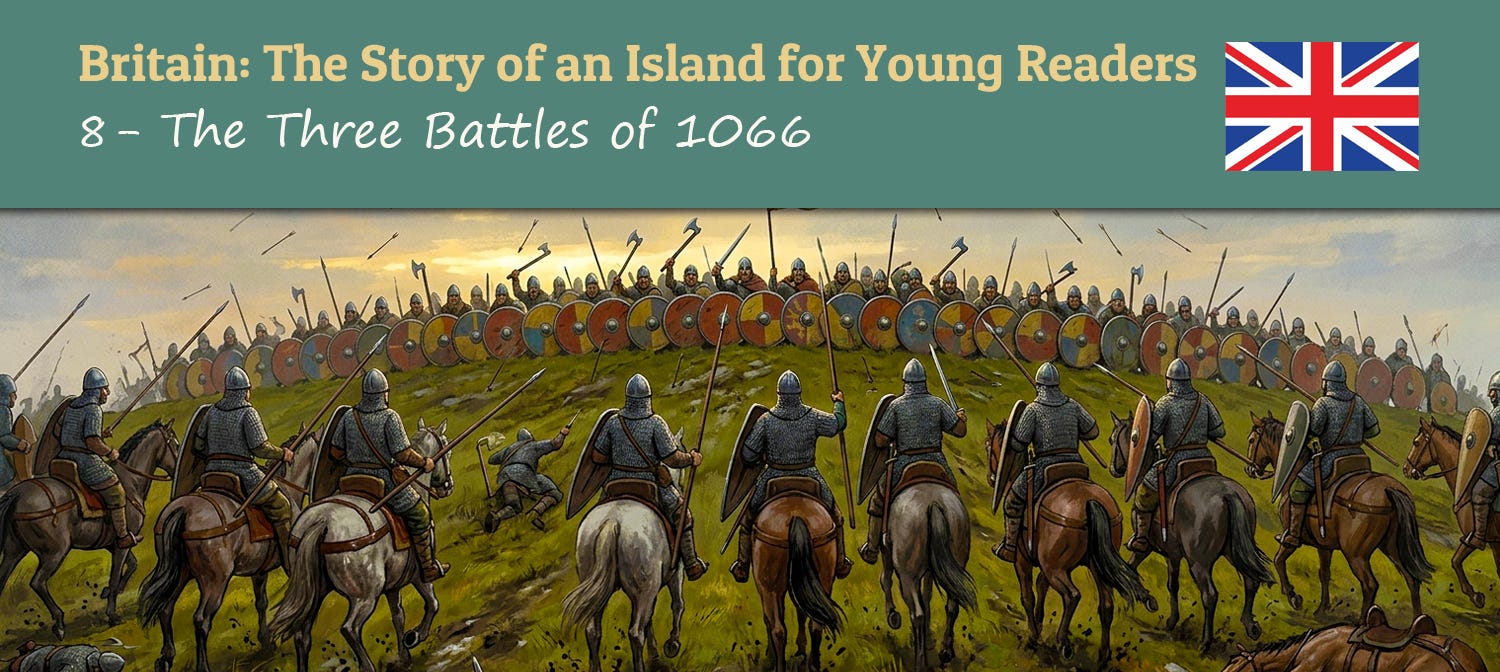
The ridge was a strong position. The English army formed their shield wall along the crest, packed shoulder to shoulder, their round shields overlapping, their long axes and heavy swords ready. Harold’s personal banner, the Fighting Man, flew at the centre of the line.
They had no cavalry. They had almost no archers. What they had was the shield wall, the high ground, and the courage of men who had already marched the length of England and beaten one of the finest armies in Europe.
At dawn on the fourteenth of October, William’s army came up from the south.
The battle opened with a strange piece of theatre. A Norman knight named Ivo Taillefer rode forward alone, tossing his sword and lance into the air and catching them, singing as he came. He charged into the English lines, and was killed at once.
Then the battle commenced.
Wave after wave of Norman cavalry charged uphill at the English shield wall, their heavy horses labouring on the steep ground, lances splintering against the packed wall of wood and iron. King Harold and his army held on. Between the cavalry charges, Norman archers poured volley after volley of arrows into the English ranks. The toll was dreadful, but the shield wall held.
The axemen cut down the horses and riders with blows that could split a man from shoulder to waist, and the Norman knights had never faced infantry like this. They could not break through. They could not pull the wall apart. They fell back, reformed, and charged again, and each time the English held.
On the Norman left, the cavalry broke and fled back down the slope in disorder. The men on King Harold’s right, many of them local fyrd rather than professional soldiers, saw the enemy running and charged after them. It was a fatal mistake. William, in the centre, wheeled his disciplined troops onto the pursuers and destroyed them.
The hours and the battle, ground on. The English line grew thinner but did not yield. The dead and wounded lay so close together on the hilltop that the fallen could not sink to the ground.
Late in the afternoon, William tried the trick that would decide everything. He had seen how readily the English right had broken ranks in pursuit. Now he ordered a deliberate feigned retreat, sending his cavalry tumbling back down the hill in apparent panic. Again, the less disciplined English troops abandoned their positions and pursued them. Again, William’s army turned on them mercilessly and cut them down.
What remained was only the heart of King Harold’s army, the huscarls, the men who had fought at Stamford Bridge and marched south without rest. They gathered around their king and his banner, and they fought on.
William ordered his archers to shoot high, so that the arrows would fall in a steep arc over the shield wall. It in amongst this storm of arrows, that King Harold was struck.
How exactly King Harold died is not entirely certain. The traditional account says an arrow struck him in the eye. The Bayeux Tapestry, stitched within living memory of the battle, appears to show this moment, although scholars have argued for centuries about which figure in the scene is King Harold and what exactly is being depicted. What we know for certain is that Harold Godwinson, King of England, fell at the foot of his standard on that October afternoon 1066.
His brothers Gyrth and Leofwine had already been killed. The surviving huscarls withdrew into the woods behind the ridge, still fighting. William’s cavalry, pursuing in the fading light, rode into a deep, hidden ditch on the reverse slope. Horses and riders tumbled in, and the English who were still alive, fell on them in the darkness, but the battle was over.
William had three horses killed under him that day. He had fought in the front ranks, and had earned his victory in iron and blood. England was his.
King Harold’s body was found among the fallen, stripped of its armour. His mother offered to pay the weight of the body in gold for the right to bury her son in consecrated ground, but William refused. King Harold, he said, should be laid upon the shore he had given his life to defend. The body was later moved to Waltham Abbey, which King Harold himself had founded. It lies there still, somewhere beneath the quiet ground, although nobody now knows exactly where.
The hill at Battle is quiet today. The abbey that William built on the spot where King Harold fell, in penance, or in triumph, or perhaps something in between the two, is mostly ruins. But the ridge is still there, and the slope where the Norman cavalry charged is still steep enough to make you catch your breath if you climb it.
If you walk across that hilltop on an October morning, when the mist sits in the hollows and the rooks wheel overhead, you can feel the shape of the ground beneath your feet, the long crest where the shield wall stood, the falling ground where the cavalry struggled uphill. The grass has grown over everything, and the bones are deep in the Sussex clay.
King Harold Godwinson won two of the three great battles that were fought in the year 1066. He marched the length of England twice, defeated one of the greatest warriors in Europe, and turned to face another without pause. But he lost on an autumn afternoon, on a hill with no name, and when he fell, the Saxon world fell with him.